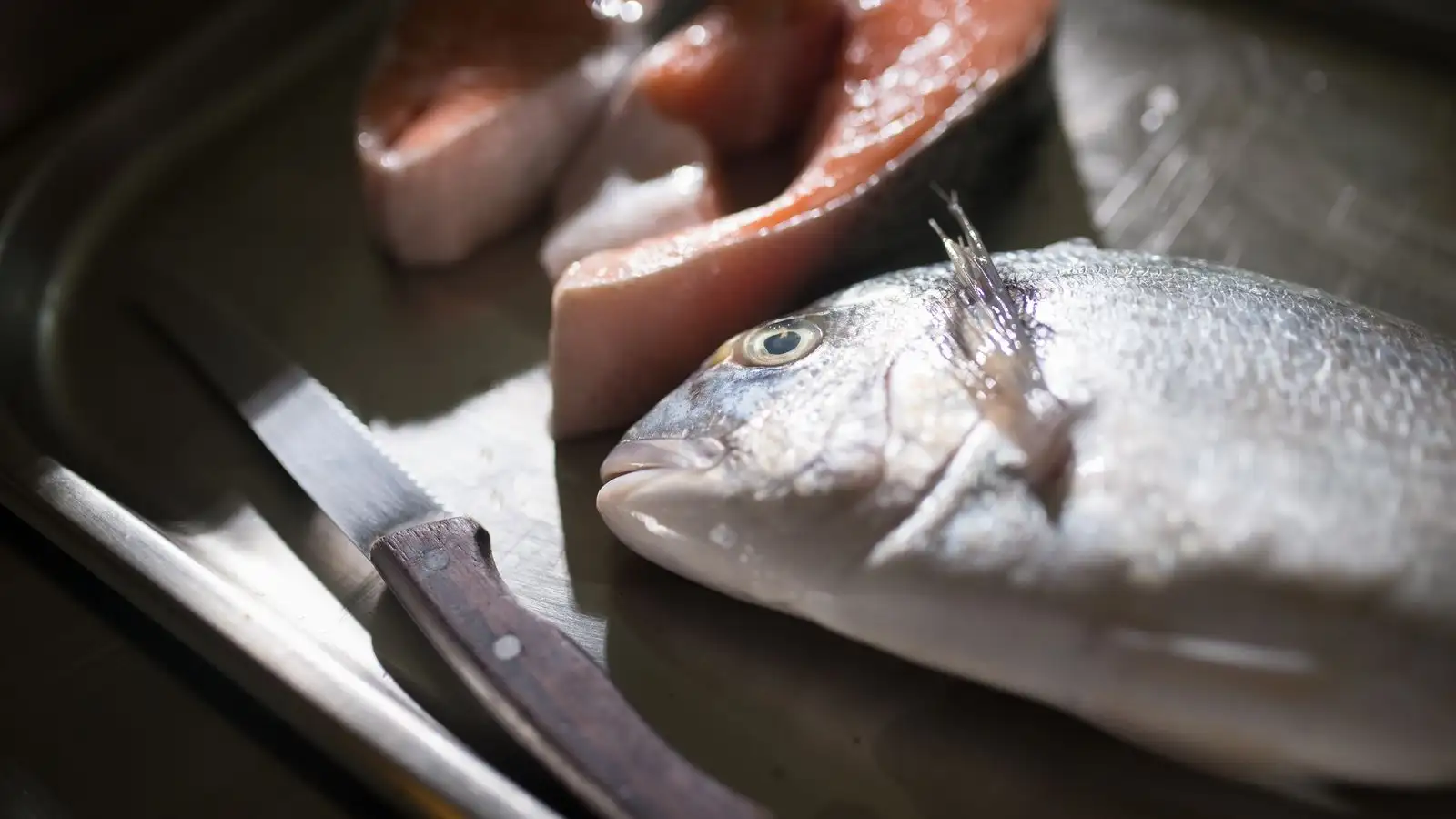
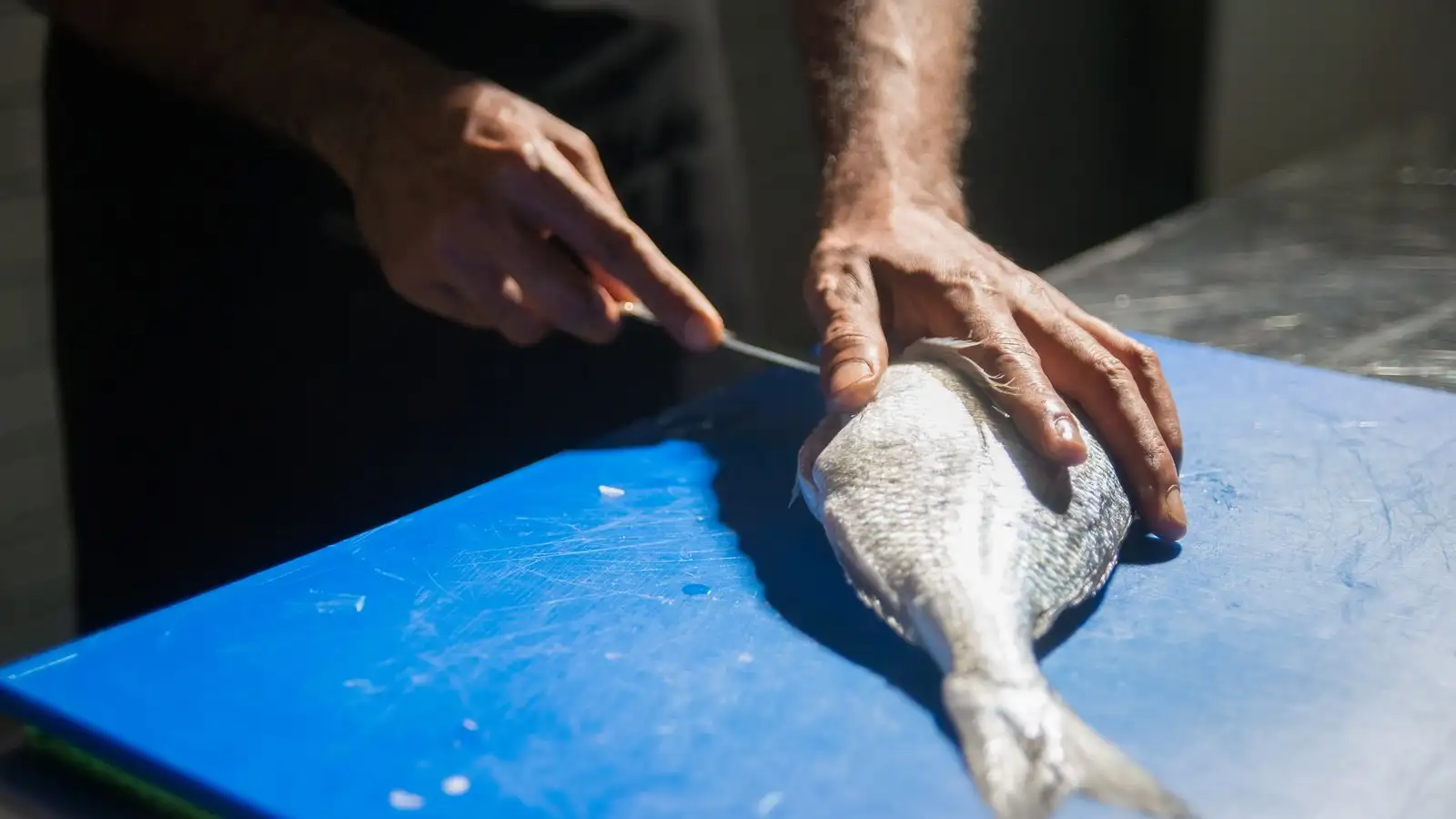
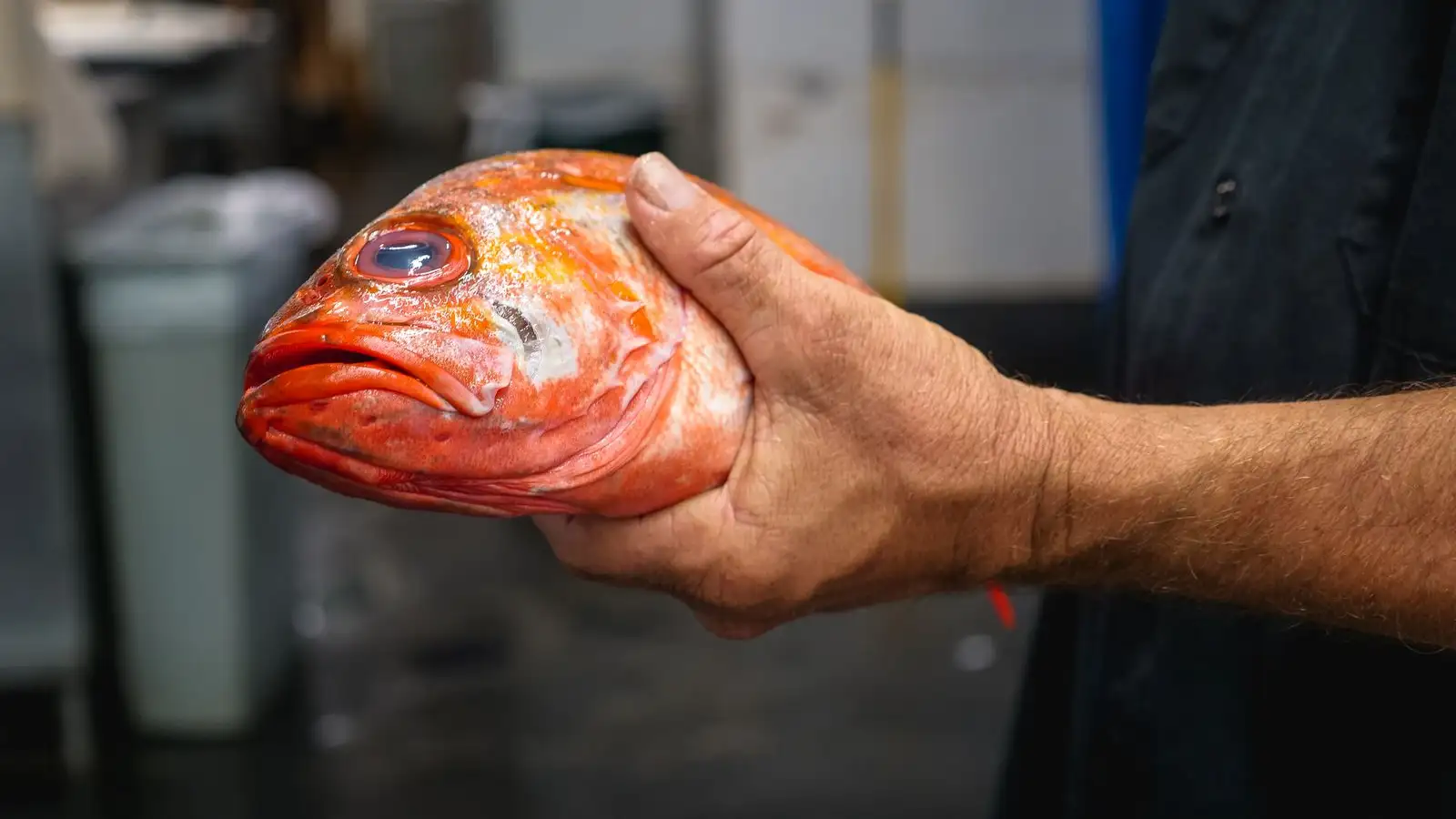
Everything left on the board after the fillets come off — the frame, the head, the collar, the ragged belly trim, the odd strip of meat clinging to the ribs — is the start of a second meal, not the tail end of the first one. Simmer those frames and heads gently for thirty to forty-five minutes and you have a fish stock that no cube or carton will match. Pick the cooked meat off the bones, fold it with the trim, and you have fish cakes or croquettes that carry the whole thing back to the table. One catch, two or three plates.
The board is wet. There's a frame on it, still cold, and when you press the spine with your thumb the bone gives slightly and the meat along it shifts. That frame is what I want to talk about, because everything I know about getting a second meal out of a fish starts with looking at it instead of scraping it into the bin.
Three piles, not one
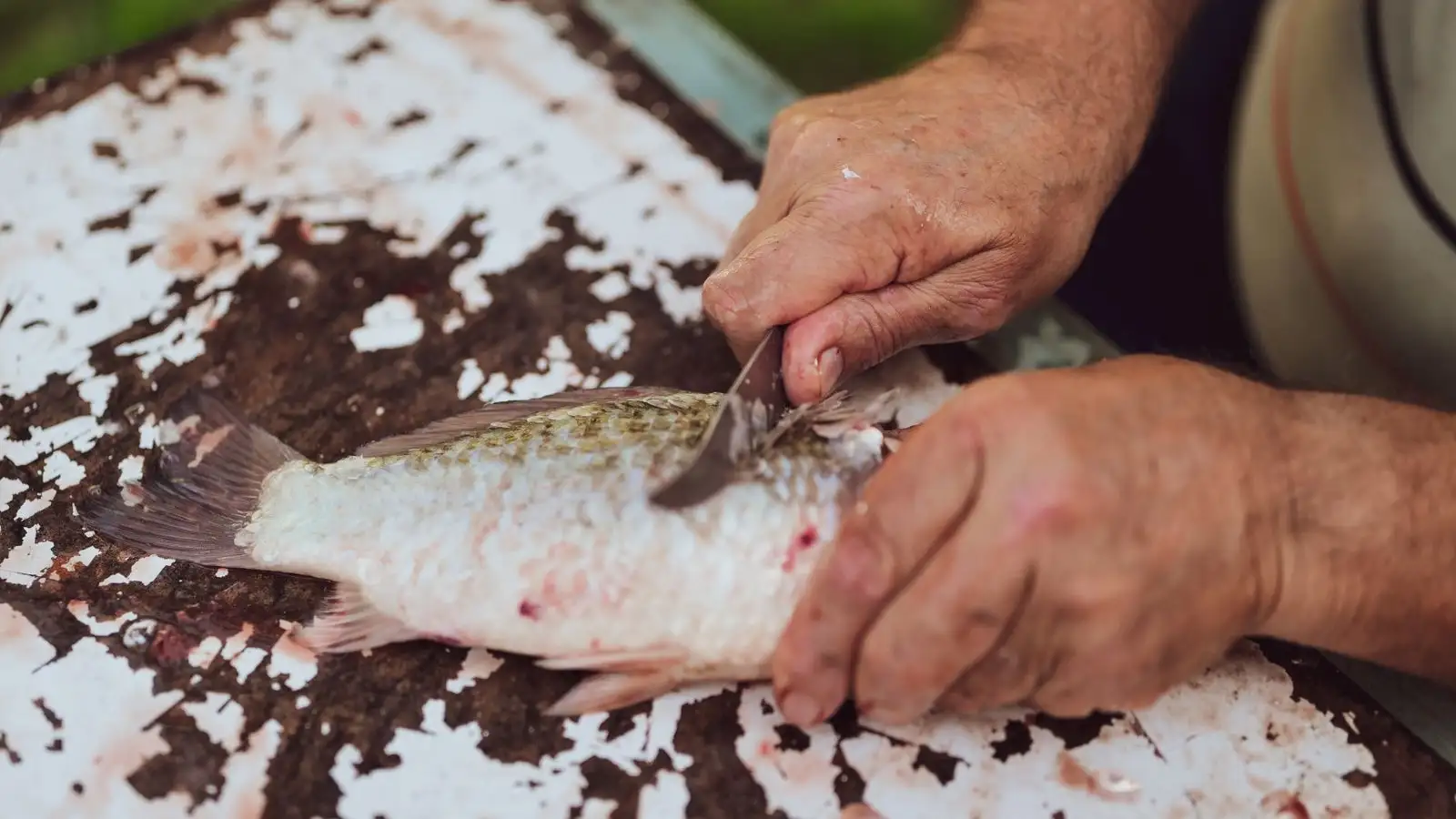
Here's how I sort. Frame to the left. Head next to it, split or whole depending on the fish. Trim to the right: belly flaps, the torn bits around the ribs, the pieces that came off ragged because I got impatient with the knife. If I filleted two fish, I've got two of everything, and the pot is already on the back burner on low.
I do the sorting at the sink with cold water running slow, mostly to rinse loose scales off the frames. Scales in stock are a nuisance. They're easy to get rid of now and impossible later.
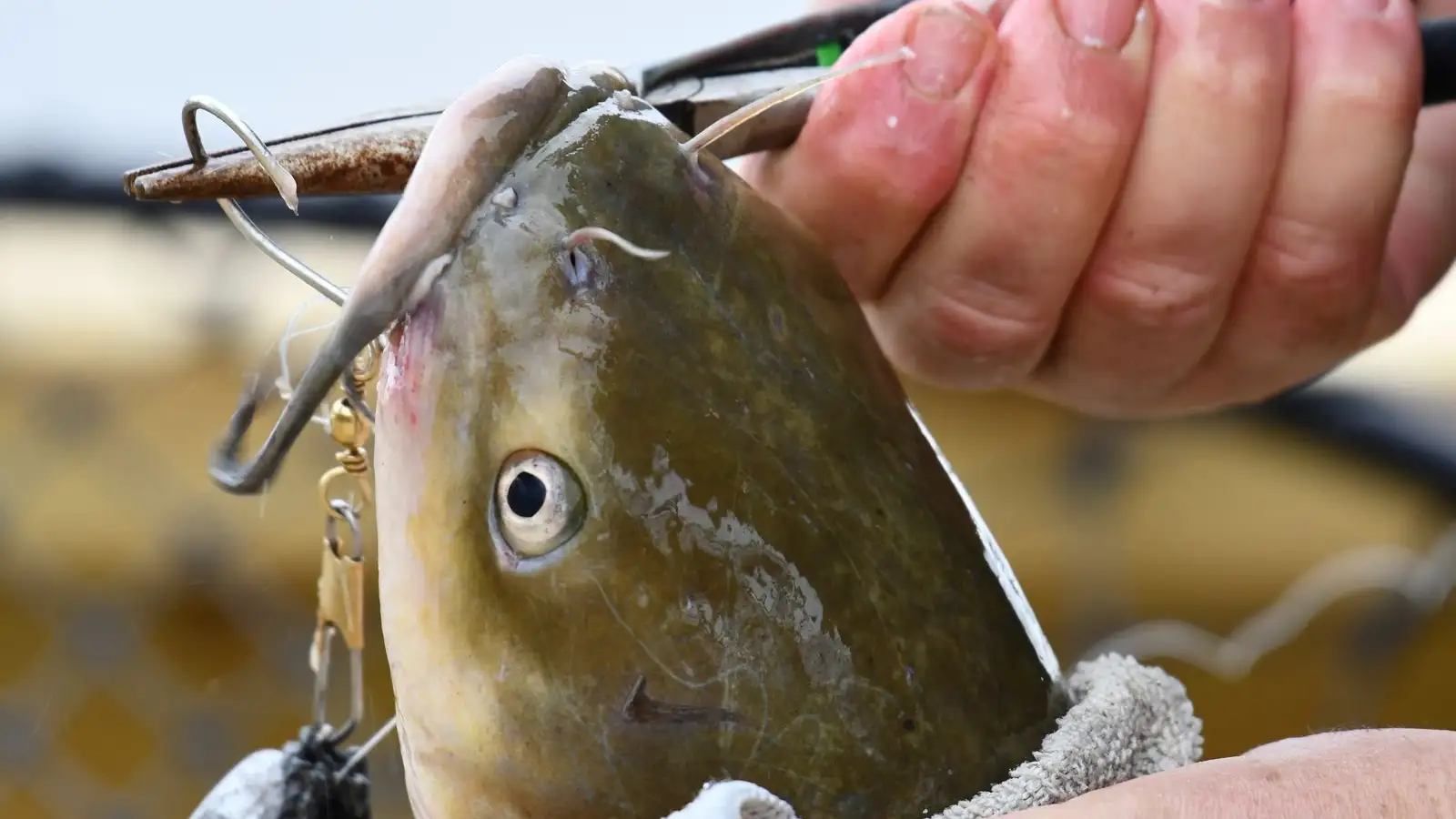
Before anything else, I open the gills and pull them out with my fingers, over the bin. Gills are the one part of a head that will actively ruin a pot of stock: they're dark, they're full of blood, and they turn the liquid muddy and bitter in a way you can't strain out afterward. Everything else on the head can stay. Cheeks, collar, the meat behind the eye — all of it's good.
Stock: gentle, short, unsalted
Cold water, just enough to cover. Not a gallon for one frame. You're making stock, not fish tea. An inch over the top of the bones is right.
Then heat. This is the part people get wrong, and it stops being subtle once you've seen both versions side by side. A hard boil breaks fat and protein into tiny droplets that stay suspended, and you end up with a cloudy, faintly bitter liquid that tastes like it's trying too hard. What you want is a bare simmer — bubbles breaking at the edges of the pot, the surface trembling, nothing rolling. That's the whole difference between a stock that's clean and gold and one that's murky.
Thirty to forty-five minutes for frames and heads. That sounds short if you're used to beef bones going all afternoon. Fish isn't beef. Past the forty-five-minute mark the bones start giving up things you don't want, and the stock picks up a flat, chalky, slightly fishy edge. You're not extracting more flavor at that point. You're cooking the flavor you already had.
First ten minutes, skim. Gray foam rises and I take it off with a spoon and tap it into a cup. After that the pot mostly behaves itself.
Aromatics: half an onion, a stalk of celery, a bay leaf, a few peppercorns. A slice or two of leek if there's one in the drawer. I keep it light on purpose. Fish stock is a supporting player in most of what I cook, and a pot that tastes like celery and carrot is a pot I can't use for anything else. No salt. Salt goes in at the end, or in the dish the stock ends up in.
Heads and collars, and what they're for
If you've eaten in a coastal town anywhere, you've eaten this. Bouillabaisse, cioppino, fish head curry, a Korean maeuntang, a Japanese ara jiru with ginger and scallion — every one of them starts with the parts most people here cut off and throw away. The collar, that thick band of meat just behind the head, is arguably the best bite on the fish, and it's the first thing that goes in the bin.
When I have a head and a collar and about a quart of stock, I don't make a dainty broth. I split the head, simmer it in the stock with ginger, scallion, a little soy, and some tofu, and eat it with rice. That's the third meal, and it costs nothing but twenty minutes.
Roasting the bones first
Raw frames give you a clean, pale, delicate stock. That's what I want for a light broth or a sauce. Roasted frames give you something browner and deeper, closer to the register of a meat stock, and that's what I want when it's going into a soup with tomato and fennel, or a chowder base.
Roasting is simple: sheet pan, 400°F, twenty to twenty-five minutes, until the edges of the bones have gone brown and the kitchen smells like you're cooking the fish a second time. Don't go past that. Burned fish bones are bitter in a way no amount of simmering will fix.
The tradeoff is real. Roasted bones cost you an extra half hour and give you a darker, stronger stock that's less flexible. If I'm only doing one, I do the raw version and keep my options open.
Getting it off the heat and into the fridge
Ladle it through a fine-mesh strainer. If I want it really clear, I line the strainer with a damp cloth. One rule: don't press the solids. It's tempting, because there's liquid in there, but pressing pushes the cloudy stuff through with it and undoes everything you did by keeping the pot calm.
Cool it fast — shallow pan, or the pot set in a sink of cold water with a stir every few minutes. Then the fridge. Overnight, if the frames had enough skin and connective tissue on them, the stock sets up like soft gelatin. That jiggle is collagen, and it's the reason fish stock made this way has body that a boxed version doesn't. Bones and skin aren't filler; they're the structure. Skin also carries a fair amount of flavor, which is why I don't strip it unless the fish was strongly flavored to begin with.
Skim any fat off the top. Use it within a few days, or freeze it. I freeze in pints and in flat bags so they stack like books on a shelf. The pints get labeled. The flat bags I just use fast.
The cakes
Let the cooked frames cool until you can handle them, then pick. Spine first, then the collar, then the cheeks, which I eat standing up about half the time. Two cups of picked fish makes a batch.
The mix, roughly: two cups flaked cooked fish, one egg, a third of a cup of mayonnaise — or a quarter cup of milk if you want them lighter — half a cup of breadcrumbs or crushed crackers, a couple of scallions, a handful of parsley or dill, a teaspoon of mustard, some lemon zest, a pinch of cayenne. Salt and pepper. Fold it with a fork rather than mashing it. You want flakes, not paste.
Then chill the mixture for half an hour, because cold mix holds a shape and warm mix doesn't. Form patties, chill them again while the pan heats. Medium heat, thin film of oil, don't crowd the pan, flip once. Three or four minutes a side, until they're browned and firm.
If you'd rather bake, 425°F on an oiled sheet, brushed with a little oil on top, twelve to fifteen minutes a side. They come out a touch drier, which is fine if you're serving them with something wet — a lemon aioli, a tomato salsa, or a spoonful of that stock reduced down until it coats a spoon.
Croquettes are the same mixture with more binder, shaped into cylinders, breaded, chilled hard, and fried. More work, better crunch, and the right move when there are people coming over.
The ratio isn't sacred, and this is the part recipes tend to skip: it depends entirely on how wet the fish is, and the fish is wetter or drier depending on how it was cooked and how long it sat. So I test. Squeeze a small patty in my palm. If it holds together and my hand comes away greasy but not dripping, it's right. If it crumbles, more binder. If it's gluey, more fish. Then I cook one patty and eat it, because that's the only reliable way to know whether it needs salt.
Here's the thing that makes the whole exercise worth doing: the cakes don't have to come from that day's fish. A fillet from Friday, flaked with a fork, works exactly the same way on Tuesday. Same for a piece of grilled or smoked fish that nobody finished. That's the second meal showing up a second time.
Where it goes sideways
Not every frame makes the same stock. Lean freshwater fish — walleye, perch, bass, panfish, trout — give a mild, clean, gelatinous stock that takes light aromatics well. Oily fish are a different animal. Bluefish, mackerel, salmon and their relatives give a stronger, oilier stock that's very good in a chowder and wrong for a clear broth. I use oily frames the same day rather than letting them wait, and I roast them more often than not.
If you scaled the fish at the sink, rinse the frames twice. If the fish sat in the cooler a day longer than you meant it to, the stock will taste like that, and no amount of ginger will cover it.
And the last thing: don't chase it. Fish stock isn't a project you extend. Forty-five minutes, strain, done. The bones have given what they have.
By the end of the night there are three containers in the fridge — a quart of stock, a bowl of picked meat, and a plate of cakes for tomorrow. That's from one fish, plus about an hour of work I was already doing. I used to throw all of it away. What changed my mind wasn't thrift. It was the first batch of cakes, which were better than the fillets that started the whole thing.