The short answer is that barbless hook rules are handling-time rules, not hooking rules. A barb is a one-way gate: it lets the hook slide in and resists it coming back out, and that same feature is what makes unhooking slow, sometimes slow enough to matter. A water with a barbless requirement has decided it would rather lose the occasional fish to a thrown hook than spend the extra seconds digging a hook out of a jaw, a gill raker, or a throat. That trade only pays off where fish get caught a lot, handled a lot, or handled at the wrong time of year. Where none of that is true, the rule usually isn't there. Everything else about barbless regulations, including why they stop at a boundary and why they change, falls out of that single calculation.
I was kneeling in the tailout of a small freestone creek with my forearms in the water, which is what you do without deciding to do it when the fish is finally in the net and the net is already wet and cold. Air in the thirties, water not far off it. The fish was a brown of maybe eleven inches, hooked clean in the corner of the mouth, and I could see the barb, just the nub of it, because the sun was over my shoulder and the water was clear enough to read print through.
I got my thumb and forefinger on the shank and pushed the hook forward, the way you'd push it through a piece of wood. The fish didn't cooperate. It rolled, the barb caught on the way back out through the puncture it had just made, and I lost the angle. What should have been three seconds became thirty, then sixty, and by the time the hook came free there was a red line at the corner of that mouth that wasn't there before I put my hand in the water.
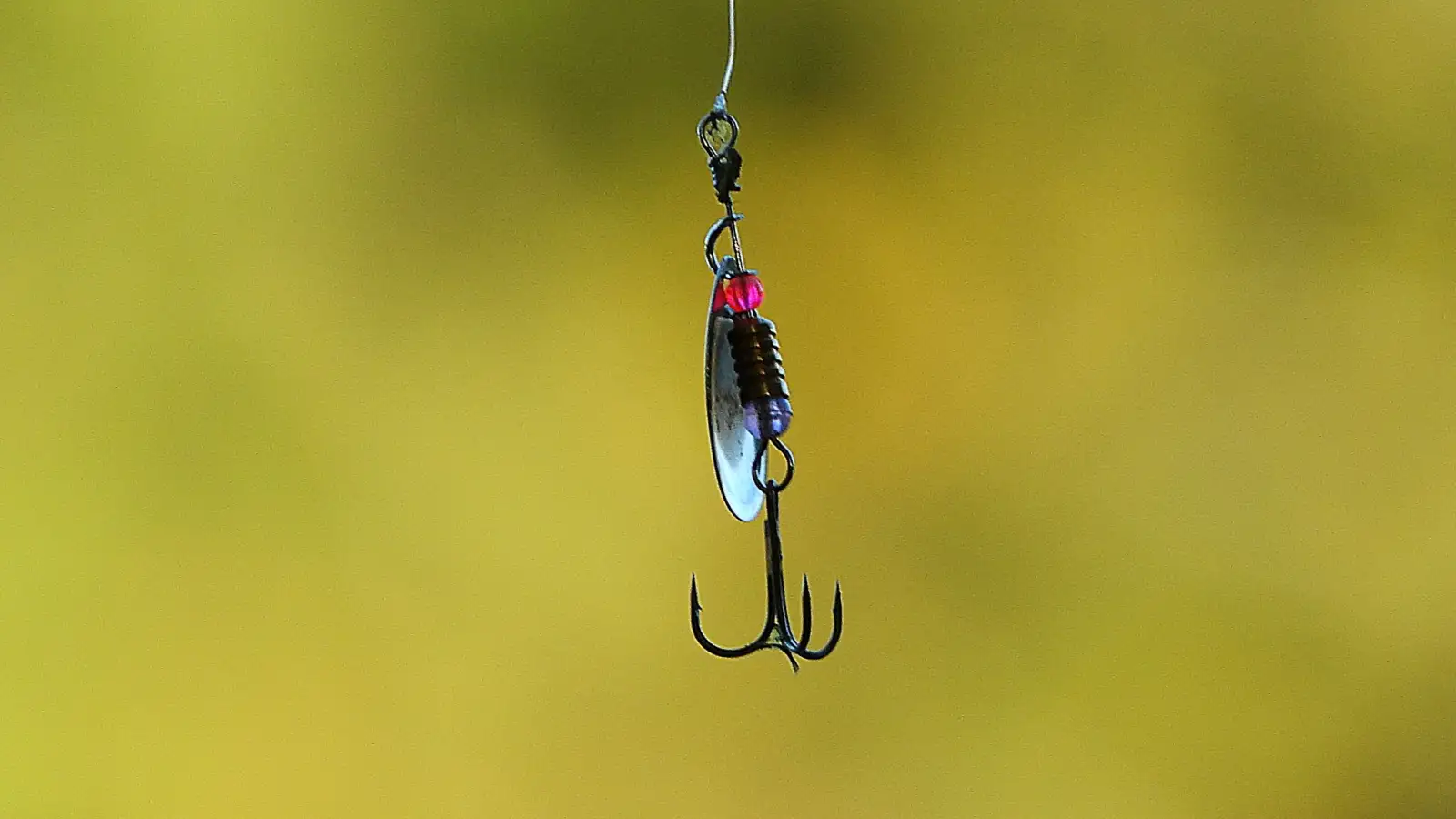
A quarter inch of wire with a small triangular bump on it. That's the entire difference between that minute and a ten-second release, and I've felt the same pattern enough times since to trust it more than I trust my memory of the stopwatch.
What the barb is actually doing
People argue about whether barbless hooks hold fish as well, and that's the wrong argument, or at least an incomplete one. The honest answer is that they don't hold quite as well. A barbless hook comes free on slack line, on a jump, on a roll in current. Every biologist who signs off on a barbless rule knows that.
The rule is not a claim that barbless is better at catching. It's an accepted cost. The water is saying: we will take a few more long-distance releases in exchange for shorter and cleaner ones up close. Whether that trade makes sense depends entirely on how many times the fish in that water are going to be caught again.
Which is why the rule shows up where it does and not everywhere.
One practical wrinkle: what counts as barbless isn't identical from place to place. Sometimes a pinched-down barb is fine, sometimes the wording expects a filed nub or a factory barbless hook. That's exactly the kind of detail that lives in the current year's book and not in what somebody told you at the ramp.
The math changes with the crowd
On a heavily fished catch-and-release water, one fish might be hooked many times in a season. Each of those hookups leaves something. A nick in the jaw. A split in the maxilla. Scar tissue at the corner of the mouth. A fish with a torn mouth feeds less efficiently, and a hook wound that gets infected doesn't feed at all. Barbless hooks don't erase the puncture, they shorten how long the metal stays in and reduce how much tissue tears on the way out. A small difference in damage, multiplied by a large number of encounters, becomes a population-level difference. Multiply that same small difference by two or three encounters a season on a water nobody fishes and you get nothing at all.
So the rule clusters where pressure is heavy, where the fish population is thin or native or both, and where gear restrictions already come as a bundle: single hook, artificial only, barbless. If you're on water like that, the barbless rule isn't really about you. It's about the twentieth angler through that pool this week, and the hundredth fish that mouth has to feed with.
Bait changes the equation into a different problem entirely, which is why bait often gets restricted where a barbless rule would do nothing. A swallowed hook isn't a handling-time issue. It's a mortality issue, and no amount of barbless wire fixes it.
And the rules don't stop at the water. Cross a state line and the same creek, the same fish, the same fly can be under a different set of requirements, because the agency on each side is working from its own data and its own co-management agreements. I've had to unlearn a habit in one direction and relearn it in the other.
Temperature has nothing to do with hooks
I once released a fish in July and watched it swim down, go onto its side, and stay there.
Cold water and warm water are two different events for a fish that has just fought. The burst of anaerobic exercise produces lactic acid, and clearing it takes oxygen. Warm water holds less of it. A fish that fought hard in cold water swims off like nothing happened; the same fight in August water can leave it unable to right itself. That's why plenty of rule books restrict fishing hours, or close stretches entirely, when water temperatures climb. Those rules are not about hooks. They're about whether the fish can recover from any handling at all.
So if you're standing in water that feels like bathwater and there's no closure on the books, you're still looking at the same biology. Rules follow conditions with a lag, and the condition you're standing in is the one that matters.
Closures, redds, and the size range that carries the future
Spawning is the other window where handling gets multiplied. Spawned fish take offerings they'd ignore the rest of the year. They're concentrated, they're visible, and they're defending something. Keeping hands off that water for a stretch protects a whole cohort at once, and a female handled badly at the wrong point in her cycle loses more than just herself.
Slot limits attack the same problem from a different direction. The logic isn't simply "big fish are the breeders." It's that a particular band of the size range contributes the most offspring, so that band goes back, while fish below it and fish above it can be kept. The specific endpoints in the book are one state's specific choice on one water. The idea underneath is a size class, not a ruler, and once you see it that way you'll notice which fish you're sliding back anyway.
Who draws the lines, and where the reasoning lives
State agencies write these rules, usually in coordination with tribal and federal co-managers who have their own trust responsibilities and their own biologists. It's not a whim, and it's not physics either. It's data plus law plus public input, revisited on review cycles.
Two things follow from that. The first is that the rationale is almost always written down. Every rule book I've handled has an explanatory section near the front that says, in plain language, why this water is barbless or why that stretch closes when it warms up. That section is the part people skip, and it's the part that keeps you out of trouble on water the table doesn't neatly describe.
The second is that the book is a snapshot. A barbless water can become a barbed water and back again. Anything you remember from a past season, or read on a forum, or heard at the ramp, is a rumor until you check the current book for that specific water. Not the general summary of the state's rules. That water, this year.
What I do with it
I pinch the barb on almost everything now. Not out of virtue, out of laziness. I got tired of digging hooks out of fish and out of my own fingers, and a flattened barb comes loose from both. When it costs me a fish on a jump, I know exactly where the cost landed, and I've made peace with it.
The more useful habit is the one that follows from seeing a rule as a proxy. A barbless requirement is a place saying the handling here matters more than the catch. A temperature closure is a place saying the water can't pay for what this fish is about to spend. A slot is a place saying this band of fish is the future. Once you know what condition a rule is standing in for, you can fish that way on water where nobody has written anything down. You can leave the redds alone. You can quit when the water hits that sluggish feel. You can turn a hook over in your palm and think about the next person through the pool.
Rules exist because not enough people make that call on their own. The regulation is the average. You don't have to be the average.