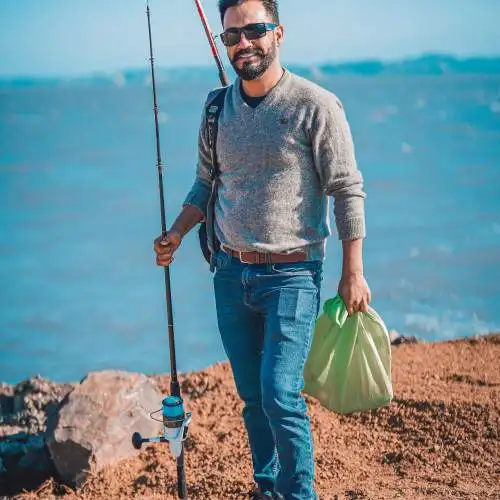
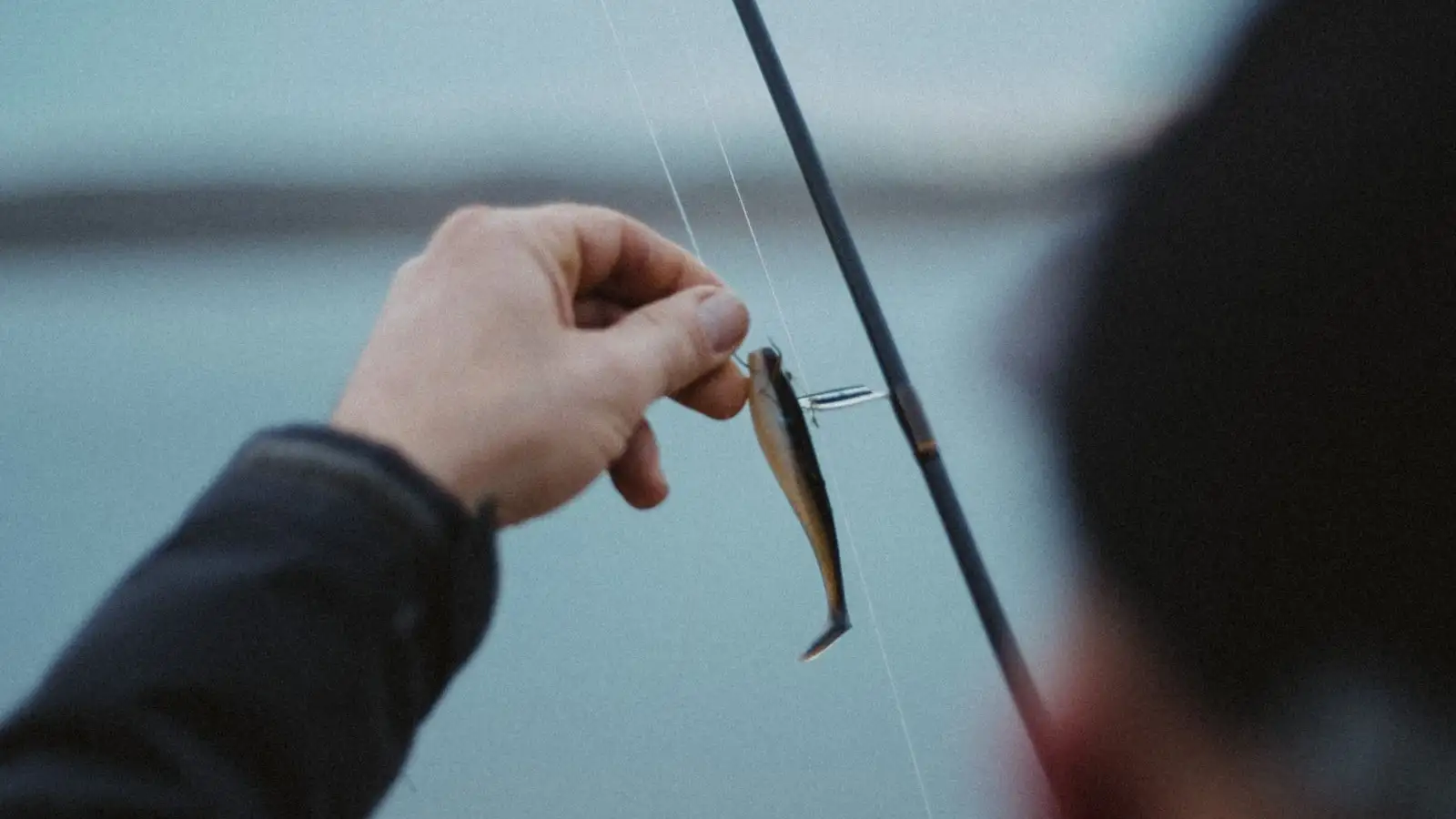
The spec that decides the most in fast, rocky wading water is rod length, and the right answer is usually shorter than the catalog suggests: an 8-foot-6 or 9-foot rod in the line weight that matches the flies you actually throw, with a moderate or moderate-fast action, so the tip loads with fifteen feet of line out and the backcast fits between the boulders behind you. What you give up is reach. What you buy is line control, a tip that protects light tippet, and a rod that doesn't demand a thirty-foot false cast before it starts working.
I want you standing where I'm standing. Thigh deep, felt soles grinding on round cobble, the current shoving the back of my knee hard enough that I'm leaning into it. Upstream and left there's a boulder the size of a chest freezer, and the water stacking against it has cut two seams with a slick chute between them. That chute is where the fish is. Fifteen feet away. In this current, fifteen feet is spitting distance, and it's also about as far as I can get a clean drift before one of those seams grabs my line and walks it downstream.
Behind me the bank goes up in alder and a rock shelf. That's my backcast. About ten feet of it, and it changes shape every time I move a step.
Everything I care about in a rod comes out of that geometry, not out of a spec chart.
The first limit is the corridor behind you, not the distance in front
Most rod advice is written by people casting on grass with nothing behind them. In boulder water you are always casting inside a slot. The rod has to be short enough that the loop clears the rock shelf on the back cast and short enough that you can flick it with the wrist alone when you can't get your shoulder into it.
That's why I stopped carrying a 9-foot-6 on tight, tumbling water. Not because it couldn't reach — it reached fine — but because every cast became a negotiation with what was behind me. When your backcast corridor is ten feet and shrinking, an extra six inches of rod is six inches of loop that has to go somewhere.
There's a second thing a shorter rod does that nobody talks about: it's less of a nuisance when you're scrambling. Both hands on rock, rod tucked under your arm, moving up a bank of wet boulders. A 10-footer turns that into a job. A shorter rod, or a four-piece broken down and strapped to your back, lets you use your hands for what they're actually for.
Short casts live in a loading window that fast rods don't cover
Here's the piece that took me a while to understand, and it's the reason I stopped blaming myself for bad casts at fifteen feet.
A rod only bends if there's enough mass in the line beyond the tip to bend it. That mass is a function of how much line is out. A fast-action rod — the kind that flexes in the top third and recovers like a spring — is designed to load with a lot of line in the air. Thirty, forty, fifty feet. It's a distance tool, and it's honest about that.
Now put that rod in my situation. Twenty feet of line past the tip, maybe less. The rod isn't bending because there's nothing to bend it. I'm casting with my arm instead of the rod, the loop is a mess, I'm false casting four times to build line speed, and every one of those false casts is a second the fly isn't in the water.
A moderate or moderate-fast action bends deeper into the mid-section. It loads with less line out. Fifteen feet of line and a big tungsten nymph is enough to feel the rod come alive, which means I can pick up, roll it, and drop it back into the chute in one motion.
That's the whole trade. Fast action gives you line speed and distance, and it punishes you for short-range work. Moderate action gives you feel at close range and forgiveness when your timing goes sideways because you're standing on a slippery rock with cold hands.
If I were going to over-line one notch — a 6-weight line on a 5-weight rod — this is where I'd do it. It loads earlier and deeper, which is exactly what you want at fifteen feet. The cost is that the rod feels slower and a little mushy on the rare long cast, and it doesn't turn over in wind as cleanly. It's a trade, not a free lunch.
Where a longer rod still earns its place
I'm not going to pretend short is always right. The honest answer is that this is a per-river decision, and I've stood in plenty of water where I wanted the extra length.
When the river opens into a wide, shallow riffle with four current seams between me and the fish, a longer rod mends better. Plain physics: more length means more leverage to flip line upstream, and a higher tip to hold line off the water so the current doesn't grab it. On a broad tailout with the wind at my back, a 9-foot-6 or 10-footer keeps more line off the surface and gives me a longer drag-free float. If that's the water I'm wading, the rod I want changes.
Same with tight-line nymphing. A 10-foot 3-weight is genuinely good in fast, broken water — it holds line off the surface and keeps you connected to the fly. I've fished them and liked them. I just don't love carrying one all day in a gorge, because that length is a lever in the wind and a hassle in the alders. If you fish that style exclusively on big open water, ignore half of what I just said. If you're hopping boulders in a canyon, don't.
Power and line weight are about turning the fly over, not fighting fish
Anglers overthink rod power for the wrong reason. In fast water you're almost never fighting a fish off the reel. You're keeping a trout out of the next boulder with your hands and your feet, and most of that is you, not the rod.
What power actually buys you here is turning over a fly in a short window against a current that wants to shove it back in your face. Heavy tungsten, articulated streamers, a double-nymph rig with split shot — that's mass, and mass needs a rod with some guts in the butt section to punch it into the slot before the wind catches it. Go too light for the flies you're throwing and you'll feel the rod fold: the loop collapses, the fly lands in a pile, and the drift is over before it starts.
Go too heavy and you've got a broomstick that can't protect 5X when a good fish surges at close range. That's the reason I keep landing on moderate action for this water. A softer tip absorbs the surge and keeps the tippet intact on a fish I hooked at ten feet, and the mid and butt still have enough authority to throw something with weight on it.
Fast action has one real advantage here, and I'll give it credit: wind. In a gorge, wind comes at you from odd angles and it comes fast. A fast rod generates tighter loops and higher line speed, which cuts through it. But it demands smoother timing than I usually have when I'm off balance in moving water. If your stroke is dialed, fast action is a weapon. If it isn't, it exposes you.
The spec that never makes the label: how it carries at hour six
Nobody puts swing weight on a spec sheet, and in wading water it's half the decision.
You're going to make hundreds of short casts in a day, most of them with your arm out at an angle, holding the rod high to keep line off the current. A long rod with a heavy swing weight will find your shoulder by two in the afternoon. A shorter, lighter rod that loads easily at close range means fewer false casts, and fewer false casts means the fly is in the water more minutes of the day. That's not a casting metric. That's a fishing metric, and it's the one I actually care about.
One more thing I've learned the hard way: a rod you can pick line up with. When the current drags your line into a downstream belly, you have maybe a second to get it off the water and back into the seam before the drift is ruined. A rod that loads at short range picks up cleanly in one motion. A rod that doesn't forces you to strip line in, re-cast, and lose the window. That single-second operation is what I'm really shopping for.
So here's what I'd rig for a day of boulder-hopping on fast water: 9 feet, the line weight that turns over the flies I'm actually throwing, moderate or moderate-fast, and a reel that's mostly there to hold line. Not because it's the best rod. Because it's the rod that stays out of my way while I do the thing I came to do — which is put a fly in a chute fifteen feet away, twenty times an hour, without thinking about the rod at all.