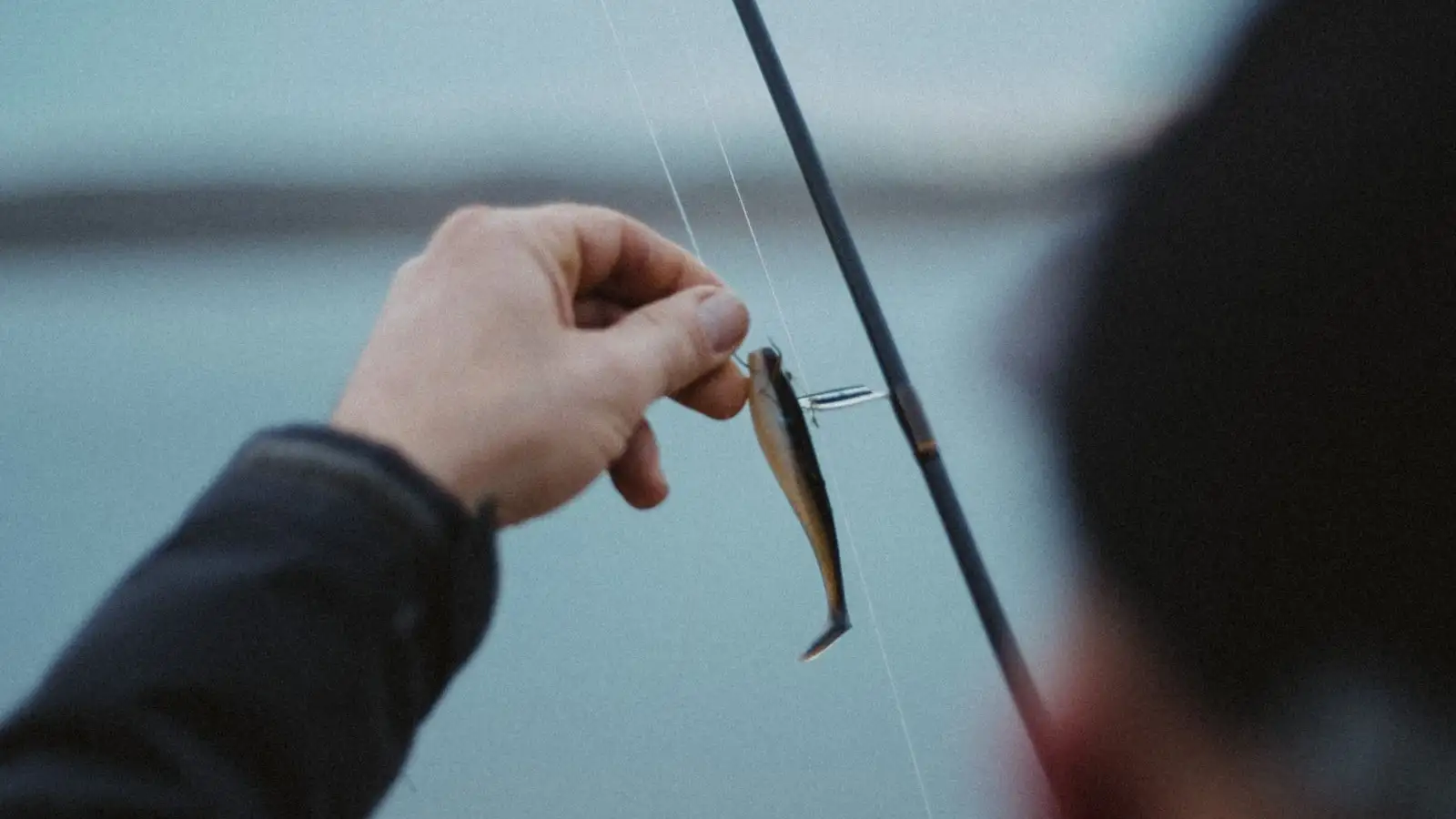
A heavier rod starts costing you fish the moment its stiffness stops matching the hook in the fish's mouth. Power in a blank buys hook penetration and the leverage to pull a fish away from cover; it costs shock absorption. On a treble-hook bait or a soft-mouthed fish, that's a bad trade, because the same rigidity that drives a hook point home is what tears it back out on the first headshake. The rod that sets the hook hardest is very often the rod that loses the fish.
I keep two rods rigged on the deck from April through October. Same reel, same line, same stretch of bank. One is a heavy, fast stick. The other is a medium with a moderate bend. The gap between them shows up about two seconds after the hookset.
The day it stopped being a theory for me, I was working a riprap bank at first light. I'd been pitching a jig into laydowns with the heavy rod, and when I decided to throw a crankbait I just tied it onto the rod that was already in my hand. Second cast along the rocks, a fish ate it fifteen feet out. I swept the rod sideways, felt the blank go solid, felt the fish turn its head, and then felt nothing at all. The bait came back with wet trebles and no fish anywhere near it. The rod never bent past the first third of its length. Nothing in that system gave, so the fish's own weight and the leverage of three hooks did the unloading for me.
A week before, same kind of bank, same size fish, but the crankbait rod. The tip folded down toward the water when the fish pulled, I felt every headshake through the reel seat, and it stayed pinned to the net. Same hookset, same drag setting, different blank.
The hookset and the fight want opposite things
A fast action rod bends less of its length before it loads, which means more of the energy from your hand goes through the blank and into the hook point. That's not a small thing. On a single hook buried in a thick, bony jaw, penetration is the whole problem, and speed plus stiffness solve it.
A treble hook is not a penetration problem. Three light-wire points stick easily and shallowly. What keeps them in is steady tension and a rod that moves with the fish. A blank that won't flex has nowhere to put a headshake, so the shock travels down the line to the hook holes, and hook holes in soft tissue get bigger.
Power is a pressure budget, not a strength rating
Power is how much load the blank takes before it bottoms out, before it quits bending and turns into a stick. More power means you can apply more pressure without hitting that wall. In cover, that's everything. In open water with treble hooks, it just means you can rip the hooks free faster.
The blank bottoming out is the moment worth watching for. That's where the rod stops protecting anything: the bend can't absorb more, so every bit of force goes straight into the line, the knot, and the hook. Rod power is really just how far away that moment is.
The pressure on a fish comes from three places
Rod power, rod angle, and drag. The rod is only one of the three, and it's usually the one anglers think about least during the fight. High-stick the rod past vertical and you're loading the thinnest, weakest section of the blank with a pull it was never built to carry. Keep the rod somewhere around 45 degrees and the bend sits in the middle of the rod, where it can actually work.
Drag is the other half of it. Set the drag loose enough and line leaves the spool before the blank ever loads properly, so you never get the shock absorption you paid for, and you hand the fish slack it can use to work a hook loose. Set it tight enough and you've removed the give from the system entirely, which is exactly the condition that pulls treble hooks out of a mouth. I set drag to the line and the hook, not to the fish I'm hoping for.
Braid deserves a mention here. It has essentially no stretch, which means on a braided setup the rod is the only shock absorber in the chain. That's fine with a single hook and a moderate blank. It's a rough combination with a fast heavy rod and a crankbait, because now nothing in the system gives and the hook becomes the weakest link.
What the blank is telling you while the fish is on
You can read all of this in real time. If the rod is bent into the handle and the tip isn't moving while the fish thrashes, you're past the working range. The blank is bottomed out and every headshake is going straight to the hook. If the top third is pumping up and down and you can feel the fish's weight pulsing through the grip, the rod is doing its job.
Recovery speed matters too, and it cuts both ways. A crisp, high-modulus graphite blank snaps back to straight almost instantly after the hookset. That's great for driving a hook at distance. It's less great for keeping one in, because it gives the fish's movement back instead of swallowing it. Glass and slower blends recover lazily, bend deeper, and feel vague on the hookset, and they hold more fish on treble hooks than anything else I've fished.
Match the rod to the hook, then to the fish
Single hook, heavy cover, thick jaw: fast action, heavy power. Flipping and punching is the one place a stiff rod is simply correct, because you're driving one point through tough tissue and then dragging a fish out before it wraps.
Single hook, open water: fast action is still fine, but medium-heavy power usually lands more fish than the extra-stiff versions, because the blank can still absorb a run.
Treble hooks: moderate or moderate-fast action, medium power. Cranking, topwater, jerkbaits. You want the bend, you want the tip, and you want a drag setting that lets a surge take line instead of levering the hooks out.
Soft mouths: go softer still, back the drag off, and ease up on the hookset. When the mouth tears, the goal isn't to beat the fish, it's to never give the hooks a reason to work loose.
There's one more tradeoff worth naming, because it's the reason I own more than one rod. A heavy rod isn't better or worse in the abstract. It's better at exactly one part of the job, putting a hook in and moving a fish, and worse at every part that comes after. The rod that gets the hookset done at forty feet is often the rod that loses the fish at four.
So I don't buy power for its own sake anymore. I buy the least power that still sets the hook cleanly on the lure I'm throwing, and the most action that still gives me control over the fish. The rod is a spring with a hinge, not a winch. Treat it like one and the landing percentage goes up without changing anything else.