The real cost of ignoring your rod's line and lure ratings isn't a snapped blank, though that happens. It's a rod that quietly stops doing its single job: storing energy during the cast and handing it back in a controlled way. Both numbers printed on the blank describe a working range. The line rating is the span of line strengths the rod can fight with safely. The lure rating is the span of weights that will actually bend the blank on a cast. Stay inside both and the rod feels like it was built for what you're throwing. Drift outside them, too heavy, too light, or too much line with the drag cranked, and you pay in distance, accuracy, hooksets, and eventually hardware. Treat both numbers as a compatibility guide between blank, line, lure, and drag setting, then verify by feel before you trust them.
I didn't learn that from a spec sheet.
A gray morning, the wrong rod, and one long cast
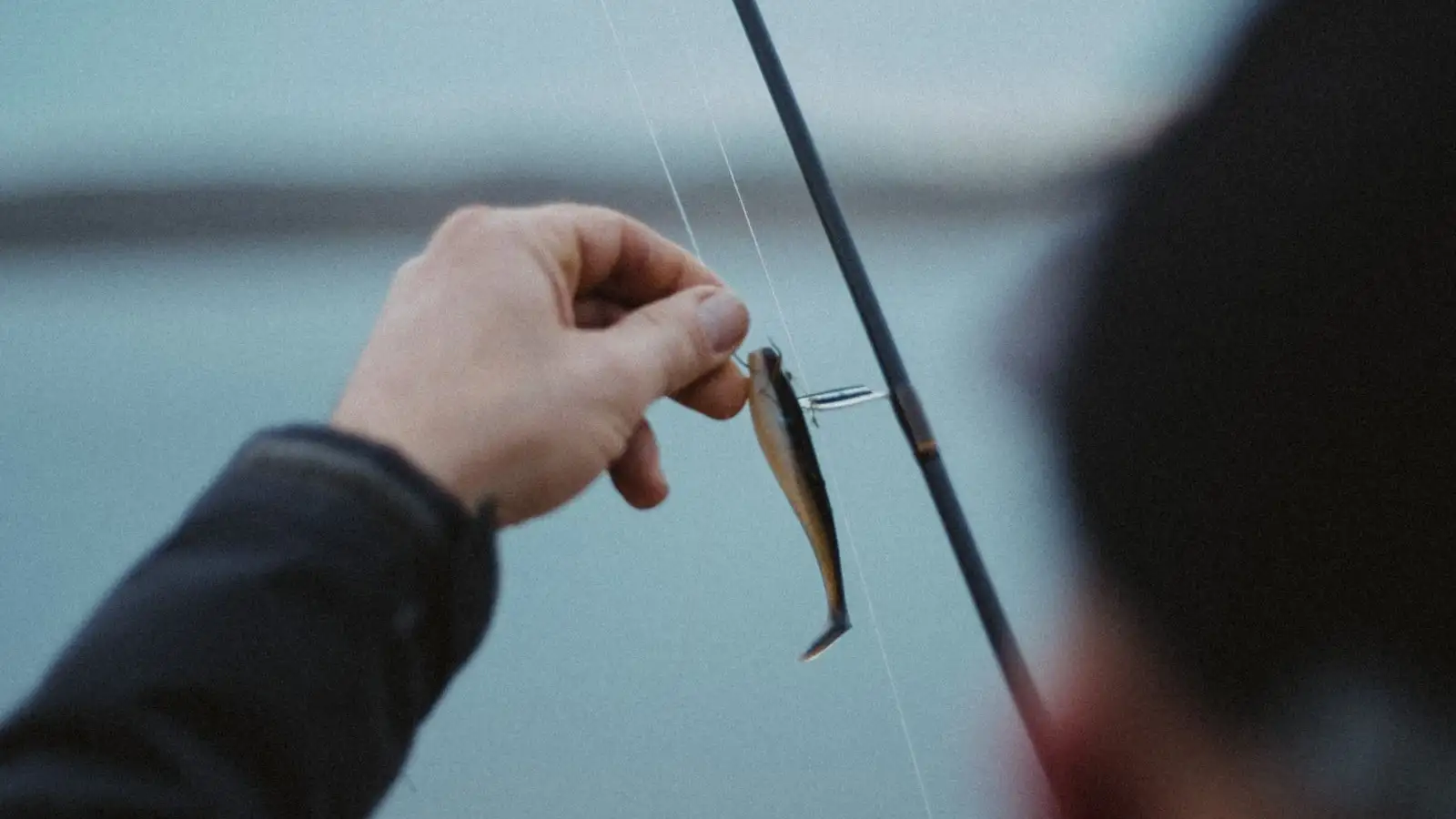
The pond dam was slick with dew, wind coming out of the northwest and pushing a chop into the riprap. I had one rod with me, a medium-light spinning outfit I'd grabbed on the way out the door, rated for something like 6 to 12 pound line and an eighth to three-eighths of an ounce on the lure side. In my other hand was a swimbait rigged on a weighted hook that I'd guess came in near three-quarters of an ounce, maybe more once the plastic soaked up water.
I didn't weigh it. I just tied it on and wound up.
You know what that cast sounds like. The rod loaded past its middle, deeper than it wanted to go, and the tip lagged behind my hands. The bait came off low and left, hit the water thirty feet short of where I was looking, and the splash spooked the shad I'd been watching flicker along the bank.
I blamed the wind. Second cast, same thing. Third cast I slowed everything down, lobbed it, and the bait went farther, but now I was casting like I was carrying eggs, aiming with my arm instead of letting the blank do the work. Somewhere in there a fish swirled on the bait and I leaned into it, and the rod went somewhere past comfortable. Not a break. Just a feeling in my hands that the blank was out of its depth, and me with it.
That's the honest version of what ignoring the ratings costs you. Not always a snap. Usually a whole morning of fishing badly.
What the two numbers are actually describing
The line rating is the manufacturer's suggested range of line strengths the rod is built to handle. Read it as a fight rating, not a cast rating. It's about what happens when a fish is pulling and the blank is the lever between you and the fish. Somewhere above that range, the rod stops being the tool doing the work and becomes the part being tested.
The lure rating is about casting. It's the window where the weight on the end of your line will bend the blank against its own inertia on the forward stroke and then spring back. A rod blank is a spring. Too little weight and the spring never compresses, so the rod stays stiff and you do all the work with your arm. Too much and the spring over-compresses, the tip lags, and the whole thing stops being predictable.
Two different jobs, two different numbers. Most of the confusion comes from reading them as one safety sticker.
The line rating is really a fuse rating
Here's the part I keep coming back to. The line is supposed to be the weakest link in the system, and the line rating tells you how strong that link is allowed to be.
If your line is heavier than the rating, the fuse is gone. Something still has to give under a hard pull: a snag you're trying to free, a fish making a run at the boat, a hookset that turns into a tug of war. With heavier line and a tight drag, the blank becomes the thing that breaks. I've pulled a guide ring out of a tip section that way, and I've watched a ferrule let go on a rod that had no business being stressed that hard.
Drag setting is where this gets practical. A drag that lets line out before the blank is overwhelmed is doing the same job as a lighter line. What you're managing is total load: rod angle, drag pressure, and line strength, all working on the same spring.
Braid complicates it, and I'll be straight with you that I'm describing a feel, not a spec. Mono and fluorocarbon stretch, and that stretch absorbs part of a surge before it reaches the blank. Braid doesn't. The same pound test in braid arrives at the rod whole. If I'm running braid at the very top of a rod's line rating, I treat that top number as a ceiling instead of a comfortable middle, and I back the drag off a notch to compensate.
Lure ratings assume a bare lure
The lure rating on the blank is written for the lure by itself. Everything you attach to it counts too: hook, skirt, trailer, worm weight, swivel, snap, a float that's been drinking water all morning.
I keep a kitchen scale in the garage for exactly this. A quarter-ounce jig with a bulky trailer and a heavy hook can weigh half an ounce before you've done anything unusual. If your rod tops out at three-eighths, you're outside the range and nothing on the packaging told you so.
Wind counts too, though it doesn't change the number. A lure at the bottom of the range that casts fine in calm air can feel like nothing on a headwind, and you'll over-accelerate to compensate. Now your arm is doing damage the blank wasn't going to do.
Three tests that take ten minutes
The static bend
Tie your line to something solid, a fence post or a hitch or a friend's gloved hand, and walk backward until the rod takes a light bend. Then stop and look at the curve instead of feeling it. You want a smooth arc that reaches roughly the middle of the blank. If the tip folds before the rest of the rod joins in, or the bend stops dead partway down and the butt refuses to come along, you're outside the range.
If you'd rather use a known load, fill a plastic bottle until it weighs what you want. A pint of water is about a pound. Hang it from the tip on a short loop of line, add water in small amounts, and watch how far the curve travels down the blank. When it stops being an arc and starts being a hinge, stop. It's a static test and not a cast, but it tells you where the blank runs out of room.
The cast test
This is the one that matters. Tie on the lure, walk to the water, and make a lob cast first. You should feel the weight of the lure bend the tip on the backcast, then feel the blank unload on the forward stroke without you forcing it.
Two failure feelings worth learning by name.
Mushy. The rod keeps bending after your hands have stopped, the lure lobs off the tip, and the whole rod wobbles through the follow-through. That's an overloaded blank. You're past the range, and your casting control goes with it.
Stiff. Nothing bends until you muscle it, and you have to over-accelerate to get any distance. Your forearm and shoulder are doing the work the blank should be doing. That's an underloaded blank, and it costs you accuracy as much as distance. A rod that won't load won't aim.
Then make one full-power cast. If the lure goes where you look and the rod loads without a hitch anywhere in the stroke, that lure is inside the working range. Do this once with every lure you plan to throw on that rod, in calm air, before you're standing on a boat deck trying to figure it out with fish blowing up around you.
The pull test
Have someone hold your line, gloved or wrapped once around a dowel, and walk away slowly while you hold the rod at a normal fishing angle rather than straight up. Watch where the blank bends.
The point isn't to break anything. It's to find where the rod runs out of power. If the bend travels past the middle of the blank and stops feeling like a curve, you're looking at the load your drag and line could generate on a decent fish. Set the drag so that load never happens.
When it's fine to color outside the lines
These are guidelines. I've thrown lures a little over a rod's top number and gotten away with it, and I've dropped lures far under the bottom number straight down off a dock where casting distance didn't matter at all.
What makes those fine is that they're decisions instead of accidents. Lobbing a slightly heavy bait a short distance is borrowing against the blank for one cast. Doing it all day shortens the rod's life or ends it.
Two things break rods regardless of what the label says. High-sticking, where you push the rod past vertical to lift a fish or pop a snag loose, and pointing the rod straight at a snag and pulling. Both put the load somewhere the blank was never designed to carry it. The ratings assume you're fighting fish with the rod at a working angle. Break that assumption and the numbers stop protecting you.
What you're actually chasing
Inside any rating there's a sweet spot, usually the middle to the upper-middle of the lure range and the middle of the line range, where the rod does everything easily. Same rod, two lures both technically inside the range, and one of them casts like it was made for the blank while the other just feels like work. That's not marketing. That's the spring doing what it was designed to do.
That's why I stopped treating the printed numbers as a warning label. They're a description of what the blank can do, and the line and lure are how you tune it. The morning on the pond dam wasn't a lesson about breaking rods. It was a lesson about fishing a rod that wasn't in its range, and paying for it with every single cast, all morning, in ways that never show up on a spec sheet.