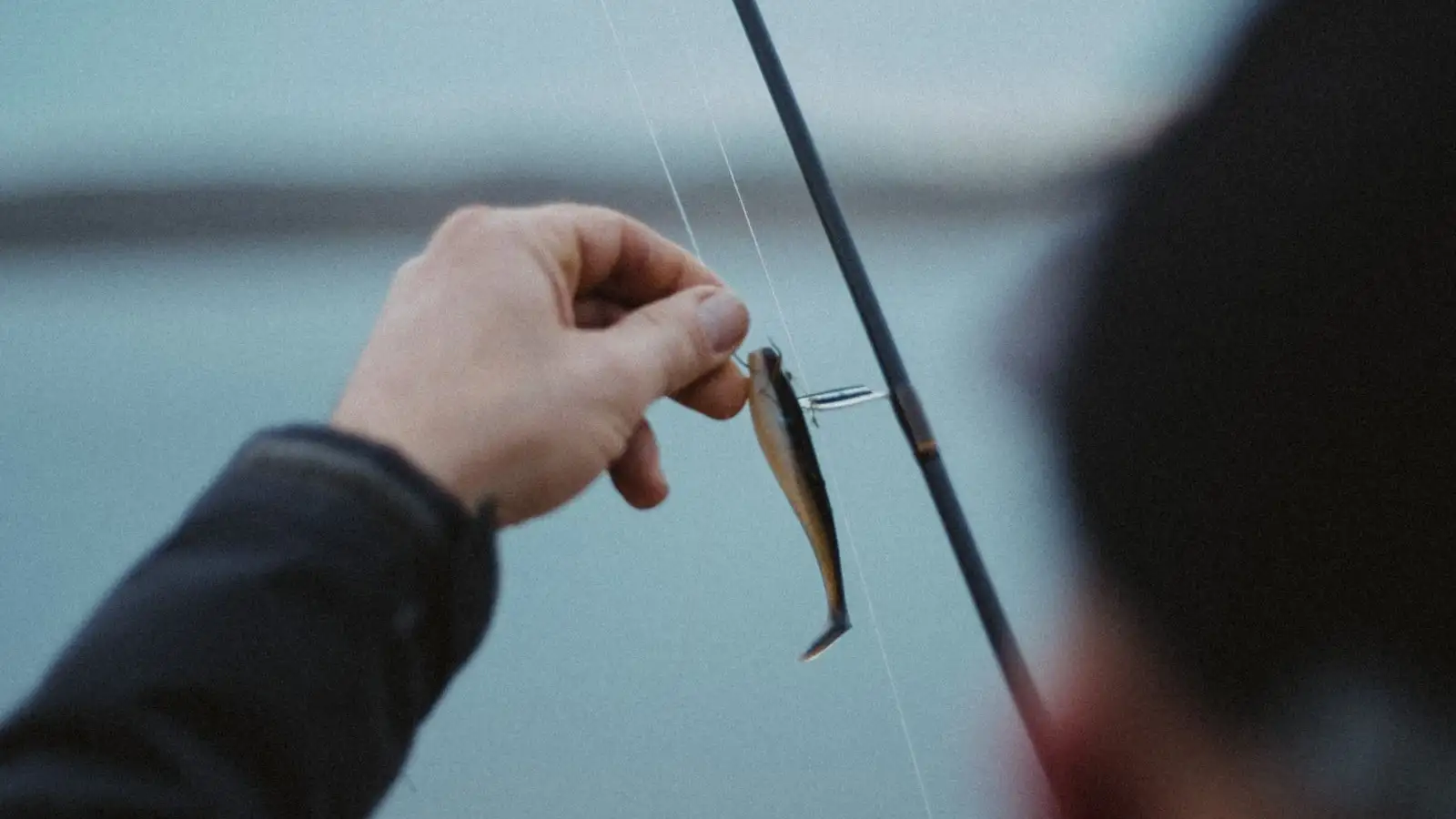
Power is how much load the blank will carry and how much pressure it can put on a fish; action is where along that blank the load gets taken up and how quickly the rod springs back. Power is a capacity, rated from ultralight to heavy, and it sets your lure weight window and your ceiling on hook-setting pressure. Action is a location and a speed, running from slow to extra-fast: a fast rod bends mostly in the upper third, a moderate rod carries the curve down into the mid-section. Two rods can wear the same power number and fish nothing alike, because one spec describes the size of the job and the other describes where the work happens.
I keep a stub of masking tape on the bench for exactly this reason. Two rods, both stamped medium, one labeled fast and one labeled moderate, and a guy who wants to know why they don't cast the same. Tape one to the edge of the bench at the butt, take the line in your fingers, and pull straight away from the tip, slowly, watching the blank instead of the line. Somewhere along that curve there's a point where the bend begins — the hinge. On the fast rod the hinge sits inside the top third, so the tip does all the moving and everything below it stays nearly dead straight. On the moderate rod the hinge is past the halfway mark, and the whole lower half leans in. Same power. Two completely different levers in your hand.
That is the whole of the mechanical difference, and it explains almost every argument people have about rods.
Why the tip fools your hand
Pick a rod up in a shop, give it a wiggle, and you are feeling the tip section — the top eight inches or so. That's the part your wrist interacts with, and it's the part that makes a rod feel "stiff" or "soft." But the tip section is a small piece of a much longer lever, and reading it as an overall stiffness number is how the two specs get welded together in people's heads.
I've handled heavy-power rods with moderate actions that felt almost polite in the hand and then turned out to have more low-end backbone than a fast medium I'd have sworn was the stronger rod. The tip lied. It always does. The tip tells you about action. Only the loaded bend tells you about power, and you can't see the loaded bend by wiggling.
So when you hear someone say a rod is "too stiff," ask which spec they mean. Nine times out of ten they mean the tip won't load with a light lure, which is an action problem, and they'll go buy a lighter power to fix it and end up with a rod that can't turn a fish.
What each one actually decides
Power is a ceiling. It tells you roughly what lure weights the blank will throw without feeling like a wet noodle, what line class it will tolerate, and how much pressure you can put into a fish before the rod runs out of answers. Underpower a rod and you'll find out in the worst place — a fish that has to be steered out of a brush pile and you've got nothing left to steer with. The rod bottomed out ten feet ago.
Action is a delivery. It decides how quickly the rod recovers after the cast, which is a big part of accuracy with single-hook lures and jigs, because a faster tip settles quickly and doesn't waggle the lure off line. It decides hookset speed, since a hinge near the tip sends your hand motion into the fish almost immediately. And it decides shock absorption. A moderate or slow action keeps bending under a surging fish, cushioning the load; a fast rod gets stiff fast and hands the shock straight to your line and hook.
That last one is where the two specs start negotiating with each other. A fast action on a heavy power with braid and a fine-wire hook is a hook-tearing machine, and it isn't because the rod is "too strong." The power is fine. The action isn't distributing anything.
Flip it around: a moderate action on the same power feels softer on the cast, loads with lighter and wind-resistant lures, and forgives a head-shaking fish — but you give up some hookset immediacy and some of the direct contact that lets you feel a lure ticking bottom. Neither is better. They're trades.
The reference rod trick
Here's the part that took me longer to learn than it should have. You cannot judge a spec in isolation. A rod in your hand with nothing to compare it to is a mood, not a measurement.
So bring a baseline. Keep one rod you know cold — you know exactly how it loads, how it casts, where it runs out of power — and put any new rod beside it and do the pull test on both, back to back. Your hands will find the difference in about ten seconds, and it'll be a real difference instead of a feeling.
Do the pull test on a rod you already own first, so you know what your own gear looks like under load. Butt braced, line pinched, steady pull, eyes on the blank. Watch for the hinge. Then flick the tip and count how fast it settles. That's your ruler.
One honest limitation: the words on the blank aren't a regulated measurement. Manufacturer to manufacturer, a medium-fast isn't the same animal, and blank material, wall thickness, and guide weight all bend the feel of a given spec. The label is a rough index, useful for narrowing a wall of rods down to three, useless as a final decision. Your hands close the deal.
What changes on the water
Once you're separating these, your tackle decisions get a lot less mysterious. A lure that won't load the rod isn't a power problem if the tip is too fast to bend under that weight. A fish you keep losing at the net isn't always a hook problem — it might be a fast action with no give in it. A cast that keeps landing crooked might be a slow tip that's still unloading when you expect it to be done.
And the next time you pick up a rod and think it feels stiff, you'll have a better question than "is this too much rod." You'll want to know where it bends. Bend it and look.