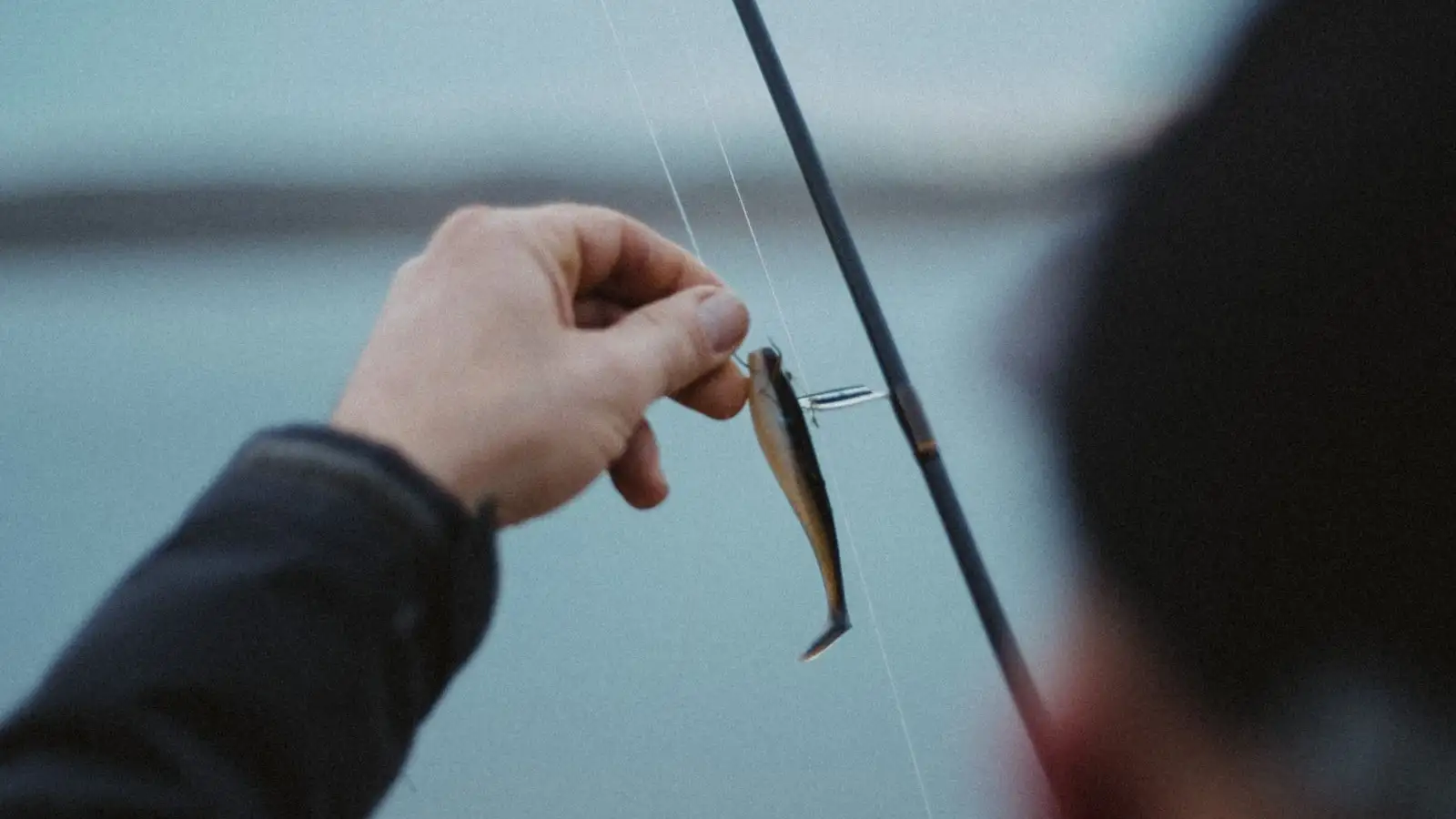
A spinning rod and a baitcasting rod wearing the same spec label are not the same tool with a different reel bolted on. Power, action, lure rating, and line rating describe how a finished rod behaves, and the two families finish the blank in nearly opposite directions: a spinning rod carries a long, steeply stepped guide train and usually a longer rear handle to tame coils coming off a fixed spool, while a baitcasting rod carries small, low guides and a trigger seat that feeds line back onto a revolving spool. Those hardware decisions move where the blank bends under load, where the rod pivots in your hand, and how much mass hangs out near the tip. The numbers stay identical. The machine under the numbers does not.
I keep a roll of masking tape on the bench for exactly this. Lay one of each down, both stamped medium-heavy, fast, three-eighths to one ounce, and run your thumbnail down the guide train of the spinning rod first. The stripper guide sits a good hand's width out past the foregrip, and the ring is wide enough to drop a fingertip through. It has to be. The line is leaving that spool at close to a right angle to the blank and arriving in loops, so the first guide's job is to catch and collapse them. Now do the same on the casting rod. The first guide is smaller than a dime and it has been pulled back toward the reel, because the line is already traveling roughly parallel to the blank and only needs steering, not catching.
That one gesture explains most of what follows.
The guide train is part of the taper, not an accessory
When I first started taping guides onto stripped blanks, I thought of guides as the part you add after the rod is designed. They are not. A guide train is a taper of its own, and it sits on top of the blank's taper and changes how the whole thing behaves.
On a spinning rod, every running guide between the stripper and the tip is still larger than what you would find in the equivalent spot on a casting rod. Larger rings mean more mass, and mass near the tip is expensive. It slows how fast the tip recovers after it unloads. So two rods that both read "fast" on the sticker can recover at noticeably different speeds, because one of them is carrying bigger rings on the last third of the blank. The spinning rod will not feel wrong — it will feel soft at the top compared to what the label promised, and that is the guide train talking, not the graphite.
There is a trade on the other side too. If a spinning rod's layout is too sparse, you hear it before you see it: a dry buzz on the forward cast, the line slapping the blank between the stripper and the next guide down. Fewer, bigger guides shed friction and add distance, but they let the line slap. More guides keep the line tight to the blank and quiet, but they add weight and drag on the cast. Baitcasting layouts mostly escape the slap problem because the line path is straighter, which is part of why casting rods can run nine or ten small guides without feeling over-dressed.
And the line path itself is a tax. On a spinning rod the line comes off the spool sideways, turns hard at the stripper, and then runs out. On a baitcaster it comes off the spool nearly in line with the blank and goes almost straight through the guides. Same lure weight, same blank, less energy lost to the turn. That is a big piece of why a casting rod can be stiffer and still cast comfortably.
Where your hand sits changes what "power" means
Park the reel on each rod and pick them up. This is the part that never shows up on the spec line.
A spinning reel hangs under the blank. A casting reel sits on top of it, right at the trigger seat, with your thumb resting on the spool. Your hand is the drag and the brake on a baitcaster whether you want it to be or not. That changes the pivot point of the whole outfit, and it changes what a "medium-heavy" rod feels like when a fish turns.
On a spinning rod the long rear grip gives you a lever for a two-handed cast and something to brace against when you lean into a hookset. On a casting rod that rear grip is usually shorter because nobody casts one two-handed, and the working lever in your hand is shorter as a result. So the same power rating translates into a different amount of leverage on the water. The casting rod tends to feel like it has more backbone low down, and some of that is real — casting rods are often built with a stiffer lower section because the typical use is winching fish out of cover — but some of it is just the geometry of where the rod meets your hand.
Rod balance falls out the same way. A combo that hangs level in your palm with a spinning reel underneath will feel tip-heavy with a casting reel sitting on top in a different spot. Neither rod is unbalanced. They are balanced for different hardware.
Same action rating, a completely different job during the cast
Action on a baitcaster is not a comfort spec. It is a functioning part of the cast.
A revolving spool only spins as fast as the rod tells it to. The blank has to load on the back cast and unload smoothly through the forward stroke so the spool accelerates with the lure instead of ahead of it. A rod that is too stiff for the lure weight will not load at all — you get a stabbing, jerky stroke, the spool overspeeds, and you spend the next two minutes picking out line. A rod that is too soft keeps loading after the lure has already left, the tip overtakes the spool, and you get the same result from the other direction. That is why baitcasting rods are so sensitive to the bottom of their lure rating. Drop below it and the rod punishes you immediately.
A spinning rod is far more forgiving down there. The fixed spool peels line off on demand, so a blank that is a little stiff for the lure still casts, and it does it without demanding that you feather anything with your thumb. The same underweighted lure that turns a baitcaster into a bird's nest will just fly a little flat off a spinning rod.
This is also why I ignore the waggle test in a shop for anything but the blank. Bouncing the tip tells you about the bend profile of the rod with no reel, no line, and no load on it. It cannot tell you how the rod will cast, because casting is a line-management event, not a bending event. Half the machine is missing when you wiggle it in the aisle.
How I compare them when I can't fish them first
If I only get a bench and a spec sheet, I read the guide train as a map of intent. Lots of small guides set close to the blank means the designer was chasing tip recovery and line control. Fewer, larger guides mean coil management and distance with less friction. Then I look at the rear grip length, because that tells me whether the rod expects two hands or one.
A static load test is useful but limited. Hang a known weight off the tip, measure the deflection, and you learn something honest about the blank — but you are measuring the blank plus guide mass, not the rod as it will actually cast. Two rods can deflect identically on the bench and behave nothing alike on the water.
The only honest comparison is the one where you swap the same reel and the same lure onto both rods and cast them. Failing that, compare within a type. A medium-heavy spinning rod against another medium-heavy spinning rod is a fair fight. A medium-heavy spinning rod against a medium-heavy casting rod is two different measurements that happen to share a font.
The label is a claim about a system, and a big chunk of that system is bolted on at the reel seat. Once you start reading guides and grip length instead of just the sticker, the spec sheet stops being a promise and starts being a description — one you can check with your own thumb.