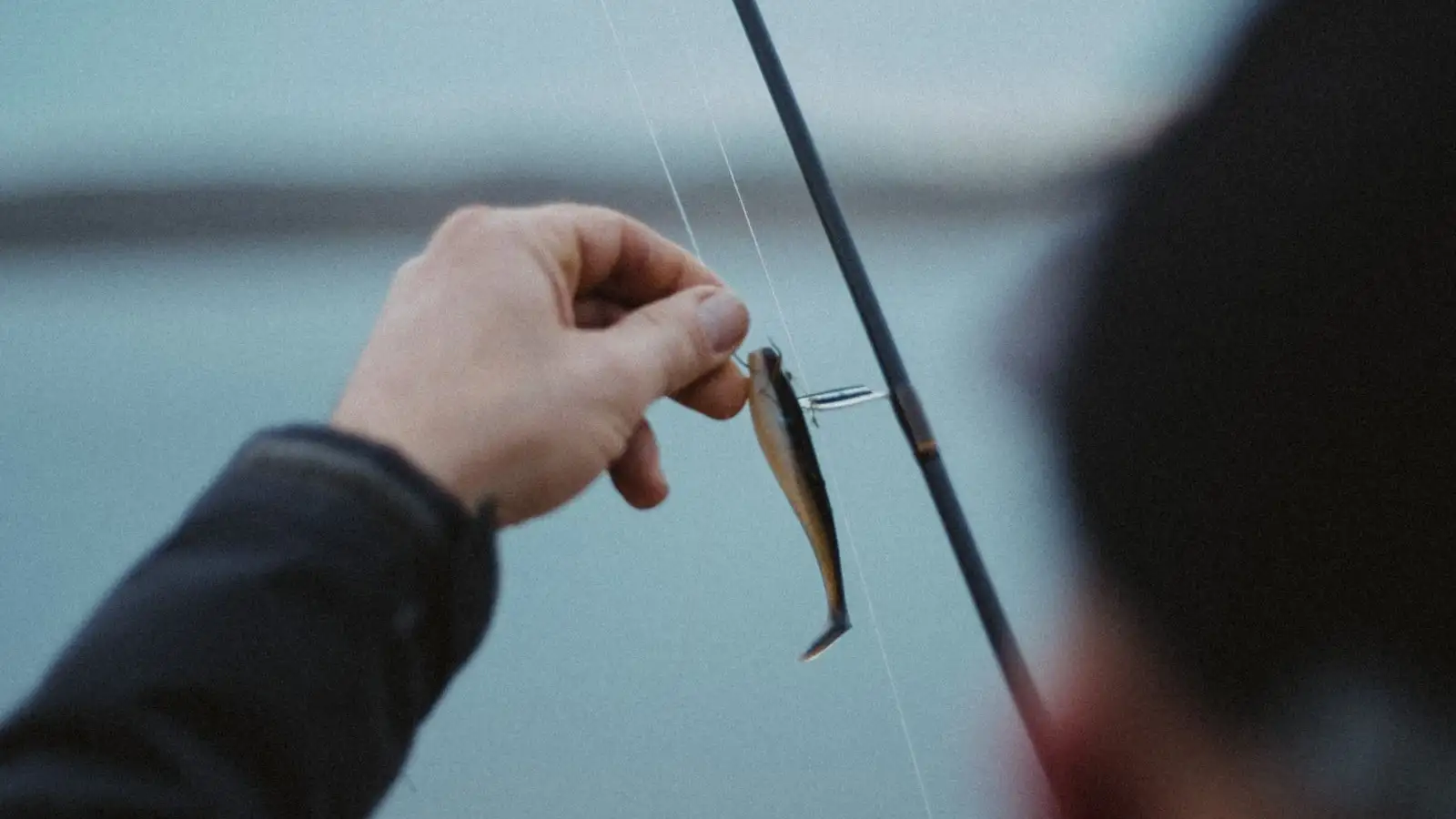
The difference between graphite and fiberglass comes down to which trade-off you are willing to live with, not which material is better. Graphite buys you less weight and more felt sensitivity, and it charges you in fragility. Fiberglass buys you toughness and a smoother, slower load, and it charges you in ounces and muted feel. A composite blank mixes the two deliberately, putting each material where its weakness hurts least. Power and action are set by the taper and the wall, not by what the blank is made of. So the useful question at the rack is never which blank is better. It is which cost your fishing makes you pay most often.
I do most of my thinking about this standing at a bench with a rack of unfinished blanks behind me, sighting down each one like a cue stick, checking for straightness and finding the spine. The first thing I do is not read the label. Labels are marketing and a modulus number. The blank in your hand is geometry and resin.
The tap test tells you more than the label
Butt in my left hand, thumbnail against the blank a few inches ahead of the grip. Graphite rings back at me: high, clean, and it stops almost as soon as I do. Glass answers with a low woody knock, and the sound hangs there a beat longer than it should. What I am listening for is not tone. It is how much the blank wants to keep moving after I stop pushing it. A blank that rings and quits is a blank that recovers fast. A blank that hums and wobbles is telling me the tip is going to lag behind my hand, and that is information I will use long before I ever tie on a lure.
Then the deflection. I hang a fixed weight off the tip and watch where the curve starts. That curve is the taper, and it has almost nothing to do with the material. I have bent graphite blanks that folded into the middle third and glass blanks that stayed stiff through the butt and only gave up in the last foot. Two blanks of the same material can be completely different rods. This is the part that gets lost when the conversation stays on graphite versus fiberglass. Material is one axis. Taper and wall are the other two, and they are doing most of the work.
Where the ounces actually show up
A glass blank does not feel heavy on a bench. It feels heavy at hour five, fishing slow with the tip up, working a lure you have to keep in contact with. Balance matters here too. A heavier blank with a reel seat set well forward can feel lighter in the hand than a featherweight blank with a long butt section behind the grip, because the weight is closer to your wrist instead of out past it. I have handled light blanks that fished heavy and heavier blanks that fished light, and the difference was where the mass sat, not what it was made of.
Modulus is a ratio, not a grade
Modulus describes stiffness relative to weight. Higher modulus means you can build the same stiffness with less material, which is how you get a lighter blank that still stands up. It also usually means thinner walls. Thin walls are less tolerant of the kind of damage a rod actually takes: a knock against a gunwale, a truck door, a dropped rod on gravel, a guide foot that takes a hit. A nick that would be cosmetic on a thicker wall becomes a stress riser on a thin one, and stress risers are where blanks break.
So higher modulus is not automatically better. It is a bet that you will not hit your rod on anything, and it is a bet a lot of anglers quietly lose. The honest version is that modulus is a number without a taper attached, and the taper is the thing you actually fish with.
Recovery is where the material really shows
Recovery speed is the tip returning to straight after a cast, and it shapes outcomes you can see. A slow-recovery blank is still unloading as the lure leaves, which opens the loop. On an open bank that costs you nothing. Flipping under a dock with wind on your casting shoulder, it is the difference between a lure that goes into the shadow line and one that clatters off a piling.
Hooksets run the other way, and this is the part I wish more people understood before they buy. Fast recovery drives a single hook home with less wasted tip travel, which is why graphite feels so sharp on jigs and Texas rigs and bottom contact in deep water. Slow recovery spreads the load out over a longer moment. That is exactly what you want with treble hooks on a moving bait, because a rod that keeps tension and gives a fraction of a second lets a soft-mouthed fish stay hooked instead of tearing loose. A glass crankbait rod is not a compromise because glass is cheap. It is a design choice that matches a slow, steady load to a bait that pulls back.
Sensitivity is a chain, not a material
What you feel through a blank is the sum of everything between the water and your hand. Blank, guide weight, guide train, thread, finish, reel seat, grip material, and how tightly you hold the rod. A high-modulus blank under a heavy grip and a fat guide train is a waste of money. A modest blank built clean, with light guides and a seat that leaves more of the blank exposed, will transmit more than a fancy blank buried under hardware. Builders know this because they feel it when they wrap: the blank does not get deafer, the build covers it up.
Power and action live somewhere else entirely
A blank's power is how much load it takes to bend it, and its action is where that bend lives. Neither one is a property of graphite or fiberglass. You can build a fast graphite rod and a slow graphite rod from the same material, and you can build a glass rod that is stiff and quick through the butt. When someone tells me a rod is fast because it is graphite, I know they are describing a label and not a rod.
What material does change is the texture of the feel. Graphite is crisper, more direct, more eager to unload. Glass is rounder, more forgiving, more willing to bend deep and come back slowly. Composite blanks exist because you can put glass where you want the forgiveness and graphite where you want the light, tight section. A glass butt with a graphite tip is not mediocre at both. It is a specific answer to a specific problem, and it fishes like one.
Picking for the lure, not for the material
I work backward from what is tied on. Treble-hook moving baits, crankbaits, topwater, and anything I want the fish to eat and turn with: slow recovery, moderate action, glass or composite, and I will carry the ounces. Single-hook soft plastics, jigs, and bottom contact where I need to feel a tick through braid at depth: graphite, faster recovery, less weight in the tip so the feel does not get smothered. Long casting days with a sore shoulder: lighter wins, no argument needed. Fishing around rock, dock pilings, and the gunwale of a boat: durability starts to outrank sensitivity, because a rod that is in the truck is worth more than one that is in the shop.
One last honest thing. The word on the label covers an enormous range. There is glass that is heavy and dead and glass that is light and lively, and there is graphite that is brittle junk and graphite that takes real abuse. You cannot sort that out with a spec line. You sort it out by tapping the blank, bending it against a fixed weight, and noticing how it feels when it comes back. That is the whole test, and it is the same test whether the blank cost a lot or a little.
Every blank makes you pay for something. The builders I know are not looking for the one that charges nothing. They are looking for the one whose bill they are happy to cover.