Baitcasters backlash even when the brakes are set right because braking systems only govern the spool during the fast opening of the cast. They cannot slow a spool that a jerky rod stroke has already whipped past the speed the lure needed, and they cannot follow a lure that suddenly decelerates into a headwind or at the water's surface. Spool tension takes the side-to-side play out of the spool and adds a constant drag, which makes it a setup value rather than a cure. The last brake is the thumb, and it has to come on progressively as the lure descends, because the failure happens at the very end of the cast, the one moment no brake dial can see coming.
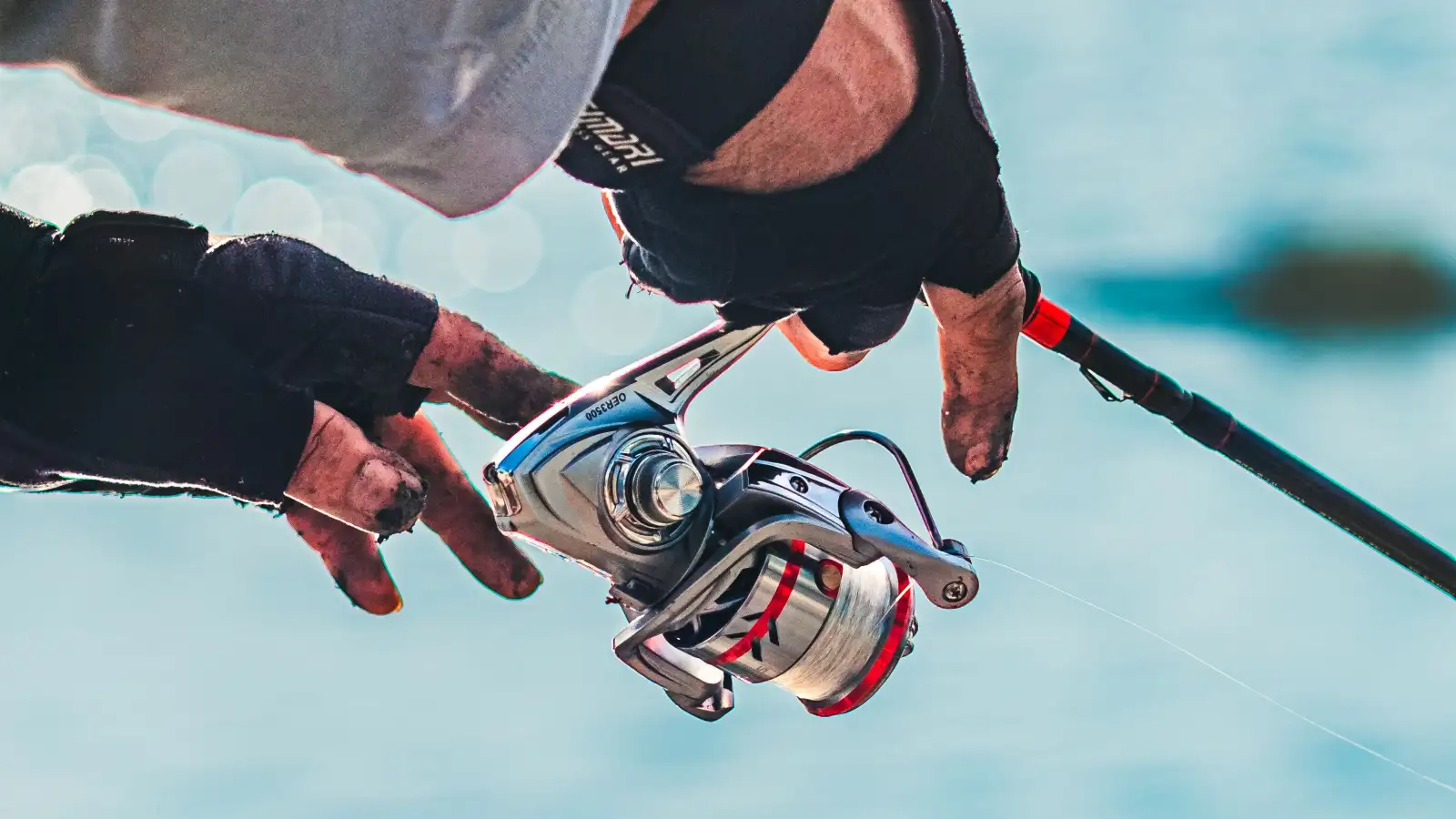
I want you standing on the bank next to me for the last three feet of the cast, because that is where the whole thing is decided. Rod loaded, pad of your thumb resting on the spool, a quarter-ounce lure on its way out. You hear the spool coming off the line: a rising whine that flattens out as the lure tops its arc and starts down. Then the lure hits the water with a small splash. Now listen to what happens after the splash. If the whine runs one beat longer than the splash, the line has stopped paying out and the spool has not, and you are already spooled into a bird's nest. It took less time than it takes you to decide to move your thumb. That is the entire problem in one sound.
What the brake dial actually does
Magnetic and centrifugal brakes work on the same principle. They resist the spool harder when the spool is spinning faster. Centrifugal brakes do it with sliding weights that fling outward against a drum as the spool turns. Magnetic brakes do it with eddy currents generated as the spool's aluminum ring passes through a magnetic field. Either way you get a speed-dependent drag curve: a lot of braking at the instant of release, almost nothing by the time the lure is settling down toward the water.
That shape is right for the opening of the cast, when the spool is trying to spin up faster than line can leave it. It is the wrong shape for everything after that. A brake cannot tell the difference between a spool spinning fast because the lure is flying fast and a spool spinning fast because you snapped the rod and the lure is hanging at the top of a sloppy loop. It also cannot tell whether the lure is still pulling line or has already landed.
And no brake setting fixes a jerky casting motion. Load the rod by hammering it rather than letting it bend and unload, and the spool gets a hard spike of energy at the same time the lure does, except the lure has air drag on it and the spool does not. You end up chasing that spike with the dial all day and nothing feels right, because the input changed every cast.
Spool tension is a setting, not a solution
The tension knob on the side plate squeezes the spool shaft. It takes out side-to-side play and adds a constant friction that does not care how fast the spool is turning. The usual setup is to put the reel in free spool and let the lure hang, then tighten until the lure falls slowly and the spool stops when the lure stops. That is a reasonable starting line.
What it is not is a proportional brake. A constant drag heavy enough to save you at the end of the cast is heavy enough to cost you distance on every cast. Set it tight and you are throwing into a headwind you built yourself. Set it loose for distance and you are back on the thumb. I run mine as loose as the spool will tolerate without lateral wobble, and I do not try to tune backlash out with drag. Side play is its own problem with its own fix.
Why the failure lands at the end
There are two families of backlash and they need different answers.
The start-of-cast blowup gets all the attention. The spool gets ahead of the lure right off the rod tip, usually from a jerk, an over-load, or a lure weight the brake setting was never matched to. Brakes do most of the work here, but the thumb still has to be there for the first beats to smooth the spike.
The one that catches people who already have their brakes dialed is the end-of-cast overrun. The lure loses energy to air on the way down, a headwind takes more of it, and then the lure touches water and stops. The spool, carrying all its stored rotation, does not know any of that happened. It keeps paying out line the lure is no longer taking, the slack overruns, and the loose loops catch the next layer coming off the spool.
The shape of the mess tells you which one you got. End-of-cast overruns sit high on the spool as loose, wide loops, because the spool was turning comparatively slowly when it started feeding slack. Start-of-cast overruns drive deep and tight, small loops buried under clean line. Check the next one instead of just picking it out. It tells you which variable to move.
The thumb is a brake with a pressure curve
Your thumb is the only brake on the reel that can react in real time, and it is the only one that knows where the lure is.
Keep the pad of your thumb in contact with the spool the whole cast. Hovering feels safer and it is not. Whatever time it takes to bring your thumb down from a hover is longer than the event you are trying to stop.
Here is the curve. Light feather at the release, just enough to take the edge off the spike and to feel the line leaving. Ease off to almost nothing through the middle of the flight, where the lure is at its fastest and the brake is already doing its share. Then, as the lure descends toward the water, start adding pressure progressively. Not a clamp. A squeeze that builds. By the time the lure touches, you want to be already on the spool, so that the stop happens because you were there, not because you reacted.
You can feel most of this through your thumb and the rod together. The pitch of the spool drops as the lure slows, and the vibration of line coming off changes with it. That drop in pitch is your cue. Everything after it is too late.
Building the timing on purpose
Pick one lure weight, one rod, one calm morning, and do not change anything for the whole session. The single biggest reason people never develop the loop is that they show up with four lures and a wind, and every cast teaches them something different.
Start close. Fifteen feet, sidearm, low casts with the thumb riding the full flight and deliberately stopping the spool a fraction before the lure lands. Then push out to thirty, then forty, then full distance. You are not practicing accuracy. You are practicing the loop between feel and response.
When you do change something, change one thing. Moving to a heavier lure means redoing the free-spool drop test at the new weight and expecting both your release and your last-third pressure to be different. Heavier lures hand the spool a harder kick at the start and land with more authority, but the timing window shifts, and habits built on a quarter-ounce will not carry to a half-ounce.
Then bring the wind. A headwind is the worst of them, because the lure decelerates in mid-flight exactly where the brake is already fading. Add thumb earlier and heavier, snug the tension a touch, and keep the cast low. A crosswind pushes the lure sideways and changes the line angle to the rod; shorten up and keep it flat. A tailwind rarely spools you, but the lure arrives fast and hot, so you still need the stop.
Only after the thumb can feel the end of the flight coming should you start backing the brakes down for distance. A light brake setting plus a thumb that knows the flight is a faster, longer cast than a heavy brake setting and no thumb. The heavy setting just hides the fact that you have not learned the cast yet.
When it goes wrong anyway
Recognize the failure before you fix it. If it is a light overrun sitting on top, thumb the spool hard, strip a few feet of loose line, and it usually comes clean. If it is buried, do not go at it with a hook point. Reel up against light tension and cut it if it will not release, because picking a tight nest with a sharp point is how you scratch a spool and lose an hour.
And when you do clear it, do not just tighten everything. Look at the shape of what you pulled out, decide whether it was a start-of-cast or end-of-cast overrun, and move that one variable. The brakes and the tension knob set the frame of the cast. The thumb is the cast. Once it knows the shape of the flight, you will run the brakes lighter, throw farther, and only really feel the spool in the last second, which is exactly when you want to feel it.