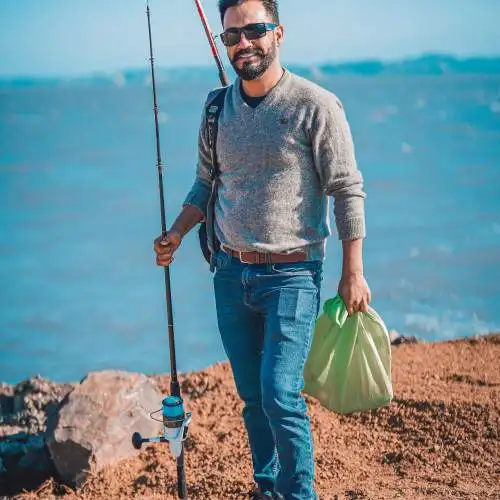
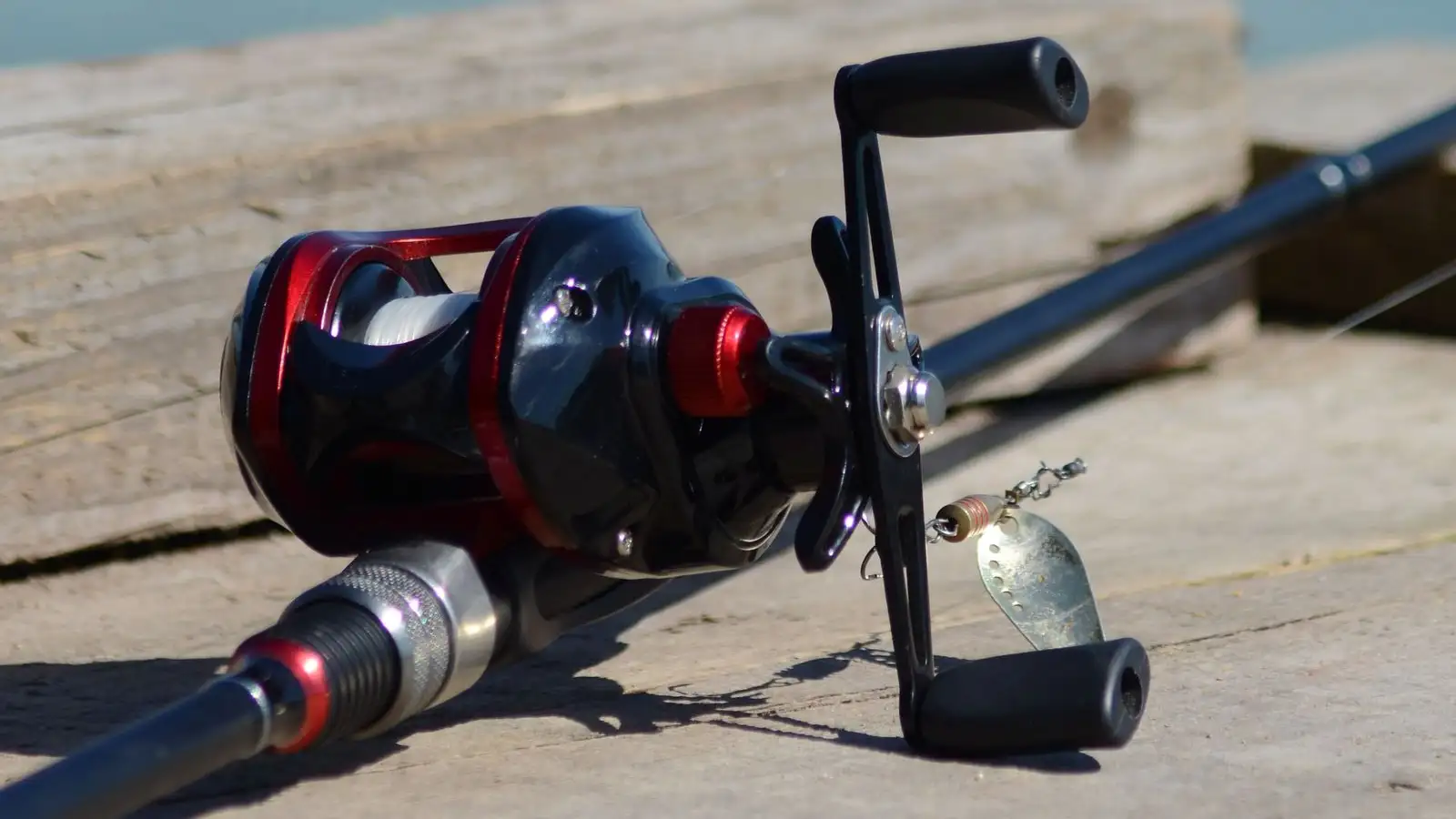
Match the stroke to your body position and the airspace around you, not to your mood or the lure: overhand only when the rod has clear room to load in a straight line behind you, sidearm when branches or wind sit in that arc, pitching when the target is close and the water is quiet, and flipping when you are near enough that the line never has to leave your hand. The cast is a solution to a geometry problem. Distance is what falls out of it.
I spent a good stretch of my early baitcaster years thinking of those as flavors. Overhand was the real cast, the one you practiced in a field; sidearm was the sloppy one you used when you were showing off; pitching was for people who couldn't cast far. That framing cost me fish and a fair amount of monofilament.
Here's the moment it changed. You're sitting on the front deck, trolling motor on low, wind walking you down a bank toward a willow whose lowest limb hangs maybe four feet off the surface. Under it there's a brush pile — you only know it's there because one bleached branch sticks out of the water like a knuckle. You've got thirty feet to cover and no more. If you stand up and go overhand, the rod loads beautifully, the lure climbs, and the limb eats it. So you don't stand. You keep your seat, drop your elbow against your ribs, rotate the reel until the spool is facing the water sideways, and the rod travels flat instead of up. The lure leaves at knee height, slips under the limb, and ticks into the water two feet from the brush. Nothing about that cast felt like technique. It felt like the only option the seat and the tree left you.
Three things I check before I pick a stroke
I look behind my shoulder first, because that's where the rod has to go. An overhand cast works by loading the rod in a straight line behind you — the tip travels back, the blank bends against the weight of the lure, and the whole thing unloads forward. Take that line away, and you don't have a slightly worse overhand; you have a snag waiting to happen. A willow behind you, a pontoon rail, a fishing partner's hat, a steep clay bank — any of those kills it.
Second, I look at the ceiling. Not just the branches I can see, but the ones I'd have to arc over and the ones I'd have to arc under. A high, lobbing trajectory is the least accurate trajectory there is, because every inch of extra height amplifies whatever error my release point already had.
Third, distance. Under about twenty-five or thirty feet, a full casting stroke is mostly a waste of motion and a good way to spook everything in the neighborhood.
Those three answers pick the stroke for me before I've thought about it as a choice.
When the sky behind you is clear
The overhand cast earns its reputation in open water, and it earns it honestly. Maximum distance, straight-line load, the lure leaving on the rod tip's path. If I'm on a main-lake flat, or throwing along a riprap bank where I can back off the rocks, or working a point with nothing but air behind me, that's the stroke. It's also the one I want in my hand when the wind is at my back and I need to punch through it rather than around it.
What most people skip is the positioning part. An overhand cast is a decision about where the boat sits. If I want to throw overhand at a laydown, I don't stand where the tree forces me into some improvised thing — I move the boat until the tree is in front of me and the air is behind me. On the bank, that means walking twenty yards to get a clean backcast instead of fighting the one spot you stopped at. The cast is available or it isn't, and where you put your feet is what decides.
When the airspace closes in
The sidearm cast exists because the world has low ceilings. Keep the rod roughly parallel to the water and the lure travels flat, a couple of feet off the surface, all the way to the target. Under overhanging limbs. Under a dock. Along a bank where the brush leans out over the water and the fish are pinned underneath it. It's also the stroke I reach for when the wind is crossways, because a flat lure doesn't get pushed around the way a high one does.
What I gave up for that is height, and height is sometimes the only way over something. Sidearm into a headwind at distance is a mess — the lure runs out of energy before it runs out of line, and you get a soft, short, splashy landing. It's also less forgiving of a bad release, because a flat trajectory has less room to correct itself. I use it where it fits, not everywhere.
Pitching: the quiet close shot
Pitching is a short underhand motion — the lure swings back low beside the boat and comes forward underhand, no full back cast, minimal rod travel. The point isn't distance. The point is that nothing announces the lure's arrival: no big loop of line in the air, no lure slapping down from three feet up, no rod waving over the fish's head.
I pitch when I'm working a bank at maybe fifteen to thirty feet, when the water is shallow enough and clear enough that a fish will notice a bad entrance. The motion is mostly wrist and forearm, and the reel stays low, close to the water. It's the stroke I use most in a boat that's drifting toward cover, because it doesn't require me to stand up or turn around or find room I don't have.
From the bank, pitching gets harder for a simple reason: you're usually higher off the water than a boater, and a high release point makes the underhand motion steeper and less precise. You can still do it, but you're pitching down at the water rather than across it, and the lure enters sharper. It works; it just isn't the same shot.
Flipping: when the line doesn't leave your hand
Flipping is the end of the line, literally. You strip a fixed amount of line off the reel — enough to reach the target and no more — and let the lure pendulum off the rod tip, then swing it forward and let the line run back out through your fingers as the lure drops. The lure goes almost straight down into the cover. There is no cast, in the usual sense.
This is the stroke for when you're right on top of the fish: a foot or two of water separating you from a dock piling, a clump of grass, a rock you can see the edge of. It's quiet, it's accurate to inches, and it keeps the lure in the strike zone instead of flying over it.
The tradeoff is that flipping demands proximity, and proximity is a problem in clear, shallow water where the fish can see the boat. It also puts a premium on line management, because a backlash on a flip is a small catastrophe — the lure is already at the target and now you're standing there with your thumb buried in a bird's nest while the boat drifts off the spot.
The stop is the whole cast
Every one of these strokes ends the same way: the rod tip stops at the target line. The lure leaves when the tip decelerates, and the tip's path at that instant is the trajectory. Follow through past the target and the lure launches low and flat and lands short and left or right of where you wanted it. Stop the tip where you want the lure to go, and the lure goes there.
That's why accuracy is a stopping skill, not a throwing skill. I don't aim with my arm. I aim with the place where the rod quits moving.
The other half of it is smoothness. A casting stroke should build — slow at the start, faster through the middle, then a clean stop. When I get lazy and punch at it, the spool spins up faster than the lure can pull line off it, and the line fluffs before the lure ever leaves the rod. My thumb can save some of that. It cannot save all of it, and squeezing harder only makes the whole stroke worse.
The switch is where you backlash
Here's the part nobody told me, and the part I'd want you to take with you. My worst backlashes almost never happen during a stroke. They happen in the half second between strokes — when I go from three overhand casts at a point and then turn and sidearm under a limb without resetting my thumb.
The reel is set for the cast you just made. Change the arc, change the launch angle, change how much spool speed the lure can absorb — and the brake and your thumb are now calibrated to a different cast than the one you're throwing. It usually shows up as a small fluff instead of a full nest, but that's luck. Give it a slightly jerkier stroke on the transition and you'll be picking at it with a hook point for ten minutes.
So when I change strokes, I consciously slow the first one down. One lazy, safe cast to recalibrate my thumb, then back to business. Costs me four seconds. Has saved me whole fishing days.
The last thing I'd say is that you'll use all four in an hour, on the same stretch of bank. The tree in front of you doesn't care what you practiced in the field. What decides which stroke you throw is where the boat sits, where your feet are, and how much air the world is willing to give you.