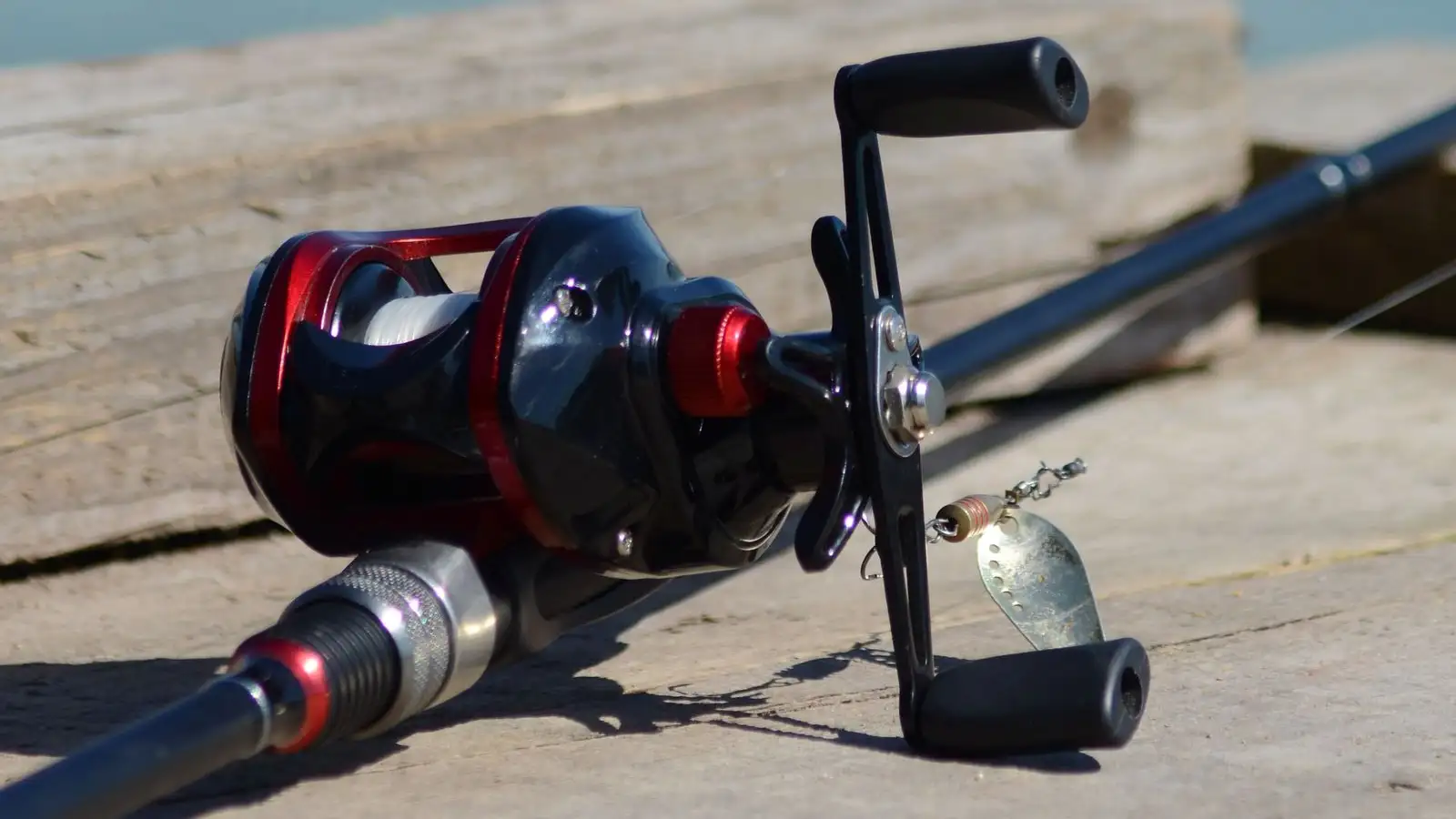
The backlash you get is a late thumb, not a bad reel or the wrong brake setting. The spool has to be feathered from the moment the rod loads, with pressure that builds as the lure loses speed, and it has to be stopped before the lure touches the water instead of clamped down after the splash. Brake settings only change how hard the spool fights you. The thumb is the only part of the system that knows where the lure actually is.
Stand beside me on a flat rock above a tailout, rod cocked, a quarter-ounce weight hanging a foot off the tip. Watch my thumb, not the reel. The cast leaves, the weight climbs, and for most of a second my thumb does almost nothing — it just rests on the spool, feeling it hum through the pad. Then the weight tops out, the line begins to bow, and my thumb closes in a slow squeeze that finishes with the weight still hanging in the air. It never gets to land on its own. That is the whole trick, and it took me two seasons of picking at nests to find it. Every backlash I ever earned came from those same two beats done in the wrong order: doing nothing while the spool was already ahead of the lure, then doing everything after the damage was already done.
The spool runs on a different clock than the lure
The spool is bolted to the rod. The lure is not. When the rod unloads, the spool starts spinning almost instantly because your stroke drove it directly, but the lure has to accelerate over the whole length of the rod's travel, and it keeps speeding up until the line stops pulling on it. Those two acceleration curves do not match, and the gap between them is where backlashes are born.
With a smooth stroke the gap stays small. With a snapped stroke the spool is at full song while the lure is still getting going, line goes slack between the spool and the first guide, and slack line on a spinning spool turns into loops. That is the early backlash, the one that shows up in the top third of the cast and gets blamed on the wind or on the reel. It is not the reel. The thumb was late by a quarter of a second at the launch.
Then there is the late one, the one in the title. The lure reaches the water, stops dead, and the spool keeps going because nothing told it to stop. The line between them has nowhere to go, so it goes backward over the spool flange. Same failure, different end of the cast, same cause: the thumb responded to something that had already happened.
Feathering is a curve, not a switch
Most people I fish with treat the thumb like a pedal with two positions, off and hard. That is why their casts come out either short or violent. Real feathering is a curve that roughly mirrors the lure's deceleration.
At the launch your thumb should be in contact but nearly weightless — enough to feel the spool, not enough to slow it. Through the middle of the flight the lure is at its fastest and the spool is mostly keeping up, so your thumb just rides along and reads the hum. Past the top of the arc the lure starts losing speed and the spool does not, and that is where pressure begins to build. Not all at once. A squeeze, progressive, so that by the time the lure is coming down your thumb is doing real braking work.
Clamp and release instead, and two bad things happen. The clamp spikes spool speed down, then the spool recovers and overspeeds again, so you have created a second and worse mismatch in the middle of the flight. And the release tells your hand the cast is over when it is not. Feathering is not a safety net you deploy at the end. It is active braking for the whole flight, heaviest in the last third.
Stop the lure in the air, not on the water
Here is the piece that changed my casting more than any reel adjustment ever did. The splash is not your cue. By the time you hear it, the spool has already turned past the point where the line can recover, and the loops are already laid.
So do not let the lure land. Arrest it. Through the last stretch of the cast you squeeze the spool down until the lure is hanging in the air a hand's width above the surface, and then you ease off a touch and let it drop. Instead of a lure that stops on contact and drags the spool with it, you get a lure that was already stopped before it touched anything.
The side benefits surprised me. The lure enters quieter, which matters over shallow, spooky water. Accuracy improves, because you are controlling the endpoint instead of guessing at it. And your thumb starts treating the last two feet of every cast as its own phase, separate from the rest of the flight.
The stroke that builds the nest before the lure leaves
You can do everything right with your thumb and still fight the spool if your stroke is a snap. A hard, sudden punch spikes rod speed at the very beginning; the spool follows instantly while the lure is still loading. Now your thumb is fighting a spool that is already ahead, and no amount of pressure over the first twenty feet fully undoes that.
A stroke that builds — slower start, hard through the middle, clean stop — keeps the spool and the lure closer together. The thumb has less correcting to do and the cast feels like it is on rails. When someone tells me their reel backlashes no matter what they try, I usually watch them cast and find the problem in the first six inches of rod travel rather than in their thumb or their brake dial.
Where the thumb sits, and what it watches
Press flat, centered, with the pad across the middle of the spool. Not the tip of the thumb, not the corner. Ride one edge and you are putting a side load on the spool, which tilts it on its shaft. You get uneven line lay, and worse, the feedback coming through your thumb stops being an honest reading of spool speed. Now you are braking with a hand that is getting bad information.
The other half is where your eyes go. They belong on the lure, not the reel. Watching the spool tells you what already happened. Watching the lure tells you what is about to. Stand in the yard with a hookless weight and cast at a bucket, eyes glued to the weight for the entire flight, never down at the reel. The first fifty casts feel blind. Somewhere after that your thumb starts arriving early without being told, because it has finally learned to predict the arc instead of reacting to the splash.
When the thumb is not enough
I will not pretend this solves everything. Casting a light lure into a real headwind, the lure decelerates hard and early, and even a well-trained thumb is doing emergency work from the first foot of the flight. In that condition the honest answer is to shorten up and flatten the arc — a low, punched cast that gets there fast — rather than to try to thumb a high, floaty lob into moving air. Accept less distance. That is the trade.
There is also a limit that has nothing to do with the thumb. An overfilled spool, or mono that has sat through a hot summer and taken a set, will nest no matter how good your timing is. That is line management, not casting mechanics, and practice will not fix it.
And to be clear about the dial: brakes help. But a brake setting is a curve you choose before the cast, and the lure's flight is a different curve every single time. The thumb is the only brake in the system that updates in real time. Set the reel so it is not actively fighting you, then leave it alone and teach your hand to follow the lure.