A fish that swims away has not necessarily survived. The real danger is not the hook — it is what happens between the net and the release. The grip, the support under the body, and the revival sequence determine whether that fish is alive the next morning. Hook design matters, but it is secondary. A fish killed by handling is dead regardless of how carefully the hook was set.
The Fish That Leaves Strong
When the handling system is applied correctly, a released fish rights itself instantly, holds a level attitude, and swims off with steady tail beats. The jaw hinge is intact. There is no pale, filmy slime damage along the flank. The gills are not bleeding. The fish dives into cover under its own power — not drifting sideways in the current.
The Complete Catch-and-Release Handling Checklist
- Rig barbless hooks or inline circle hooks before you start fishing.
- Land the fish in under two minutes using tackle matched to the expected size.
- Keep the fish in the water, horizontal, from the moment it reaches the net.
- Wet your hand before touching the fish; grip the lower jaw lip (for non-toothy species) or support the belly with a flat palm.
- Remove the hook while the fish stays in the net, in the water.
- Revive the fish facing into a gentle current until it kicks free.
- Release only when the fish can swim against light hand pressure.
Rig Before You Cast: Barbless and Circle Hooks
Switch entire setups to barbless trebles, barbless single hooks, or inline circle hooks. A barbless point slides out of tissue with minimal tearing, cutting unhooking time to a few seconds. Circle hooks lodge in the corner of the mouth far more often than deep in the gullet.
Typical time to swap: under two minutes per rod at the bench. The mistake that persists is crimping the barb only partway. Even a small remnant spur still rips flesh on removal. File or pinch the barb completely smooth — a fingernail run across the bend should catch nothing.
Fight Time That Keeps Lactic Acid Low
A fish played to exhaustion accumulates lactic acid to lethal levels. The fix is deliberate: use gear heavy enough to bring the target species to hand within 90 to 120 seconds. That means no ultralight trout rod on a 4-pound smallmouth; the thrill of a long fight costs the fish later.
The chronic error is choosing tackle for the sport rather than the survival — intentionally under-gunning the setup so the fish runs longer, then releasing it while the fish is already in physiological crisis.
Water-Level Horizontal: The Only Safe Orientation
A fish held vertically by the jaw suffers two injuries that often prove fatal. First, the jaw hinge can dislocate or tear, leaving the fish unable to feed after release. Second, internal organs unsupported in air shift downward against the spine and abdominal wall — a compression injury that shows up hours later. The rule is strict: never lift a fish out of the water unless it is fully supported horizontally.
In the net, keep the fish in the water. For a quick measurement or hook removal, lift just enough to expose the mouth while the belly and tail remain submerged. The common wrong approach — the hero shot with a largemouth hanging from a dry hand, body vertical, jaw cranked open — turns an otherwise healthy release into a dead fish swimming.
The Grip That Protects Slime and Structure
Before any contact, wet the hand. A dry palm strips the slime coat — the fish’s primary barrier against infection and parasites — in one pass. For species without teeth, the cleanest grip is a thumb inside the lower jaw lip, index finger supporting the outside, with no squeezing. The fish hangs from the lip naturally, but the body must still be supported by the other hand under the belly.
For toothy fish, pike, or muskie, skip the lip entirely. Use a flat palm under the belly, fingers gently cradling the pectoral area, while the head rests in the water. The most common mistake is grabbing behind the gill plates or squeezing the midsection. Gill tissue tears instantly under pressure, and an internal grip crushes organs.
Unhook Without Leaving the Water
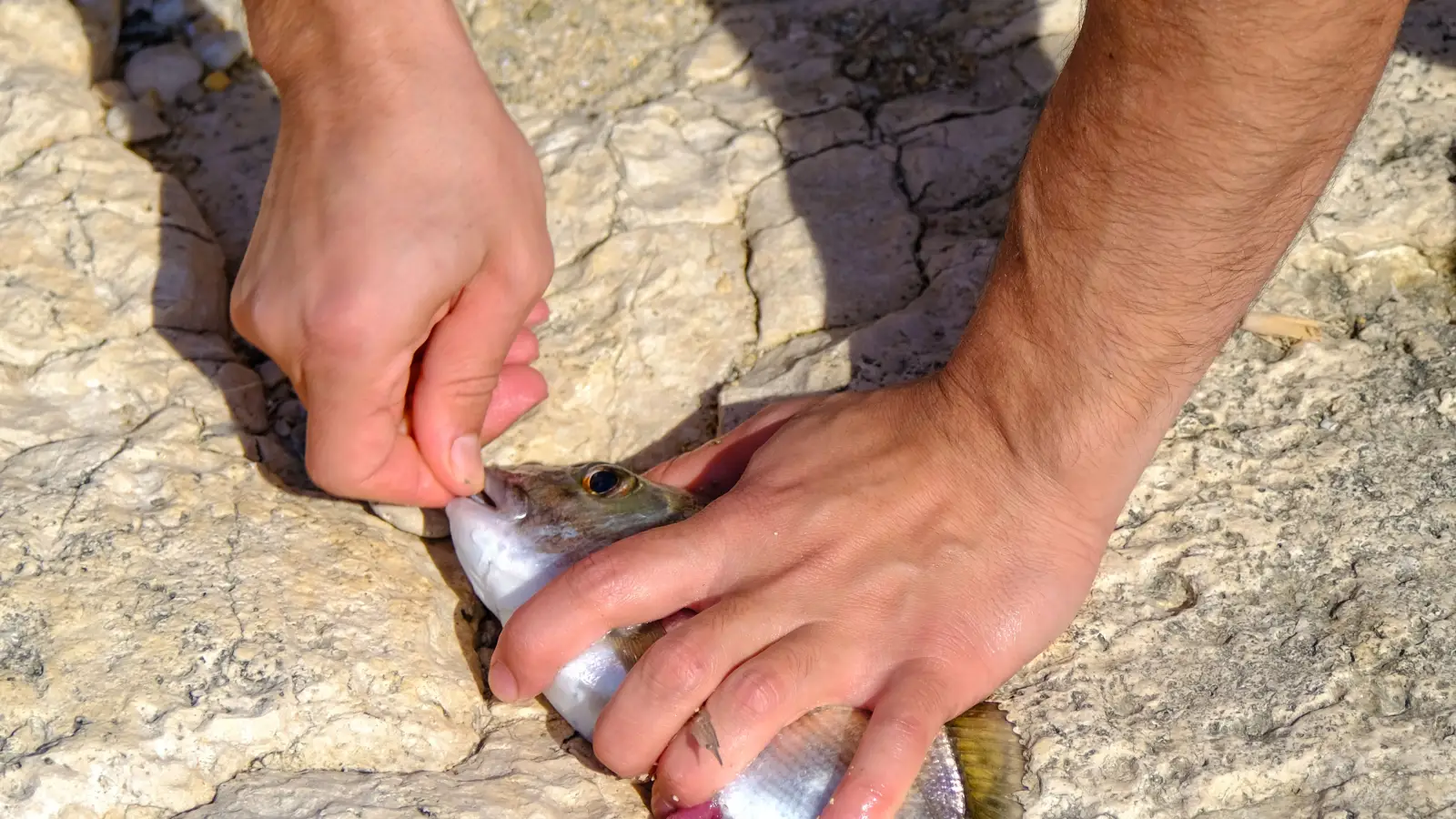
Removing the hook while the fish stays inside the net in the water cuts handling time and slime damage. Use long hemostats or pliers to back the hook out in the direction it entered. If the hook is deep, cut the line close and leave it — a barbless hook is often shed within days.
This step takes 10 to 30 seconds with a barbless setup. The persistent mistake is lifting the fish onto a boat deck or dry shore for unhooking. Every second in air adds stress and dries the gills, and a thrashing fish on a hard surface loses even more slime.
Revival That Restores Equilibrium
After the hook is out, hold the fish upright in slow current, facing upstream. Let the water flow naturally over the gills — nothing forced. Do not pump the fish forward and backward; that pushes water in the wrong direction and exhausts the fish further.
Revival duration runs from 30 seconds to several minutes, depending on fight length and water temperature. The signal that it is ready: the fish begins to push against the grip, tail beats grow stronger, and the dorsal fin stands up. The common wrong move is releasing too early because the fish twitched once. Wait until it can swim against light pressure from the hand.
Release Only When the Fish Controls the Move
As the fish gains strength, loosen the grip slightly. The fish should pull away under its own power. If it lists to one side or sinks, resume revival immediately. A fish that drifts off sideways or belly-up needs more time, not a push into the depths.
Final Verification: Before You Let Go
- Fish is fully horizontal and upright in the water.
- Gills are moving evenly, not flared or clamped.
- No patches of cloudy or missing slime on the body.
- Tail beats are steady and powerful against water resistance.
- Fish swims down and into cover, not sideways or upward.
Print This Checklist and Keep It in Your Tackle Bag
The handling sequence is repeatable for largemouth, smallmouth, trout, redfish, and most freshwater and inshore game fish. Print the checklist in a small font, laminate it, and store it with your landing net. Before each release, run down the three core checks: wet grip, horizontal hold, current-facing revival.
FAQ
Why do fish die after swimming away from a release?
Most delayed deaths come from handling injuries, not the hook wound. A torn jaw, crushed internal organs, or stripped slime can kill a fish hours or days later. Exhaustion from an overlong fight builds lactic acid that the fish cannot clear quickly, leading to cardiac arrest even after it swims off.
How long should you revive a fish?
There is no fixed clock, but most fish recover in 30 seconds to a few minutes. The key marker is when the fish begins actively pushing against your grip. In cold water, recovery takes longer; in warm water, oxygen levels are lower, so revival must be steady but never rushed. Stop only when the fish swims away under its own power.
Does holding a fish by the jaw really kill it?
Yes — particularly for fish over three pounds. A vertical jaw hold dislocates the lower jaw hinge and can tear the isthmus, leaving the fish unable to close its mouth or feed. Internal organs also sag and compress in air. Always support the body horizontally when the fish leaves the water, and minimize air exposure to seconds.
What kind of net is safest for catch and release?
A rubber or silicone-coated knotless net. These materials do not scrape off the slime coat the way nylon mesh does, and hooks rarely tangle in the netting. A rubber net also lets you keep the fish submerged during unhooking, cutting the time the fish spends out of its element.
Do barbless hooks really make a difference?
They make a substantial difference. A barbless hook removes faster, causes less tissue tearing, and if a fish throws the hook during the fight, the wound is smaller and heals quicker. Many fisheries studies correlate barbless hooks with higher survival rates, but the effect is magnified only when combined with the handling steps above — a barbless hook cannot rescue a fish that was asphyxiated on a boat deck.
What Changes When You Handle Right
A fish released with the proper grip, minimal air exposure, and a patient revival behaves differently: it immediately rights itself, powers away, and stands a real chance. The biggest difference next time is preparation, not technique. Pre-rig rods with barbless hooks, have a rubber net open and ready before the cast, and keep pliers in a pocket where you can reach them one-handed. Fix those three gear items once, and the entire handling sequence will run 30 seconds faster every time.