You pull in a sunfish that has a dark spot and a flash of orange on its gill. You’re sure it’s a bluegill, but a more experienced angler at the ramp calls it a redear. This kind of mix-up is far from rare—the five pairs here trip up anglers more than any others. But each pair has a single, reliable field mark that clears things up in a second. No guesswork needed.
The Number One Mix-Up: Bluegill vs. Redear Sunfish
If there’s one confusion that outnumbers all others, it’s bluegill versus redear sunfish. The feature you can trust every time is the gill flap. Redears show a red or orange crescent on that tab; bluegills have a solid dark flap with no crescent. Once you learn to glance at the ear, you’ll rarely misidentify either species.
At-a-Glance Distinguishing Marks for All Five Pairs
| Similar-Looking Pair | The Quick-Check Difference |
|---|---|
| Bluegill vs. Redear Sunfish | Dark spot on soft dorsal fin + red/orange crescent on gill flap = Redear; solid black gill cover with no crescent = Bluegill. |
| Smallmouth vs. Spotted Bass | Jaw extends past eye + smooth cheek scales = Smallmouth; jaw ends before or at eye + rough cheek scales = Spotted. |
| White Crappie vs. Black Crappie | 5–6 dorsal spines and vertical bars = White; 7–8 spines and scattered spots = Black. |
| Channel Catfish vs. Blue Catfish | Rounded anal fin and often spots on body = Channel; straight anal fin and no spots = Blue. |
| Walleye vs. Sauger | White tip on lower tail fin + dark blotch at rear of first dorsal fin = Walleye; no white tip + distinct saddle blotches and spotted dorsal fin = Sauger. |
Bluegill vs. Redear Sunfish: The Gill Flap Tells All
You’re not alone if these two have fooled you. They share the same flat shape and often the same brassy hue. But the ear flap is the deal-breaker. On a bluegill, the entire opercular tab is black or very dark—sometimes edged with a faint blue or purple line. On a redear, that same flap carries a red or orange crescent. Even on a young fish where the color looks faint, it’s there if you look closely once the fish is a few inches long.
A back-up clue sits on the dorsal fin. Bluegill carry a dark blotch at the front base of the soft dorsal fin; redear have that blotch farther back toward the rear base. Still, the ear flap is the first thing to check. It stays visible whether the fish is in your hand, in a livewell, or still swimming beside the boat.
Smallmouth vs. Spotted Bass: Jaw Length and Cheek Scales
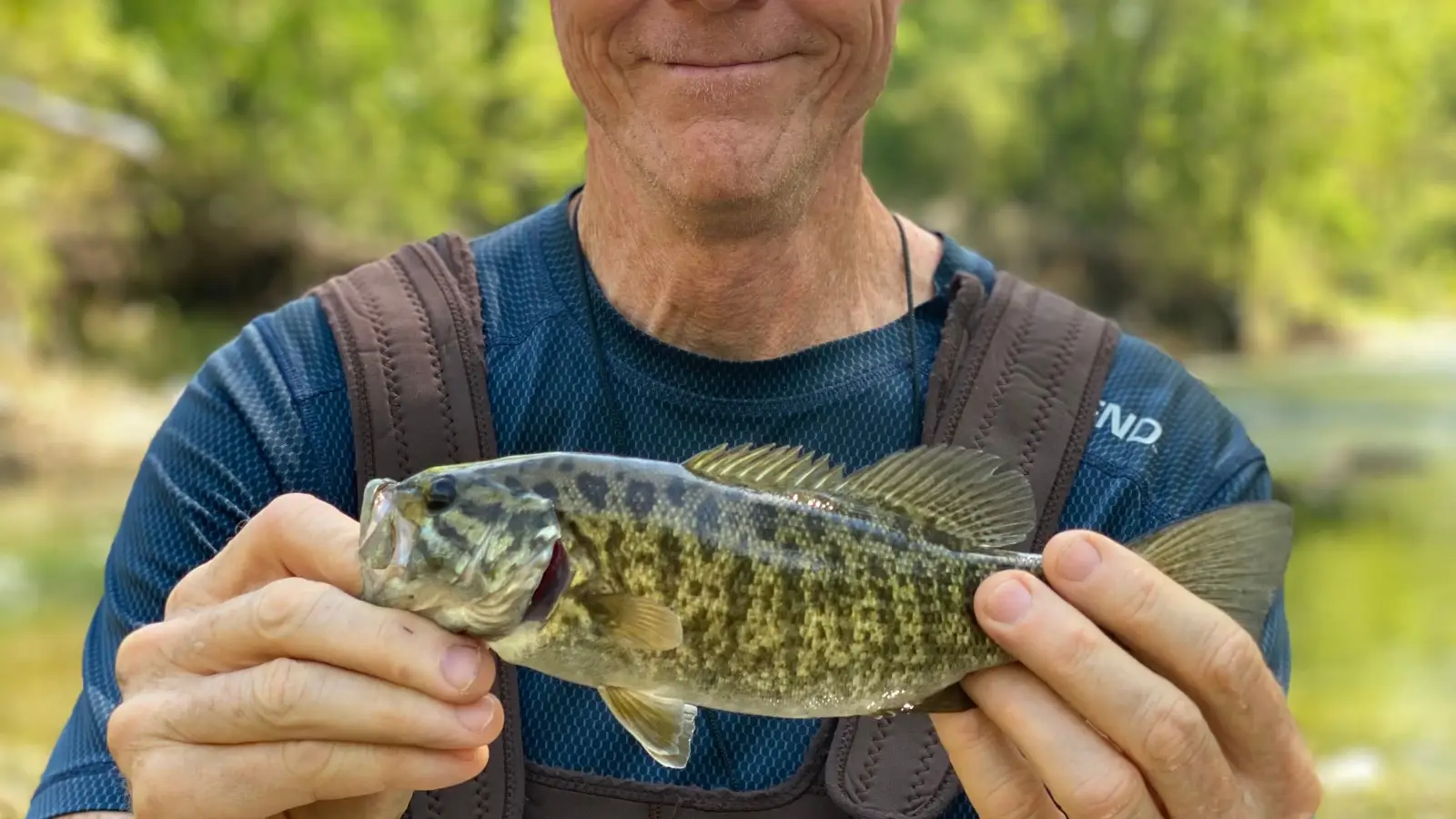
Smallmouth and spotted bass often confuse anglers on the same river stretch, but two quick checks will set you straight. First, trace the upper jaw. On a smallmouth, it extends well past the rear of the eye. On a spotted bass, it stops roughly even with the eye. Second, run a thumb lightly over the scales on the cheek. A smallmouth feels smooth; a spotted bass feels rough, almost sandpapery.
The dorsal fin adds another clue. Smallmouth have a deep notch between the spiny and soft sections—nearly splitting the fin. Spotted bass show a much shallower notch and a more connected fin profile. Smallmouth also tend to wear dark vertical bars along the sides, while spotted bass often sport a horizontal string of distinct spots below the lateral line. Ignore the tooth patch inside the mouth; it requires prying the fish’s mouth open, and you can get a solid ID without it.
White Crappie vs. Black Crappie: Spines and Body Pattern
These two crappies look almost identical at a casual glance. Counting dorsal fin spines gives you the most solid answer: white crappie have 5 or 6 spines, black crappie have 7 or 8. Snap a quick photo with your phone if you don’t want to count right away.
For a faster call, look at the body pattern. White crappie show dark vertical bars or a barred arrangement of blotches. Black crappie are covered in speckles and irregular spots—no clear bars. Black crappie also tend to carry a slightly deeper body and bigger eyes, but pattern is a more consistent clue across different waters.
Channel Catfish vs. Blue Catfish: Anal Fin Shape and Spots
Both have deeply forked tails, so that won’t help. Instead, check the anal fin. On a channel catfish, the outer edge of the anal fin is rounded—like a shallow curve. On a blue catfish, that edge is straight, almost as if you could lay a ruler against it. No need to count rays; just glance at the margin.
Color offers a secondary hint. Younger channel catfish usually show scattered dark spots across the back and sides, though those spots may disappear on fish topping 10 pounds. Blue catfish come in a clean slate-blue to gray, without any spots at any age. Size alone is a poor guide because a big channel cat can still look like a small blue.
Walleye vs. Sauger: Tail Tip and Dorsal Blotches
The simplest mark is on the tail. A walleye’s lower tail lobe has a bright white tip about a quarter inch long. A sauger’s tail lacks that white tip entirely. That one feature sorts out nearly every case.
If the tail is damaged or you can’t see it clearly, shift your attention to the first dorsal fin. Walleye carry a solid black blotch across the last few spines of that fin. Sauger show rows of distinct dark spots there, and they also have dark saddle-like patches across the back. Sauger are generally smaller on average, but the white tail tip is the go-to, field-ready mark.
The Single Feature That Settles Each ID
When you only have a few seconds before releasing the fish, here’s what matters:
- Bluegill or Redear? Look for the colored crescent on the gill flap.
- Smallmouth or Spotted? Check where the upper jaw ends relative to the eye.
- White or Black Crappie? Count dorsal spines or spot the pattern—bars vs. spots.
- Channel or Blue Catfish? Trace the anal fin edge—rounded or straight.
- Walleye or Sauger? Find the white tip on the lower tail lobe.
All of these are visible at arm’s length, and you don’t need any special tools.
If Your Catch Matches These Conditions…
Still holding that fish and unsure? Match your catch to these real-world situations:
- You’re at a farm pond and pull out a hand-sized sunfish with a dark ear flap that shows a hint of orange. That orange crescent means redear, even if everything else screams bluegill.
- You’re wading a clear Ozark stream and the bass has a jaw extending past the eye and smooth cheeks. It’s a smallmouth.
- You’re crappie fishing in spring and your fish has silver sides with clear dark vertical bars and six dorsal spines. That’s a white crappie.
- You’re on a big river and the catfish has a straight-edged anal fin and zero spots. You’ve got a blue catfish.
- The fish looks like a walleye but the tail has no white tip and the back shows dark saddle marks. That’s a sauger.
Frequently Asked Questions
Can a bluegill ever have an orange or red gill flap?
No. Bluegill gill flaps are solidly dark. If you see any red or orange on that tab, you’re looking at a redear. That’s the most dependable way to tell them apart.
What’s the safest way to count dorsal spines on a crappie without stressing the fish?
Steady the fish gently with wet hands and fan out the dorsal fin with your thumb—mind the sharp spines. Count the stiff spines at the front of the fin. A cell-phone photo works just as well if you’d rather count later. White crappie will have 5 or 6, black crappie 7 or 8.
Do all channel catfish have spots?
Not all of them. Spots are typical on smaller channel catfish but often fade on fish over 10 pounds. The anal fin shape—rounded—stays the same no matter the fish’s size or color phase, so it’s the more reliable marker.
I caught a walleye with no white tail tip—could it be a hybrid?
A true absence of the white tip points to a sauger. Hybrids (saugeye) do occur but are uncommon; they usually show a weak white tip and mixed blotch patterns. When you’re in doubt, the dorsal fin spotting pattern on a sauger is distinct, while a walleye shows a solid blotch.
Stop Guessing—These Quick-Checks Work Every Time
The five pairs covered here are responsible for the vast majority of freshwater fish misidentifications. Each one gives you a simple, visual marker that works even in low light or murky water. Glance at the ear flap, jaw length, dorsal fin, anal fin edge, or tail tip—and you’ll know exactly what you’re holding. From here on, there’s no reason to guess.