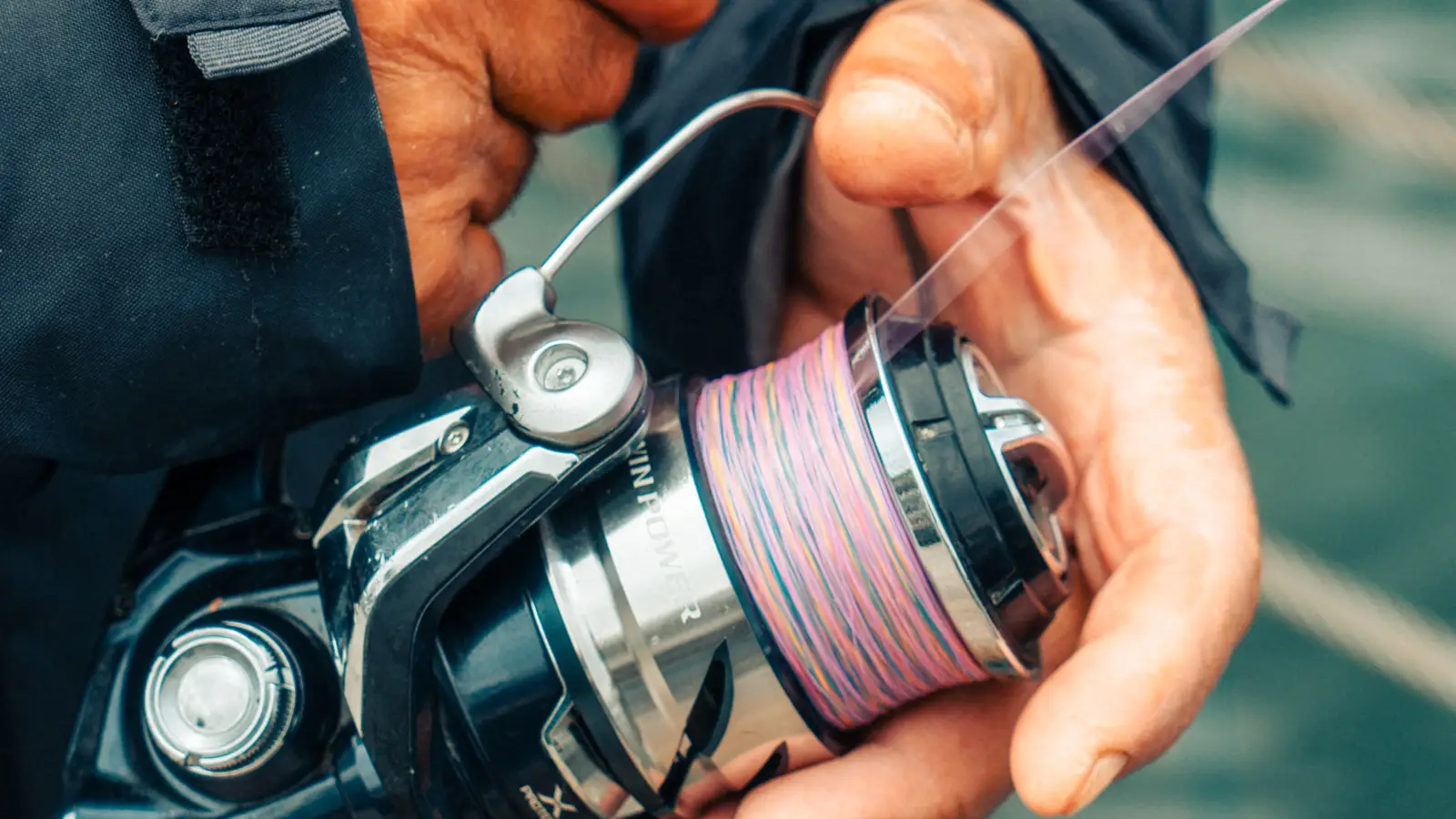
The reason nylon monofilament regularly comes off a spinning spool in tight, stubborn coils — while fluorocarbon lies straighter — traces back to differences in how their polymer chains respond to prolonged bending. Nylon's backbone includes amide linkages that form hydrogen bonds between chains; when the line sits spooled, those bonds continuously break and reform at new positions, letting the material creep into a permanent coil. PVDF (polyvinylidene fluoride) chains in fluorocarbon lack that hydrogen-bond network, relying on stronger, less mobile van der Waals forces. The result: fluorocarbon resists the kind of plastic deformation that produces tight memory coils, springing back straighter once released.
Every scenario that follows filters through that molecular distinction. When line memory directly shapes casting behavior, tangles, or lure presentation, the choice between nylon and PVDF becomes a choice between a material that reluctantly holds a new shape and one that eventually takes it.
Quick Verdict Table
| Scenario | Winner | Why (in one line) |
|---|---|---|
| Avoiding wind knots on a spinning reel | Fluorocarbon | Less memory keeps the line from springing into coils that catch the first guide. |
| Soaking bait for long stretches underwater | Monofilament | Nylon absorbs water, plasticizes, and the trapped coils relax into a limp, natural line. |
| Needing a line that sinks fast and stays taut | Fluorocarbon | PVDF's density and stiffness resist the slack that coils create, keeping tight contact with the bait. |
| Fishing topwater where the line must float | Monofilament | Nylon's specific gravity below 1.0 and its slight memory can add erratic, lifelike surface action. |
When Wind Knot Is the Enemy
A spinning spool feeds line in loops. If those loops hold the tight curl of the spool, they slap the first rod guide, tangle, and turn into the wind knot that ends a cast. Fluorocarbon avoids this because its PVDF chains have no hydrogen bonds — only van der Waals forces that are strong but not easily reformed after stretching. Pull the line straight, and it stays straight. Nylon, with its repeating amide groups, behaves differently: the constant bending strain while spooled causes the hydrogen bonds to let go and reattach in new orientations, allowing the chain segments to slide into the spool's curve. The line “remembers” the spool, and when it hits the guides still curled, the loop catches air and itself.
Opting for fluoro on a spinning reel means accepting two tradeoffs. First, cost: PVDF line runs three to five times the price per yard. Second, the initial suppleness that lets mono cast well even with lighter lures — fluorocarbon's wiry stiffness can spit a too-light lure short. But if wind knots have cost more than a few fish, the trade makes sense.
When Your Bait Sits Still Underwater
A bait soaking for minutes — a chunk of cut bait on a circle hook, a live minnow under a slip bobber — leaves the line slack. Coiled mono lifts off the bottom in humps, telegraphing unnatural movement if a fish picks up the bait. Here, though, nylon's chemistry turns from liability to advantage. Nylon 6 and nylon 66 are hygroscopic: they absorb water molecules that disrupt the same hydrogen bonds responsible for memory. After 20–30 minutes submerged, the line plasticizes, chain mobility increases, and those sharp spool curls relax into a soft, sinuous lay. Fluorocarbon absorbs essentially no water; it retains its stiffness and any residual set, potentially holding a bait at an odd angle that fish ignore.
The catch: mono's memory relief is only active while wet. Let it dry on the reel between trips, and the coils return. A braid-to-mono leader can sidestep this, but it adds a knot and a step.
When You Need a Line That Sinks Fast
Deep-diving crankbaits, drop shots, and Carolina rigs demand a line that sinks quickly to keep the lure at depth and remove surface slack. Fluorocarbon delivers on two fronts. PVDF's specific gravity — close to 1.78 — drags it downward without added weight. Nylon at about 1.14 hangs near neutral, so it resists breaking the meniscus and forms surface coils that rob depth. The molecular detail adds a second advantage: fluorocarbon's chain stiffness prevents those sinking segments from developing springy bows that turn slack retrieval into a guessing game. When you reel down on a fish, PVDF transmits force directly because it isn't busy straightening stored coils. Nylon must first pull those hydrogen-bonded bends taut — a tiny delay, but deep in the water column it can mean a missed hookset.
The tradeoff is buoyancy. If the same rig is swinging a floating lure, fluorocarbon drags the nose under and kills the action.
When Topwater Lures Demand a Floating Line
Walking baits, poppers, and buzzbaits need a line that won't pull the lure's head underwater. Nylon's sub-1.0 specific gravity keeps it on the surface, supporting the lure. The slight memory that lingers — a gentle wiggle of coils — can even assist a walk-the-dog bait by adding irregular twitches as the line drags slack loops across the surface. The effect is small but real, a downstream result of those incompletely relaxed hydrogen-bonded chains. Fluorocarbon's dense, rigid chains slice through the surface film and sink, dragging the lure's nose down and muffling the topwater commotion.
The tradeoff is backlashes: that same relaxing mono that adds action can also throw a loose coil on a baitcaster if spool tension isn't set tight. But for surface-focused anglers, buoyancy is non-negotiable.
Where They're Practically Twins
On a baitcasting reel with a levelwind guide that actively lays the line in place during the cast, the coiling memory difference between mono and fluoro becomes negligible for presentations under 30 yards. The levelwind's control over the line's path off the spool is strict enough that even a coiled nylon line cannot bind and loop. Additionally, if line is replaced every few trips — well before the nylon's stress relaxation has time to set in significantly — both materials behave almost identically straight from the spool. In these situations, memory isn't the bottleneck. Focus on leader diameter and knot integrity instead.
Deal-Breakers
The Hard Stop for Monofilament
Water temperatures below 40°F stiffen nylon's flexibility and accelerate stress relaxation. The hydrogen-bond network freezes into a brittle state, coiling intensifies, and spinning reels churn out hoops too tight to salvage. Below that threshold, the material won't cooperate.
The Hard Stop for Fluorocarbon
Cost. When the budget forces a choice between a spool of PVDF line and bait for the next trip, the coiling advantage rarely justifies the price gap. Fluorocarbon's memory reduction is a quality-of-life improvement, not a requirement, and no amount of polymer theory changes that.
What You Pay for Memory Relief
Fluorocarbon fills a 200-yard spool for $15–$30; monofilament does the same for $5–$10. The difference reflects the expense of PVDF polymerization and extrusion, but for the angler it usually boils down to: one fewer wind knot per outing versus an extra pack of soft plastics. If finesse or distance casting dominates the trip, the cost makes sense. If the day is mostly soaking bait or trolling, it probably doesn't.
FAQ
Does soaking monofilament in water really reduce memory?
Yes. Nylon's amide groups absorb water, which disrupts the hydrogen bonds that lock in coil memory. After 20–30 minutes submerged, the line becomes noticeably more limp. The effect reverses as the line dries.
Why does my fluorocarbon still coil sometimes?
Fluorocarbon has less creep, but it isn't immune. If spooled under excessive tension or stored in high heat, the PVDF chains can be forced into a set — though the coils are usually larger and easier to straighten than mono's tight rings.
Can I stretch either line to remove coils permanently?
Stretching temporarily aligns polymer chains, but for nylon the hydrogen bonds will relax again over time, re-forming coils. Fluorocarbon resists this re-setting better. A deliberate stretch before fishing can improve performance for a few hours on the water.
Is there a temperature where fluorocarbon's memory advantage disappears?
Cold makes all polymers stiffer, but PVDF's lack of water absorption and stronger intermolecular forces mean the advantage holds even in icy water. Nylon's memory gets markedly worse below 40°F, widening the gap.
The One Question That Settles It
For the most common scenario — a spinning reel where wind knots wreck the day — fluorocarbon's lower memory is the decisive winner. The only real question: "Am I losing more fish to line coils than I'm willing to accept, or am I managing memory well enough that the extra cost isn't justified?"