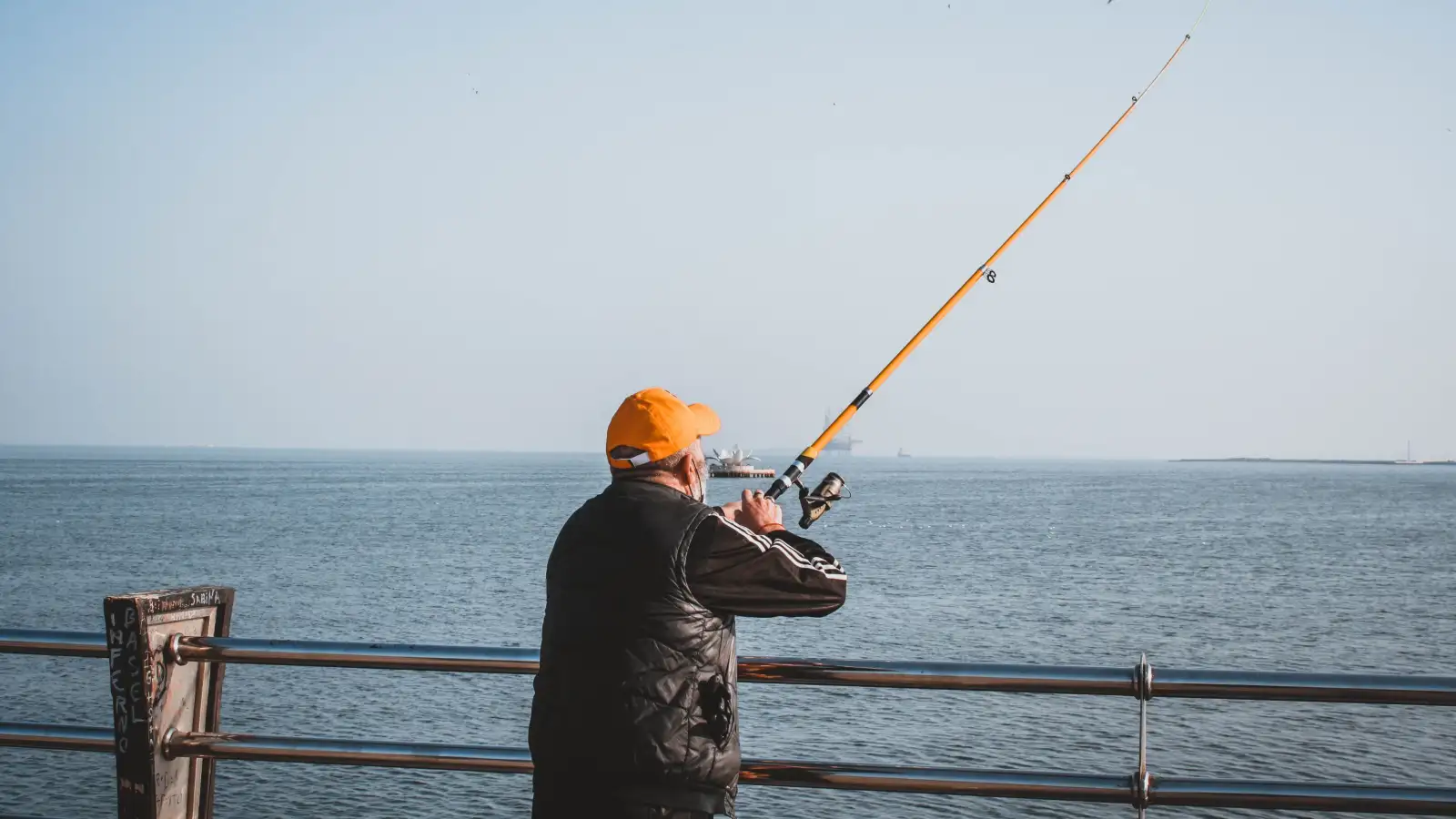
Fish get lost at the pier rail because the last ten feet of a fight happens where the line is shortest, the rod angle is worst, and the fish has finally worked out that something is wrong. More pressure does not fix that. Changing where the fight ends does. Wear the fish down out past the pilings, walk it clear of the structure before it gets a second wind, bring it to the rail already beaten, and have the landing method decided in advance: swing it over on a long rod, lift it in a net on a rope, or walk it to a lower piece of deck. Hoisting a green fish straight up by the leader is what turns a good fight into the story about the one that got away.
I'm at the rail on a warm evening, forearm on the wood, creosote still radiating heat from the afternoon. The deck here sits a long way above the water, far enough that the surface goes dark and vague in the evening shadow, and the pilings run down out of sight like fence posts in a pond. You've got the rod in one hand and a coffee you forgot about in the other. The tip taps twice. You set, and it isn't a snag, because a snag doesn't move sideways.
For the first thirty seconds everything is fine. The fish runs, the drag ticks, the rod loads into that deep curve you can feel in your wrist. Then it turns and heads back toward the pilings, and that's the moment the whole thing gets decided.
The last ten feet is a different fight
Down there, the fish is inside the cone of water the pier owns. Every piling is a corner it can cut, and the line is short enough that a single head-shake translates straight into the leader. Fifteen feet of line means you have no stretch to absorb anything. Twenty-five feet means you have a little. That difference is not about the fish's size, it's about leverage, and the fish has all of it.
So the work happens earlier. When it turns toward the structure, I give it line and walk. Not backward, sideways, down the length of the pier. Ten yards, fifteen, whatever the deck allows. The fish is now fighting in open water with no corners to cut, and every run it makes is burning energy on nothing. That's the tired part. Not the pulling part.
You can feel the change. The runs get shorter. The fish stops taking line in long screaming surges and starts taking it in short grabs. When it planes instead of dives, when you can steer it with the rod instead of just holding on, it's ready to come to the rail. Bring it in slow and low, rod tip down and off to the side, never straight up. A rod bent past vertical at the rail is a tip section waiting to snap, and it puts the leader right at the fish's teeth.
Read the deck before you read the water
The landing method gets picked by the deck, not by the fish. Before the bait ever hits the water, look at where you're standing. If you're on a low float or a dock with the water within a few feet of your boots, you can swing modest fish over the edge on a long rod with almost no risk, and you can kneel down and reach them. If you're on a high pier, twenty feet of air between you and the surface, no rod on earth lifts a heavy fish that far. The rod is not a crane. It's a spring, and it's a spring built to bend, not to hoist.
That's the fork in the road. High deck means the fish has to come up in something, or the fish has to be walked somewhere lower. There's no third option that ends well, and the fishermen who lose the most fish at the rail are the ones who haven't accepted that yet.
The net on the rope
A landing net on a long rope is the single most useful thing on a high pier. Not a net on a handle you're holding, a net on a rope you can lower. You drop it over the side, open it a couple of feet under the surface, and steer the fish headfirst into the hoop with the rod. Then you lift the net by the rope, hand over hand, and the handle never carries the load.
Fish spill out of a net that's lifted by the handle. They don't spill out of one that's lifted straight up by the rope. That's the whole trick, and it's the reason a cheap rope matters more than an expensive net.
When there's no net
You walk it. Most piers have one end that sits lower, or a ramp, or a float tied off, or a set of steps down to the water. If the fish is legal and you intend to keep it, that walk is worth taking. If you intend to release it, the walk is even more worth taking, because you can often do the whole thing at the water's surface without ever lifting the fish out of it.
The leader grab is the last resort and it gets people in trouble. When the deck is low and the fish is small, pinching the leader just above the hook and lifting smoothly, with the fish's weight coming up under your hand and not against the rod, works fine. When the deck is high, or the fish is heavy, or the fish is still green, it doesn't. The leader parts, or the hook tears, or the fish drops back into the water and you're standing there holding eight inches of monofilament.
Bringing it up right
If you're keeping the fish, what happens at the rail is a handling question, and the answer is boring: support the body, don't let it swing by the jaw, don't drop it on hot planks. A fish that's been flipped and flopped on concrete is fish you're going to eat anyway, so treat it like food and put it down once.
If you're letting it go, the handling is the whole point of the fight. Wet your hands first. Dry hands strip slime off a fish like sandpaper, and slime is its first line of defense against everything in the water. Keep the fish horizontal. A fish held vertically by the jaw is hanging its own organs off a spine that wasn't built for it. And keep it out of the air. Three seconds for a quick look, ten or fifteen seconds total if things go smoothly, and then it goes back. Every second counts double on a hot day.
Reviving it in the current
Once it's back in, don't just let go and hope. Hold it upright, headfirst into whatever current the pier has, and let the water move through its gills instead of moving the fish through the water. The old habit of pushing a fish back and forth to force water over the gills mostly just moves the fish around; current does the work better and the fish does less. When it stops leaning on your hand and starts holding itself upright, open your fingers and let it swim. If it turns over, pick it up gently and try again. If it never comes back, that's information about how the fight went, and it's worth thinking about.
Fish that come up wrong
Pier fish often come from deep water, and deep water does things to a fish that shallow water doesn't. They arrive at the surface flat, or bloated, or barely able to hold themselves down, and they can't just be flipped back over the rail and forgotten. These are the fish where the photo costs the most.
My rule is simple: if a fish comes up in bad shape, it goes back immediately, at the surface, without leaving the water at all. Lean over the rail, wet your hands, unhook it in the water or right at the surface, and let it swim out of your fingers. No lift, no measure, no picture. You'll catch another one. The one on the deck isn't coming back.
The thing the rail teaches you
Landing a fish at a pier is a decision you make three minutes before the fish arrives. Deck height picks the method. The open water past the pilings is where the fight gets won. The net on the rope or the walk to the low end is how the fish gets out of the water, or doesn't have to. Everything after that is just handling, and handling is where most pier fishermen lose the fish they already beat.
The ones who land fish consistently aren't the ones with the strongest arms. They're the ones who looked at the rail, did the arithmetic on the drop, and picked their move while the fish was still running.