On an artificial-only stretch, bait is anything a fish can eat, swallow, or taste, and that definition reaches much further than a worm on a hook. It commonly takes in scented soft plastics, dough and paste baits, fish eggs, cheese, corn, and any lure you have sprayed with an attractant. The rule exists for three reasons that point the same direction: bait gets swallowed deeply and kills the fish the stretch is trying to protect, bait moves organisms and disease from one watershed into another, and a bait line is one of the few rules an officer on the bank can verify at a glance. Learn those three reasons and you can predict what almost any artificial-only rule covers, on water you have never seen, without memorizing a single state's list.
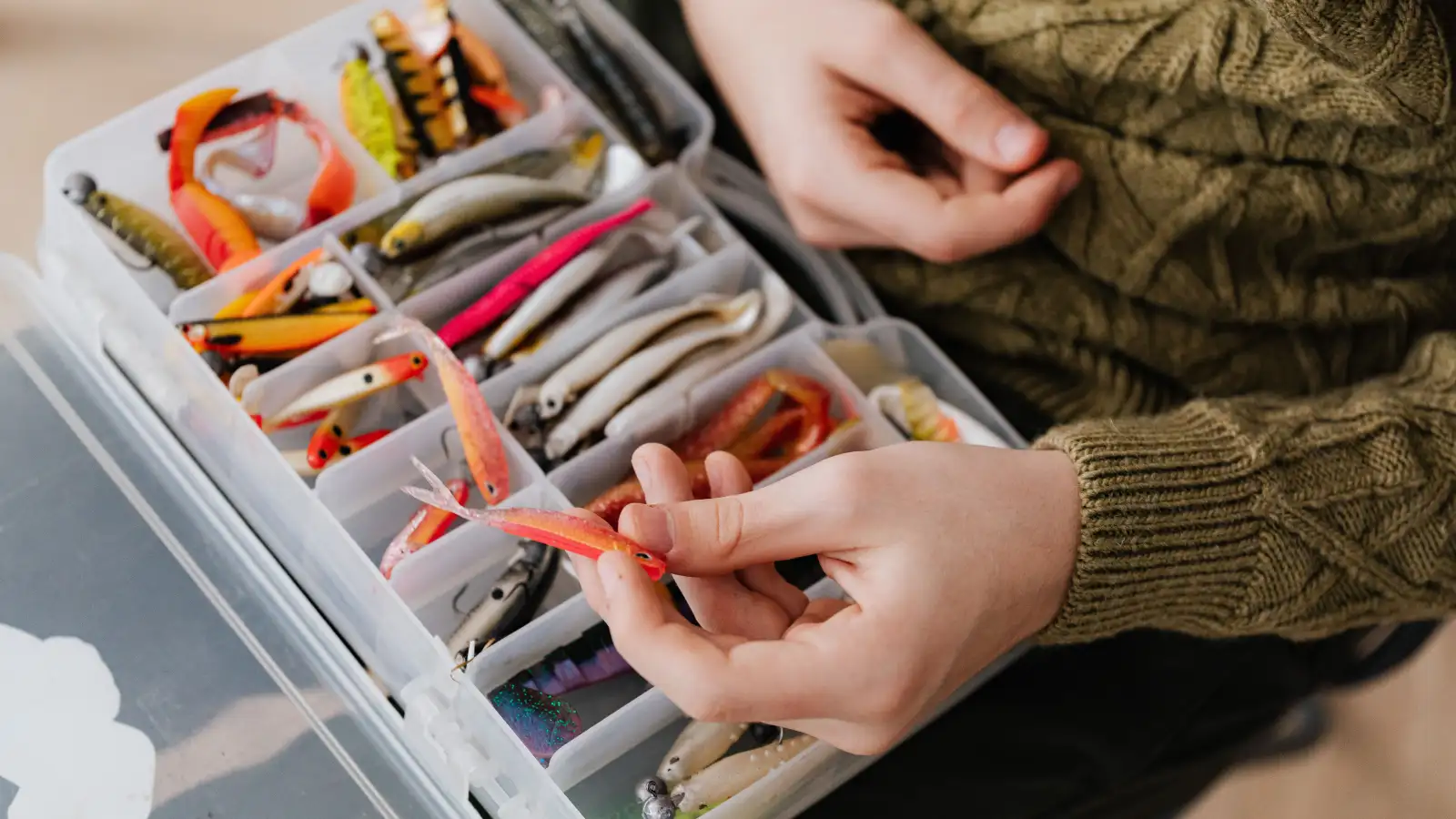
I want you at the tailgate with me. Gray light, gravel still wet from the night before, mist standing on the river behind us. The lid of my box is flat on the metal, and I'm going to hand you something. A four-inch plastic worm, root beer with red flake. Hold it up. Now smell it.
That's the question. Not "is it plastic." Plastic has nothing to do with it. The question is whether the thing in your hand is shaped and scented like something a fish would eat on purpose.
Ask the box three questions
I run every questionable item through the same three, and I've never found a bait rule that didn't come back to them.
Can the fish swallow it? Not strike it — swallow it. A metal spoon gets smacked and the hook ends up in the jaw hinge. A ball of dough gets taken, held, chewed, and the hook ends up well past the bend. That difference is the whole reason these rules exist, and I'll come back to it.
Does it leak anything into the water? Scent, oil, dye, blood, juice. A fish can taste a bait it never sees. Anything that puts a chemical trail downstream of your hook is doing the work of bait whether or not it looks like food.
Did it come from something that was alive? This is the one that catches people. Fish eggs, worms, minnows, crickets, chicken liver, a strip of squid, a shrimp out of the grocery case. Also a soft plastic that has been sitting in a jar of garlic scent since last season.
Yes to any of those three, and the smart read is that the rule treats it as bait until you have read the definition yourself.
Why the rule lands where it lands
Now picture the fish. Small, wild, eight inches, out of a cold stream that reproduces its own population. You could hold it in one hand. Where's the hook?
With a lure it's almost always in the lip — the corner of the jaw, sometimes the roof of the mouth. Forceps, a twist, and the fish swims off. With bait, the fish has time. It takes, it turns, it starts to swallow, and by the time you feel the tap and lift, the hook is down the throat or behind the gill arch. That fish bleeds. It doesn't matter how quick your hands are.
That's the biology behind the geography. Wild and native fish are what these stretches are protecting, because they're the ones that can't absorb the losses. A stocked fish was put there to be caught — it's a bucket cost, replaced by a truck. A wild fish that grew up in that system is the system. Take a few of those out every trip, season after season, from a small population that has to reproduce on its own, and the arithmetic runs out quietly. Nothing dramatic. Just steady.
The bucket at the ramp
Walk down to a boat ramp at dusk and look at the water's edge. Half the reason these rules exist is right there.
Live bait is legal in plenty of places. Moving live bait from one water to another is a different question entirely, and that set of rules has nothing to do with how you hook a fish.
Baitfish move. They also carry things. A minnow that's harmless in the reservoir it came from can eat the eggs of native fish or out-compete their young in the creek you dump it into. Along with the minnows come parasites and pathogens, and those don't read the lines on a map. Whirling disease and viral hemorrhagic septicemia are the two names that come up most; they are not the only ones.
And the transfer almost never happens on purpose. It happens at the end of the day, when there are six minnows left in the bucket and you don't want to carry them home. Over the side. Three seconds, and the water's clean, and you have just stocked a lake.
That single habit — the leftover dump — is one of the most reliable ways a non-native baitfish gets a foothold somewhere it never existed. It's why so many watersheds restrict not just how you use live bait, but whether you can move it at all. The fix is a one-second decision at the truck: leftovers go on shore or in the trash. Never in the water, and never into the next lake.
The same river, two rulebooks
Stand at an access and look upstream: one rule set. Turn around and look downstream: possibly another. The boundary is almost always a landmark you can stand on — a bridge, a confluence, a set of falls, a posted line on the bank — because a line you can point to is a line that can be enforced. Above it, artificial only. Below it, bait allowed. Same water, same fish, different rules.
Timing and species work the same way. A restriction might only run through the cold months, when fish are stacked and vulnerable. It might apply to one species and not to the one swimming beside it. It might apply to wild fish and not to hatchery fish in the same pool, which asks you to know what you're looking at before you decide what to tie on.
Then there is the gear clause, and this is the one that changes your afternoon rather than your ethics. Bait restrictions are frequently bundled with hook restrictions — single hook, barbless, sometimes both.
Now re-rig. A crankbait with trebles becomes a crankbait with one hook at the belly and the barbs pinched flat. A spinnerbait with a trailer hook loses the trailer. A jig with a soft-plastic trailer forces the question of whether that trailer is part of the lure or bait, and the answer lands on the definition in the book and, honestly, on the judgment of whoever is checking. If the trailer is scented, you have made that call harder for everyone.
Rule books also tend to split the world into three categories — natural bait, artificial lures, and flies — and each category can carry its own hook and gear limits. A fly rod does not turn a worm into a fly. Bait fished on fly gear is still bait in every rule set I've read, because the category is decided by the thing at the end of your line, not the thing in your hand.
Reading a rule you have never seen
Four things to find, and none of them is the summary in bold at the top of the page.
The definition of bait. This is the section that decides everything else. Look at what the word "natural" is attached to. Look for whether the definition mentions scent, attractants, or "any substance." If it's silent on scented plastics, you have found a gap — and the way to handle a gap is to behave as though it were closed.
The boundary. Where it starts, where it stops, which side of the landmark you're standing on.
The timing and the species. Year-round or seasonal, all fish or one.
The gear clause. Hook count, hook type, whether barbs have to come off.
One more thing about that: the sign at the access can be years out of date. Signs get posted and the rule gets amended, or the sign gets replaced and the app on your phone still holds the old version. The current rule book is the authority, and it changes more often than the signage does.
I'll say the other half out loud, too. Definitions genuinely differ from one state to the next. Scented plastics land on both sides of the line depending on where you are, and some rule books are simply silent on the questions anglers ask most. This is a map of the reasoning, not a reading of your regulation.
Legal is the floor, not the point
Everything above is legal reasoning, and it's useful, but here is what I would rather you carry away: the letter of the rule and the reason for the rule are not the same object.
You can be completely legal and still do exactly the damage the rule was written to prevent. An unscented plastic grub on a barbless single hook, fished with a slow lift and a long pause, throat-hooks fish at nearly the rate a worm does — and if that particular rule's definition doesn't mention scent, you are inside the law and outside the point. The rule exists because of throat-hooked wild fish. It does not exist because someone prefers feathers to rubber.
So the question I ask on a new stretch isn't what the rule technically allows. It's what the person who wrote it would think if they watched me for ten minutes. Most of the time the answer is obvious. Sometimes it means leaving something in the truck.
When I'm heading for an artificial-only stretch, I pull the bait out of the box the night before, at home, not at the access — not because I expect to be checked, but because the decision at the tailgate happens too fast, and half a second of reaching into the wrong compartment is how people end up on the wrong side of a rule they already knew.
What goes in the box those days: unscented plastics, plain jigs, a few inline spinners, streamers and nymphs if flies are allowed, forceps, and side cutters for pinching barbs. If the water also says single hook, the cutters earn their keep.
Three questions, one habit. Can the fish swallow it. Does it leak. Did it used to be alive. And the leftover bait goes in the trash.