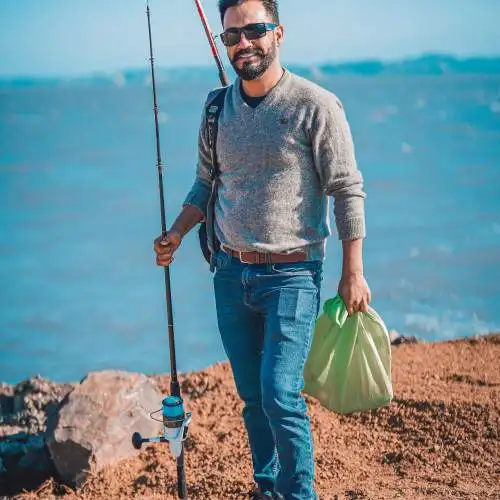
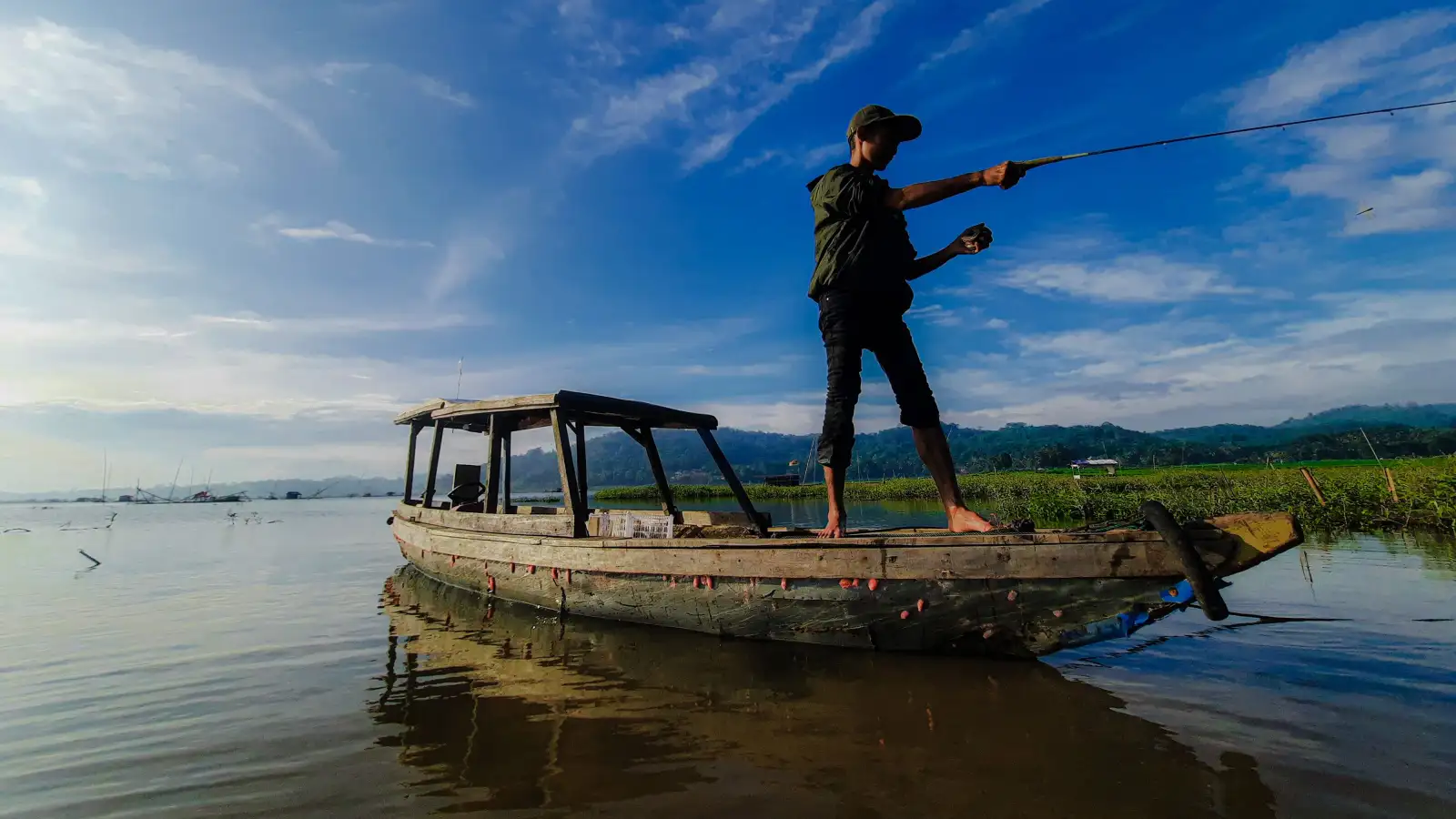
Release a fish cleanly from a boat by never giving yourself a reason to lift it. Stage the net, the unhooking tool, and a wet measuring surface before the first cast, swing the fish into a knotless net that never leaves the water, do the unhooking and the measuring right there at the gunwale, and hold the fish upright boat-side until it kicks free on its own. Nearly every rough release that happens off a deck is a staging problem, not a handling problem.
Stand on my front deck with me on a still morning in late July. The carpet is already warm through your shoes and it isn't even eight o'clock. The net lies across the deck, handle tucked under your knee, hoop hanging over the gunwale so the bag sits in the water and the mesh is soaked through. Forceps are clipped outside your pocket, not buried in a box. A ruler sticker runs along the gunwale cap right where your left hand naturally lands when you lean over the side. You haven't made a cast yet. That is the entire point of the setup.
Now you cast. A fish eats, you set, and it comes up and boils. Here is what your body does when the deck is staged: you drop the rod tip toward the water, sweep the net under the fish head-first, and the fish is in wet mesh before it knows anything changed. Your rod goes down on the deck behind your heel. Your hand is already wet because you dipped it while you were watching the line. The net stays where it is, in the water, over the side, and you lean over it.
The Boat Takes Away Your Options
On a bank you have things a deck doesn't give you. You can kneel in six inches of water and let a fish rest in the shallows while you find your pliers. You can lay it down on wet gravel. You can stand up and think.
From a boat you have a gunwale, a hot carpeted deck, and a platform that moves. Every second a fish spends in the air is a second it isn't supported by water, and every surface you might lay it on is either too hot, too dry, or too abrasive. So the design goal isn't "handle it carefully." The design goal is "don't handle it."
Stage It Before You Cast
Three things need to be reachable with one hand while your other hand holds the net: the unhooking tool, the measuring surface, and a wet towel. If any of those lives in a compartment with a latch, you've already lost, because you'll be holding the fish in the air while you open it.
I keep long-nose forceps clipped outside a pocket. I keep the net handle under my knee or laid across the deck where I can grab the middle of it without looking. I keep a soft tape or a stick-on ruler right at the gunwale cap. The wet towel is cheap insurance for any fish that does end up on the deck. Lay it down first and the fish contacts wet cloth instead of hot carpet.
The Net Is a Holding Pen, Not a Trophy Case
A knotless or rubberized bag is not a luxury item. Nylon mesh drags across a fish's body, and the slime coat it takes with it is the same slime coat that keeps bacteria and fungus off a fish's skin. A rubberized bag tangles less, too, which matters because a fish wrapped in nylon is a fish you have to handle twice.
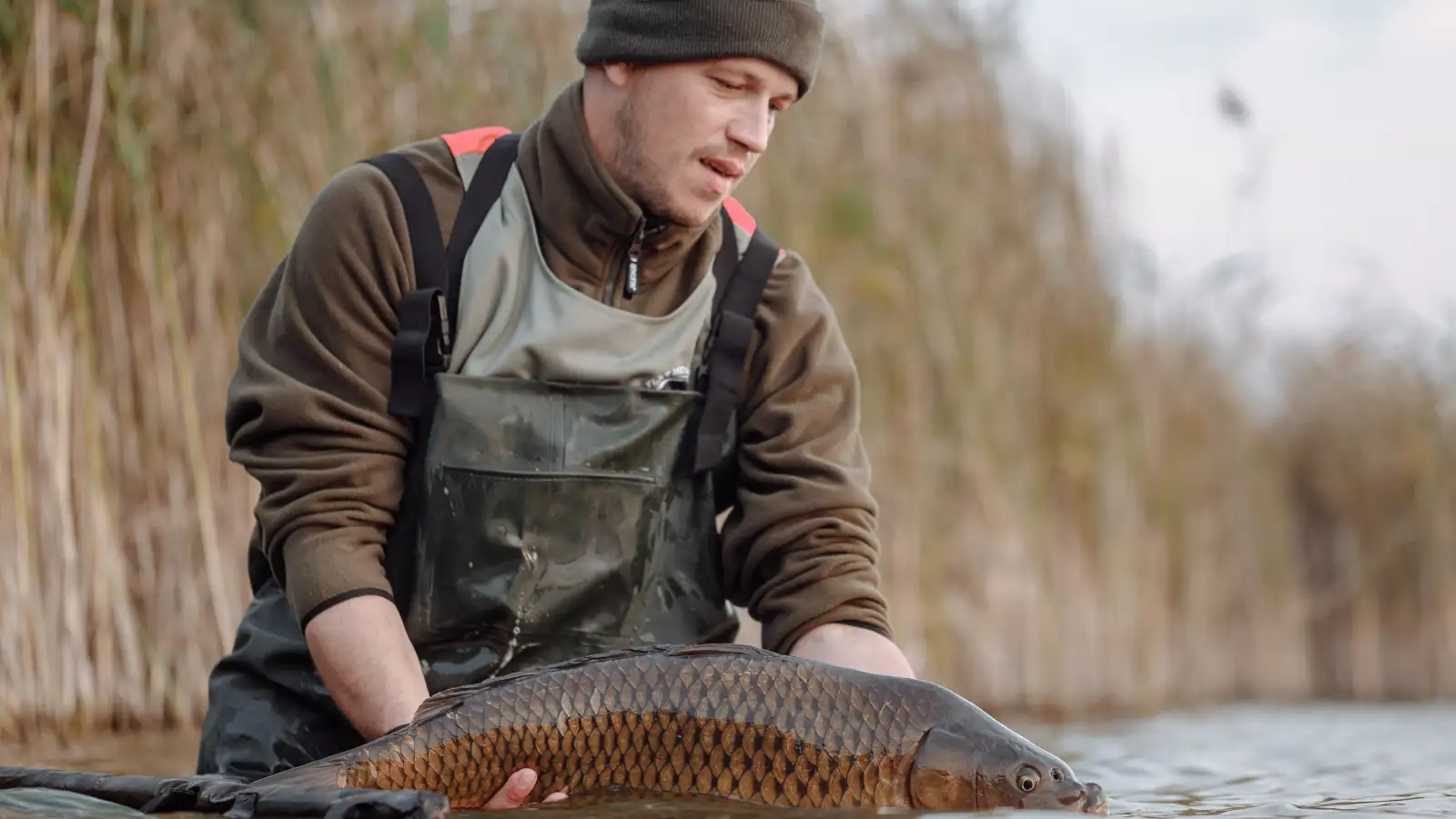
The technique is the part people skip. Once a fish is in the net, don't lift the bag out of the water to admire it. Leave it submerged, reach in with wet hands, and unhook the fish with the net still hanging over the side. On most single-hook setups that's five seconds of work. The fish's body stays supported, its head stays under, and if it thrashes it thrashes into mesh instead of into your knuckles or the deck.
Measure, Shoot, and Put It Back, In That Order
If you need a number, get it while the fish is already controlled. A bump board on the deck, or a sticker along the gunwale cap, means one motion instead of hunting for a tape with a fish in your hand. I wet the board before I lay anything on it. If the fish doesn't need a photo, I measure it inside the net and skip the whole production.
If you do want a picture, have the camera already on and pointed. Lift the fish only for the length of the shutter. Support the belly on anything with some size to it, because a heavy fish hanging by the jaw alone is a fish whose weight is pulling against its own spine. Then put it back in the water before the photo has finished uploading.
The Hook You Shouldn't Pull
Some fish come in with a hook buried past the bend. You can feel it when you look down into the net: the eyelet is barely out, the point is somewhere you can't see, and nothing about the angle is clean. Your instinct is to go after it. Don't.
A hook sitting that deep is anchored in tissue, and backing it out the way it went in drags a wound channel the wrong direction through structures the fish needs. A hook left flat in place is something the fish's own chemistry can deal with, if it will corrode. That's the catch. Plain carbon and bronze hooks pit and weaken in wet, warm, slightly acidic conditions and eventually work loose. Stainless doesn't. There is no version of this where you leave a stainless hook in a fish and call it a clean release.
So if I can't get a hook out with one straight, gentle attempt, I reach down with cutters and take the line off as close to the hook as I can manage without digging at the fish. The fish goes back with hardware and with a lot more of its own tissue than it would have had if I'd fought it.
This is a decision you make in advance, by the way. It isn't a call you can make with a fish hanging in the air.
Reviving Is a Conversation, Not a Count
Some people count to twenty and throw the fish. I'd rather watch the fish answer.
Hold it upright in the water beside the boat, one hand under the belly, the other lightly at the wrist of the tail, head pointed into whatever flow exists. The fish's job is to tell you when it's ready. A fish that's coming back holds its fins down, holds itself upright against your hand, and starts to push. A fish that isn't ready will roll onto its side the second you loosen your grip. Rolling means more time, not a bigger throw.
On a river, current does the work for you. On a lake with no flow, you have to make some. Idling the outboard in gear, or just bumping the trolling motor, moves water across the gills, and moving water beats still water every time. If the boat is drifting, drop the fish over the side and drift with it for a few yards. What you don't do is pitch it over the gunwale and hope. A fish that goes airborne and lands on its side has spent energy it didn't have to spare and is now floating away giving you the one piece of information you needed, from thirty feet out of reach.
Warm Water Shortens Every Clock
Surface temperature in the mid-80s with air well above it changes what a fish can absorb. Warm water holds less dissolved oxygen, and a cold-blooded fish's metabolism is running flat out in warm water, so demand is high while supply is low and every extra second out of the water compounds. The deck matters too. Dark carpet in August sun will genuinely be too hot to leave your own palm on. Don't test it with a fish.
In that kind of water I start skipping steps that don't produce anything. No net for a small fish I can reach at the gunwale and unhook with pliers while it's still in the water beside the boat. No photo. No board. Line off, hand under the belly, let it go. If a warm-water fish goes belly up on you anyway, staying with it and holding it upright until it stops rolling is still worth doing. That fish isn't gone until it's gone. But the smarter move was made four minutes earlier, when you decided how the deck was laid out.
What I've Stopped Doing
No fish that's going back touches a livewell. No dragging across the carpet. No dry hands, because a wet hand on a wet fish pulls far less slime than a dry hand does. No gripping by the gill plate. No lifting a fish by the line. And no nylon net on my deck, ever, because the net is the one piece of gear I use on every single fish and it's the cheapest upgrade in the boat.
Everything here is one idea wearing different clothes. From a boat, the way to handle a fish less is to set up so that handling is never required. That setup costs you ninety seconds at the ramp or before the first cast, and it's the cheapest part of your day.