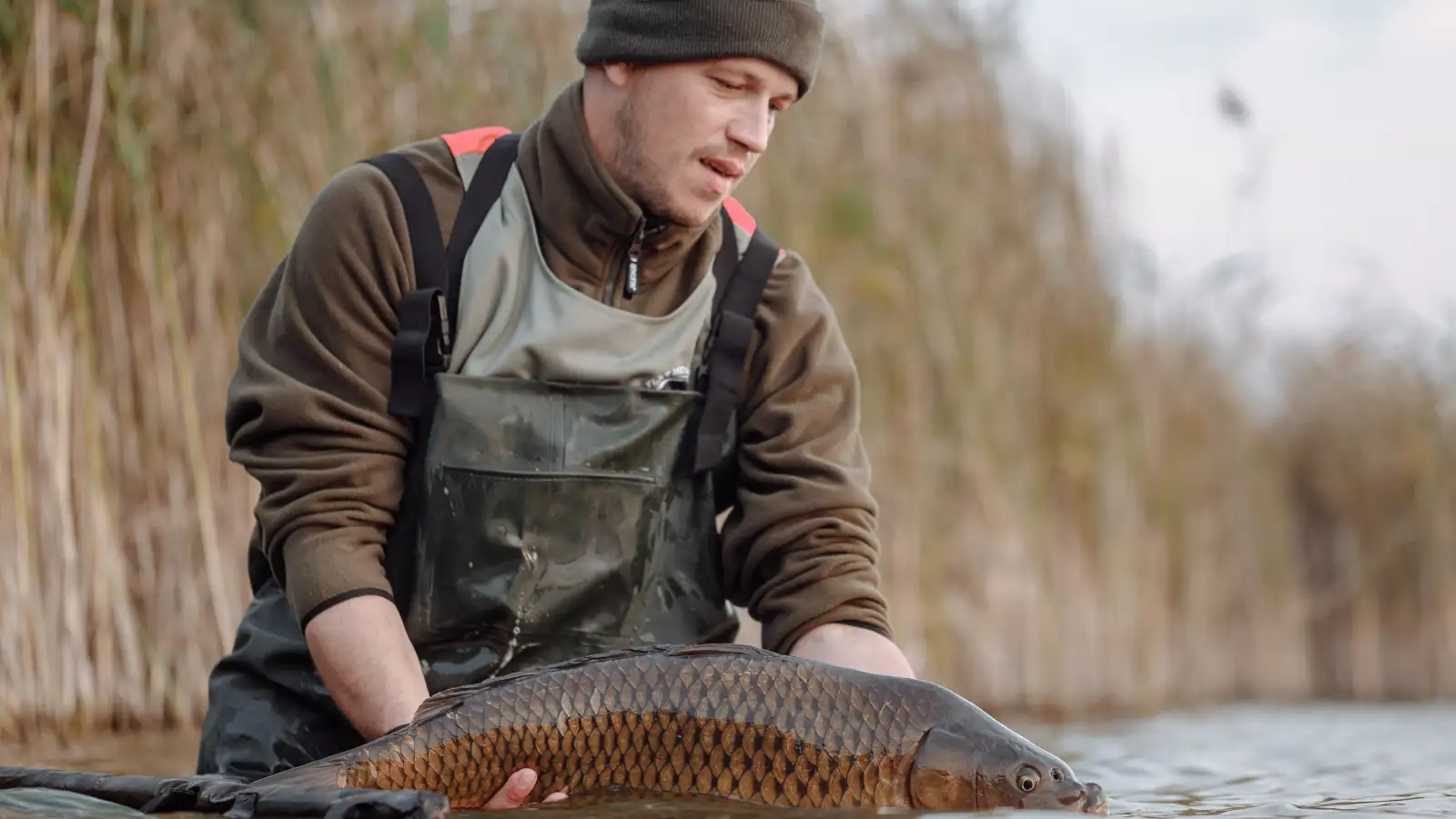
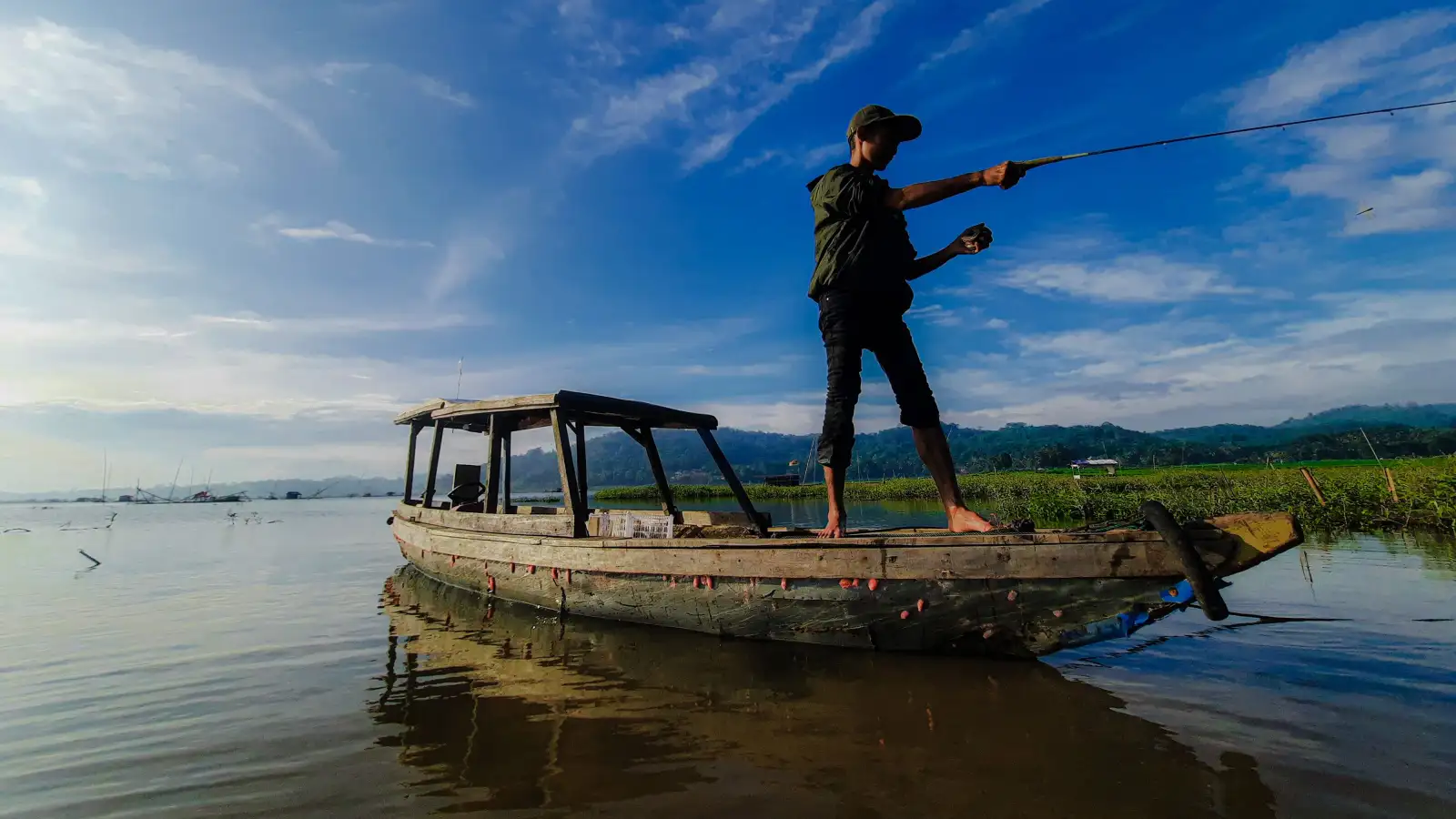
Casting from a boat deck safely and accurately comes down to three adjustments made before the lure ever leaves your hand: a wider, lower stance, a shorter rod stroke, and a release timed to the boat's stable beat rather than its rocking one. The deck is elevated and it moves under you, the hull is suddenly the nearest thing behind your backcast, and open-water wind pushes a lure off line harder than shoreline wind ever does. Get those three right and accuracy follows. Ignore them and the morning turns into picking line off the trolling motor and picking a backlash apart while a school pushes bait off the point.
I want you standing where I stand: front deck, trolling motor down and idling on low, bow swinging an inch or two left every time a wake rolls under the hull. Your partner is on the back deck. There is a laydown off the starboard bow and a dock ahead, and the wind is crossing your casting shoulder.
Now make the cast from the bank version of yourself and watch what happens. The long, loose, full-arc overhead that works fine from the dirt catches the butt section on the pedestal seat behind you, or drives the bait straight into the outboard cowling on the backcast. That reverse cast is the one that ends with a hook in a seat cushion or a rod guide wrapped around line.
Stance and stroke first
Feet wider than your shoulders. Knees bent, hips low. Not a crouch, just low enough that when the deck rolls, your weight rolls with it instead of holding still while the boat slides out from under your feet. That is the entire balance trick on a moving platform: stop fighting the boat's motion and start moving with it.
Then shorten the stroke. From the bank you can use your whole arm and let the rod travel a big arc. On a deck you work from the elbow and wrist, and the tip covers a smaller arc. Less line in the air at once, faster rod load, fewer moving parts to go wrong. It feels cramped for about twenty minutes and then it feels normal, and you notice you are more accurate because the rod has fewer places to wander.
Time it to the stable beat
The boat is never still. Waves roll under it and the trolling motor torques the bow to one side every time it corrects. So you do not cast on a random beat, you cast on the quiet one. On a slow roll, the bow rises and hangs for a moment before it falls again. That hang is your window. Release there and the deck is briefly level under your feet. Release at the bottom of the drop and you are casting uphill, which is how you launch a bait into the gunwale.
You can feel the beat after a few minutes if you stop trying to ignore the motion. In chop you might only get one clean cast per cycle. That is fine. Take the good cast instead of three bad ones. If the water is rough enough that you cannot find the hang at all, sit down and wait, or turn and change your angle to the wind.
Wind, and the real reason you backlash
Open water is a different wind than the bank. On shore, trees and terrain break it up. Out on a lake it is steady and it has miles of runway to build speed, so a bait that flies high gets carried and a bait that flies flat does not.
This matters more than most people admit, because it is also the main cause of the backlash. A baitcaster backlashes when the lure slows down and the spool does not. Into a headwind, the lure decelerates through the air while the spool keeps spinning at the speed you launched it, and the line stacks. So the fix is not just more thumb. It is keeping the lure moving: aim low, use a sidearm or three-quarter cast with the rod tip roughly parallel to the water, and feather the spool lightly through the flight instead of clamping down at the end.
Low casts also keep the bait off your own hat and out of the wind that is trying to lift it. Two problems, one adjustment.
When the boat is the obstacle
The front deck gives you height, and that is its own quiet advantage: you are casting down at the water instead of across it, you see more of what is in front of you, and a lot of the time fish get a poor look at you from that angle. What you do not get is room behind you. The pedestal seat, the console, your partner, and the outboard all live back there, and a conventional overhead backcast is going to find one of them.
That is where the roll cast and the flip earn their place as deck casts, not just as techniques you read about. The roll cast never sends line behind you. A loop of line forms out over the water past your rod tip and you punch it forward. It reaches a moderate distance with zero backcast room. The flip is shorter still. You strip line off the reel with your free hand, let the bait swing back under the rod tip on a short pendulum, load the rod, and shoot it forward low. Neither is glamorous, and both are the reason you can keep fishing the laydown at your ten o'clock instead of skipping it because you cannot get a backcast.
Two anglers, one patch of water
With a partner aboard, the rule that keeps everyone fishing is simple: you fish different water, not the same water from different angles. The front angler works forward off the bow, the back angler works off the stern. If you both throw at the same laydown, your lines cross on the retrieve, you double the pressure on that fish, and one of you is going to take a bait back into the ear.
Call your casts out loud. Going left. Cast past you. My fish, hold. It sounds like small talk and it is really the whole system. When I am on the back deck I aim behind the front angler's target and work my bait away from theirs, never through it. You both catch more fish that way, because a pressured fish off the front deck is a fish that quits eating, and it quits eating for both of you.
Sitting down to skip
Docks and overhanging trees are where you find out how low you can go. The only bait that gets under a dock is one that skips across the surface and keeps going, and the only way to skip reliably is to get your rod tip down near the water. That means sitting on the deck, or kneeling, and coming sidearm with a low, flat trajectory.
There is a cost, and it is real. When you sit down, you lose your legs. Your hookset becomes rod and wrist, all of it. On a skip bite you either drive the rod up and back and accept that the leverage is not there, or you brace and stand during the set, which you can only do if the bait is a foot from the boat. When I am skipping for fish with shoulders, I plan the hookset before I make the cast: where my feet go, whether I stand, whether I am going to have to lean back hard into it. Standing up mid-fight on a rolling deck is its own risk, so it is worth deciding in advance.
Deck awareness
Keep the working area of the deck clear. Loose line is a trip hazard and a tangle waiting to happen the moment you move. Watch the pedestal seat behind you, watch your partner's backcast, and do not climb onto a wet gunwale to get a better angle at a fish. When the water is rough, kneel. Low is stable, and stable is fast.
The bank teaches you distance. The deck teaches you timing, angles, and where the boat ends and the water begins. Once you start reading a hull the way you read current, feeling the stable beat, keeping the stroke short, aiming under the wind instead of into it, casting off a deck stops being a gamble and turns into the easiest part of the day.