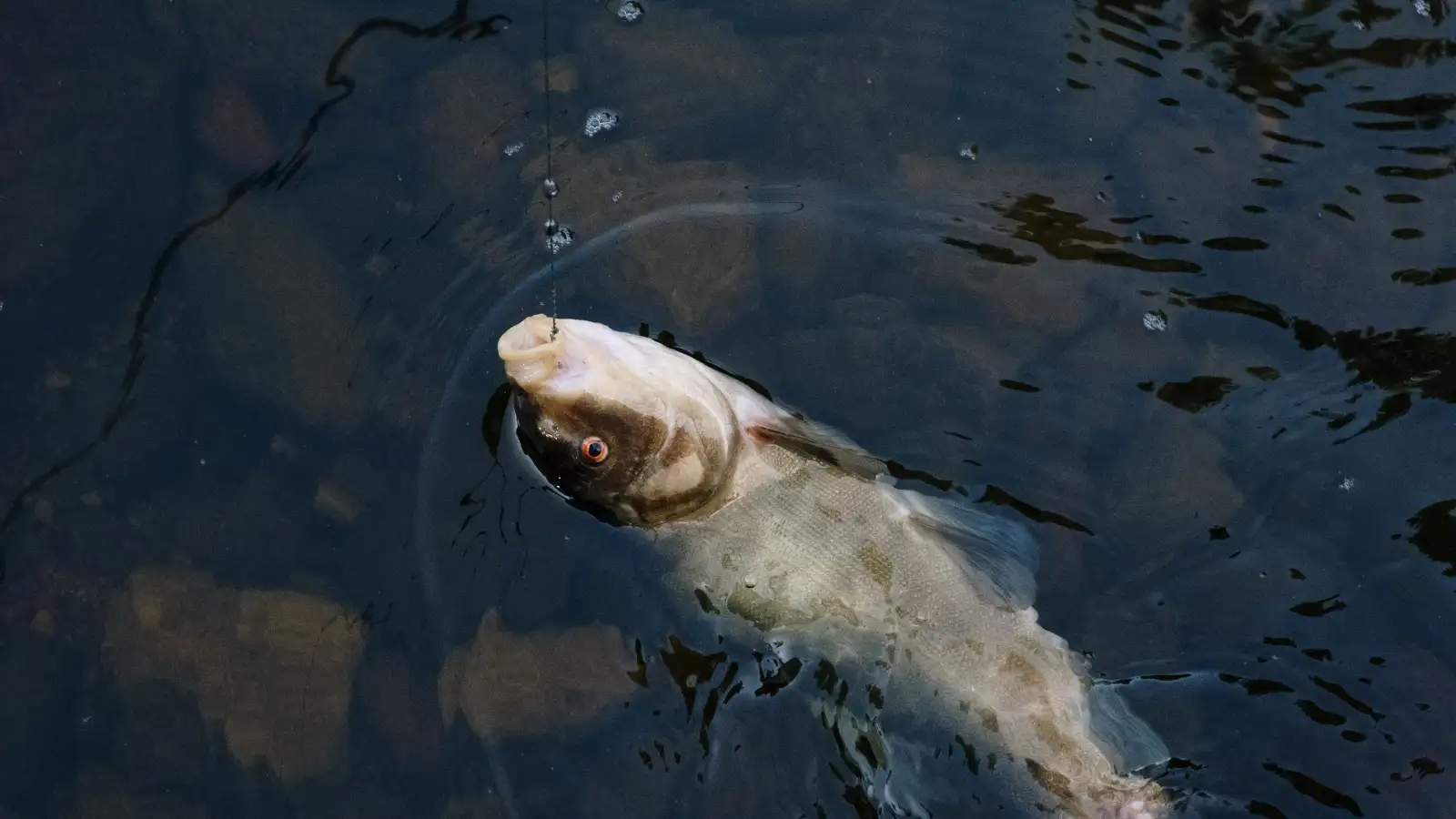
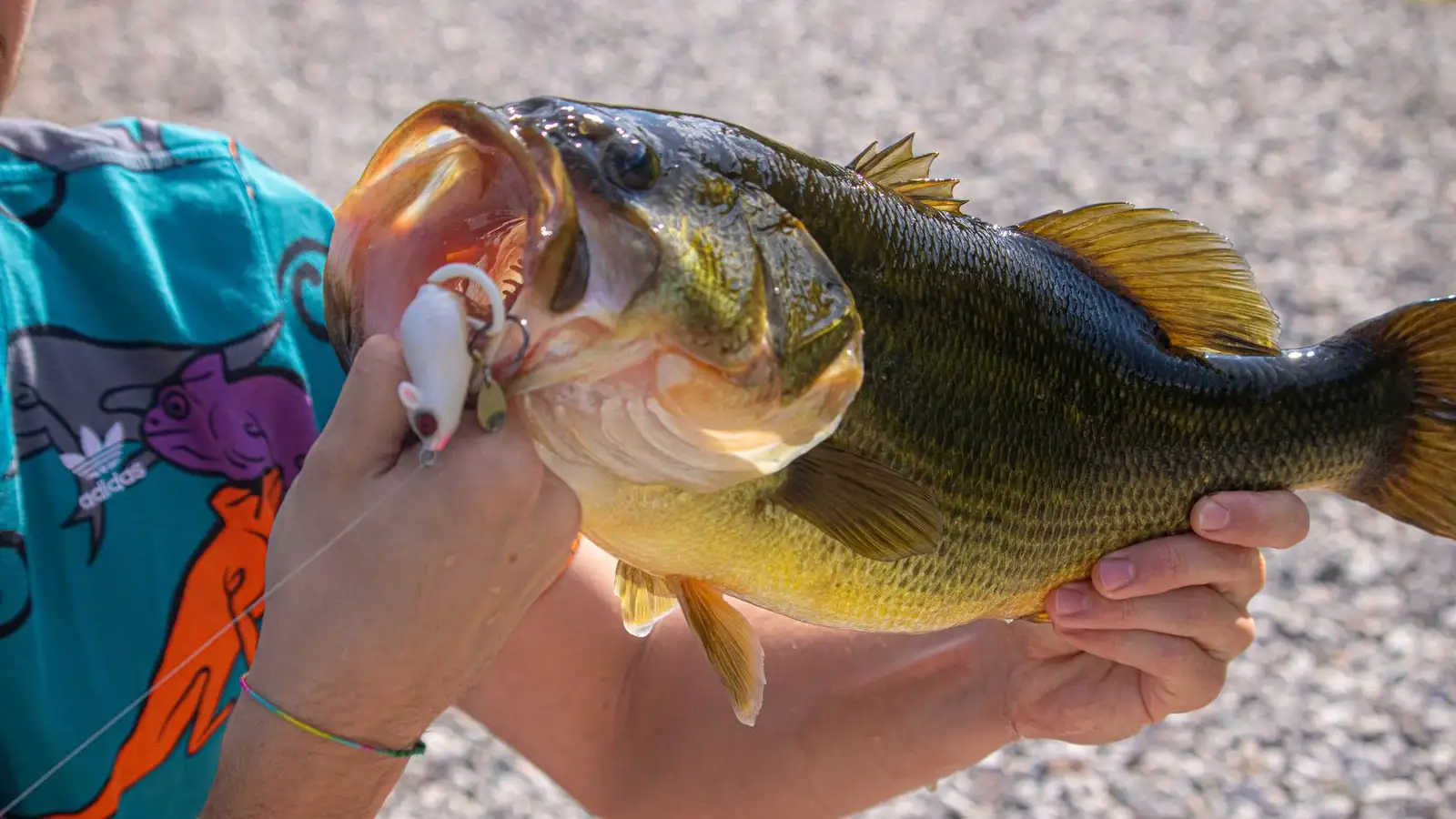
Three checks settle almost every bass identification before the fish ever comes into the net: where the upper jaw ends in relation to the eye, whether the dorsal fin is deeply notched or connected over one shallow line, and how far the mouth actually opens. A fourth check — where the fish was holding when it ate — confirms or overrides the other three. That last one matters more than most people give it credit for, because in water that holds all three species, any single physical mark will eventually lie to you, and the address is usually the tiebreaker.
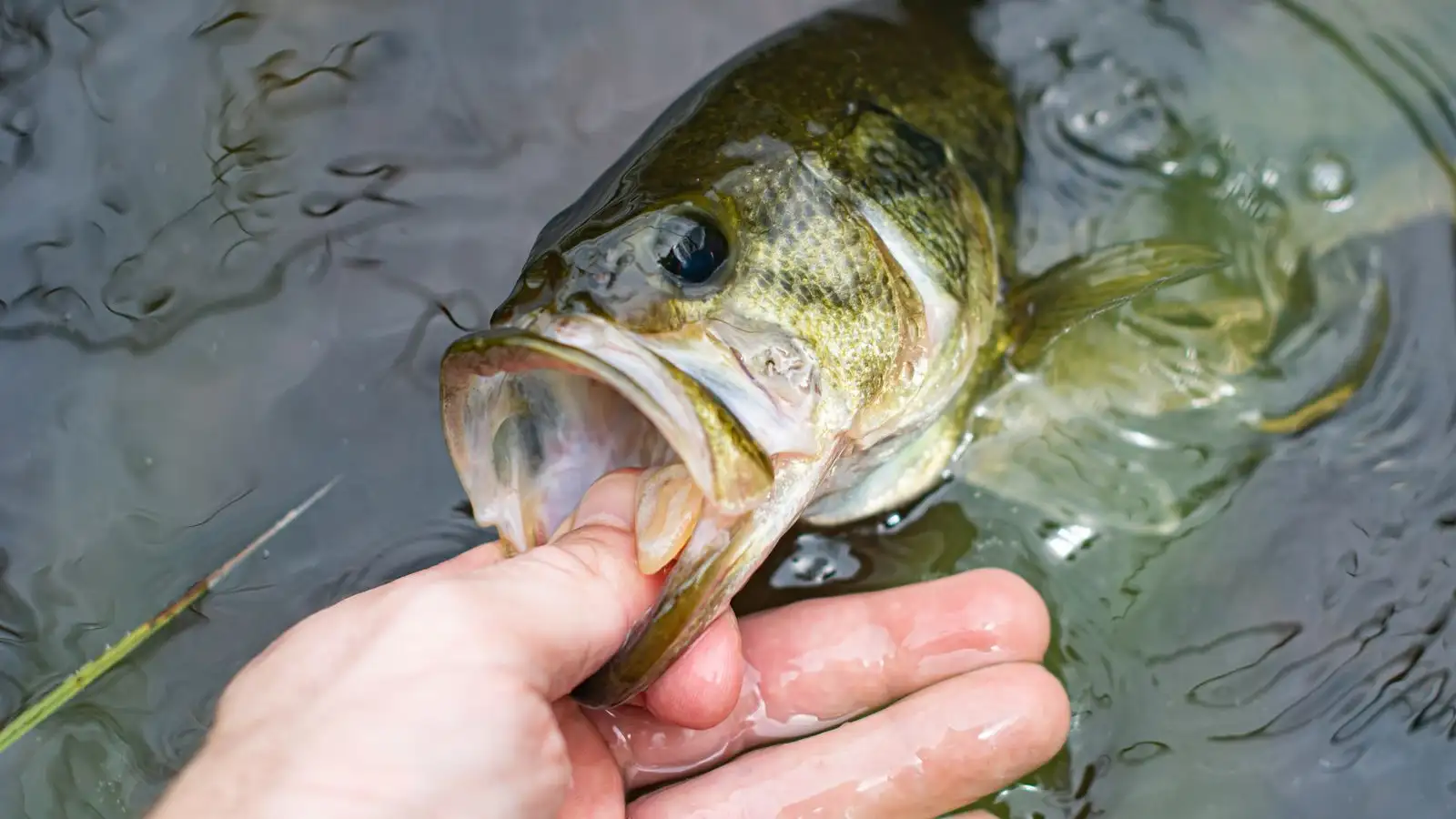
My thumb goes to the tongue before my eyes get to the side of the fish. There's a tube jig hanging off the corner of the jaw, the net is still flat on the deck because I haven't decided yet whether this fish is coming over the gunwale, and the pad of my thumb is pressed against the back of the mouth. Sandpaper. That little rasp of teeth on the tongue, and now I know what I'm dealing with and I know there are more of them down there, because spots run in packs. If the tongue had been slick as wet glass, I'd have been looking at a smallmouth in the same twenty feet of water, and the next three casts would have gone somewhere completely different.
That's the whole point of this. Identification isn't a label you put on a fish after the photo. It's a prediction you verify in your hand, and it changes what you do in the next thirty seconds.
The jaw line, checked with the mouth closed
Close the fish's mouth and look at where the upper jaw ends relative to the eye. On a largemouth, that hinge runs past the rear edge of the eye — on a good fish, well past it. On a smallmouth, it stops around the middle or back of the eye and goes no further. On a spot, it's the same neighborhood, roughly even with the eye.
That single mark is the fastest one you have, and it's also the one that lies the most. Big spotted bass push their jaw out further than small ones, and I've held spots that made me second-guess myself for a full minute. A ten-inch anything has a jaw relationship that reads mushier than a four-pounder's. So the jaw is a filter, not a verdict. It tells me whether I'm still in the running for a largemouth. If it's past the eye, I stop there and don't bother with the rest.
The dorsal fin answers one question only
Run a finger along the back. Largemouth have a deep notch between the spiny front section and the soft rear section of the dorsal — so deep on some fish that it reads as two separate fins. Smallmouth and spots have a shallow dip with a membrane bridging it.
Here's what people get wrong: this check separates largemouth from everything else. It does not separate a smallmouth from a spot. If you're standing on the deck trying to use dorsal notch depth to decide between those two, you're using the wrong tool, and you'll convince yourself of either answer depending on the light. I use it early, on a green fish still thrashing half in the water, because I can see it from above without lipping anything.
Which leaves the tongue, the eye, and the rows of spots
Once largemouth is off the table, three marks do the real work. The tongue patch is the most reliable — spots carry a distinct rough tooth patch, smallmouth have a smooth tongue, and largemouth sometimes carry a weak, rounded patch of their own. That last part is why I never run the tongue check on a fish whose jaw already told me it's a largemouth. It's a smallmouth-versus-spot test.
Coloration helps and shouldn't be trusted alone. Smallmouth run bronze with faint vertical bars and usually a red eye. Largemouth wear a broad dark horizontal band down the side and a jaw that's often lighter than the rest of the head. Spots have broken rows of dark marks below the lateral line. All three of those washes can flatten out in cold, deep, or muddy water, and largemouth blotches can look like spot rows on a pale fish. Marks are confirmation. Structure and behavior are the argument.
The address: cover and current
Ask where the fish was when it ate. A bass buried in milfoil, pads, or laydown wood in two to eight feet of warm, still water is a largemouth almost every time. A fish that came off chunk rock, gravel, or a boulder in current is a smallmouth, and it was probably facing upstream, sitting in the seam behind the rock rather than in the fast water itself. A fish that ate in open water, off a main-lake point, suspended over a channel edge, or in the tailrace below a dam is a spot until proven otherwise.
The spot address is the one that surprises people. They live deeper than most anglers instinctively fish — fifteen, twenty-five, thirty feet on hard bottom, or suspended in the water column over structure with no visible cover anywhere near them. If your sonar shows a wad of fish stacked over a channel swing in forty feet, and you drop straight down on them, you're fishing for spots whether you knew it or not.
Where the three overlap, this becomes the deciding check rather than a supporting one. There are plenty of lakes holding all three within a mile of each other, and the fish that looks ambiguous in the hand is usually resolved by remembering exactly what it was sitting on.
The fight arrives before the fish does
You get a species read twenty seconds before you see anything, if you're paying attention.
Smallmouth are the ones that take line in long, angry runs, jump more than once, and come back for more every time you think they're done. Largemouth bulldog — short heavy surges, head shakes you feel through the rod butt, an urgent lean toward the nearest cover. Spotted bass fight deep and in circles, tight and relentless under the boat, and they rarely show you their side. When a fish has been grinding under the keel for a full minute without ever going airborne, I'm already leaning toward spot, and I'm already reaching for the jaw when it comes up.
The fight tells you something else practical: how hard to push. A largemouth heading for a dock piling gets leaned on. An open-water spot that's been circling in thirty feet has been pulling against a dragging fish all the way up, and horsing it just tears a bigger hole. Knowing what's on the other end before it surfaces is a landing-rate decision, not a curiosity.
Beds tell you which species you are looking at
Spawning behavior is the most useful habitat read of the year, and it's also the one that gets treated as an absolute when it isn't.
Largemouth nest shallow — the backs of pockets, protected flats, hard bottom in inches to a couple feet of water, often near wood or a stump. Smallmouth nest deeper, on gravel and rock, frequently on main-lake flats and points, in that four-to-ten-foot band where you can still see the bed on a calm morning but you're not sight-fishing in the conventional sense anymore. Spots usually spawn deeper still, and in current on river systems.
So if you're up shallow with polarized glasses looking at a pale circle in a foot of water, you're looking at a largemouth. If the beds are on gravel out on a point in six feet, smallmouth behavior is the better bet — but not a guarantee, because spots use similar ground, and short of seeing the fish on the bed you can't always separate them. Nest location narrows the field. It doesn't seal it.
It also changes your presentation. Bedding largemouth get a bigger, softer offering worked slowly and left in place. Bedding smallmouth get a small tube or a drop-shot bait, and they want it close. And if the fish you're looking for spawns deeper than your eyes can reach, you're fishing electronics and drop-shotting structure, not peering through the surface.
Bedding fish are the most vulnerable bass in the lake, and how much pressure you put on them is a judgment call you get to make. Making it deliberately starts with knowing which species you're actually looking at.
What the identification changes
Every one of the checks above exists to change a decision you're about to make anyway.
A largemouth means fishing cover, not water — pitching and flipping, slow and close, with a bait big enough for a mouth that opens wide enough to swallow your fist. A smallmouth means rock and current, faster reaction baits, a crankbait burned through the seam, a tube on the drop, a fish that chases rather than ambushes. A spot means looking out, not in — off points, over channels, in schools, on the sonar, and often vertical. Those are three different days on the same lake.
And practically: a fish I've identified before it comes over the gunwale is a fish I handle once. Net, jaw, hook out, back in the water. The alternative is a bass flopping on carpet while I stand there flipping it over trying to figure out what it is, which is worse for the fish and worse for the next cast.
So run the checks in order. Jaw first, because it's fast and it clears the biggest category. Dorsal notch if you're on a green fish you don't want to touch yet. Tongue, eye, and mouth size to split the two that look alike. Then the address and the fight as the checks that were there all along, telling you what you were looking at before you ever got your hand on it.