Rigging a kayak for fishing doesn’t need to be a Saturday project. Strip it down to what actually helps you catch fish, ignore the rest, and you’ll finish in under an hour. This article lays out that path — a setup you can build in one push, with tools you probably have in the garage, and no steps that require you to watch a separate how-to video afterward.
What stalls most beginners is the feeling that a working fishing kayak has to look like a tournament boat before it ever leaves the driveway. That’s not how fish see it. A boat that moves quietly, keeps two rods and a few lures within arm’s reach, and holds position in a light current is ready. The process below is built around that minimum — time-boxed, sequenced bow to stern, and refined to cut out every unnecessary mounting bracket and accessory that doesn’t earn its weight on the first trip.
What the Kayak Looks Like After One Hour
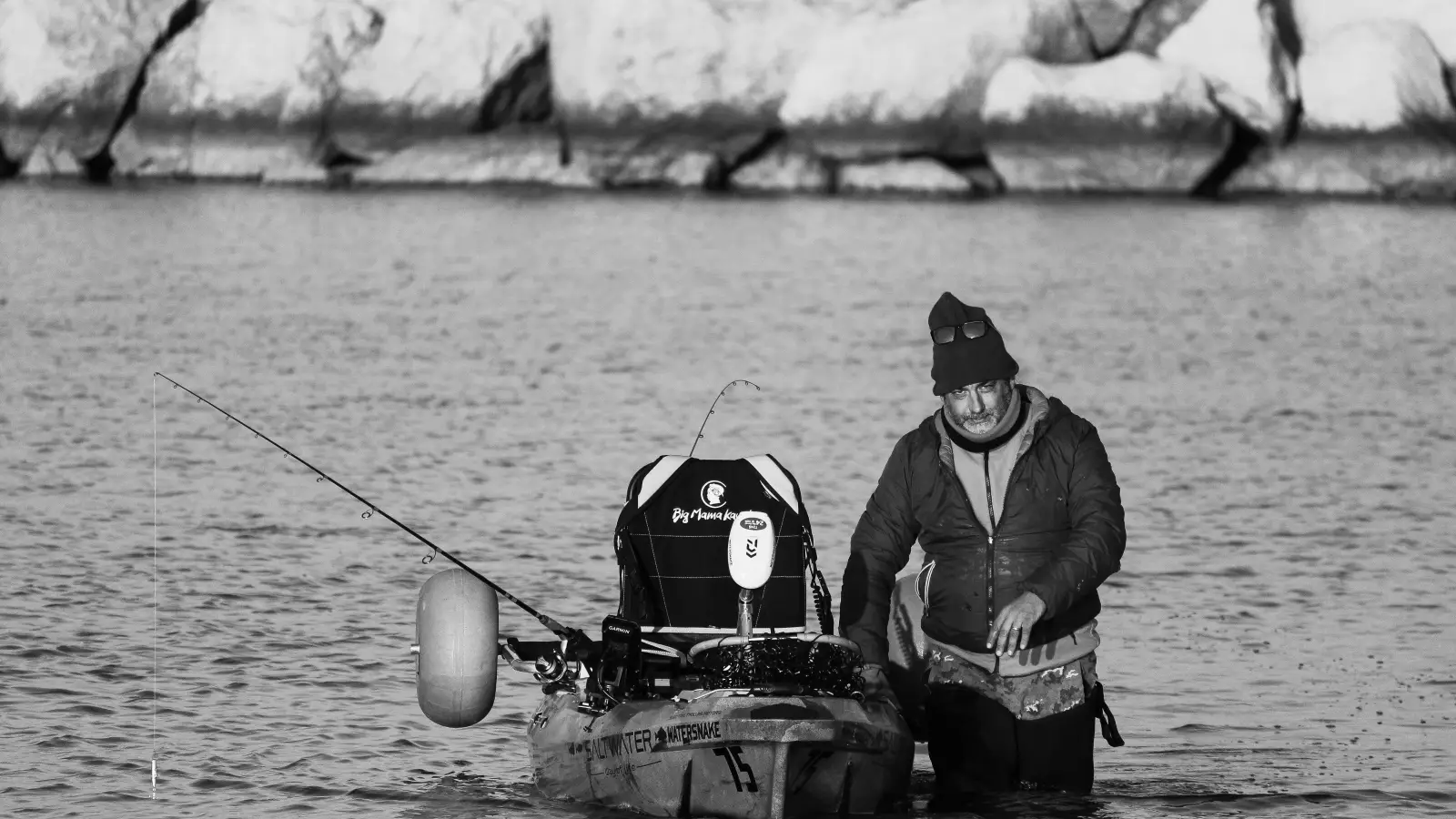
Two rod holders sit behind the seat, angled slightly outward so the rods clear your paddle stroke. A small tackle crate is strapped down tight, right where your off hand can open it without leaning. A single anchor line runs through a cleat at your hip. Paddle and rod leashes keep the important gear attached. A stiff safety flag marks your position above the water. From the seat, everything you need is reachable without twisting past the point of balance.
The Under-an-Hour Setup: Eight Actions in Sequence
- Mount two flush-mount rod holders behind the seat
- Secure a small tackle crate with cam straps
- Install a paddle leash and one rod leash
- Attach a safety flag and a whistle on your PFD
- Rig a manual anchor line or stake-out pole
- Tie a short bow line for shore stops
- Sit in the boat and adjust every reachable point
- Load a single trip’s amount of tackle
What to Do at Each Step
Mount the Rod Holders: 15 Minutes
Use a kit that includes a backing plate — the goal is to spread load, not just hold a tube. Clip the template to the deck behind the seat, checking that the rod butt won’t jab the seatback when you’re sitting. Drill cleanly, seal each hole with marine silicone, and bolt down with hand pressure plus a quarter-turn with a wrench. Most people mount them so far back they have to stretch and risk capsizing to get a rod out. Lean forward from your usual paddling position and mark where your hand naturally lands before drilling.
Secure the Tackle Crate: 5 Minutes
A standard milk crate or a purpose-made kayak crate works. Run two cam buckle straps through the bottom of the crate and around pad eyes or scupper holes. Tighten until the crate won’t shift when you grab and shake it. Put a short bungee over the top as a quick lid. The common error isn’t the strapping — it’s loading the crate like a base camp instead of a day trip. Plano boxes for topwater, mid-column, and bottom lures, plus a small terminal tackle bag. If the crate feels heavy when you lift it with one hand, pull stuff out.
Rig the Paddle and Rod Leashes: 5 Minutes
Clamp the paddle leash to the shaft outside your normal grip, then tie the other end to a pad eye you can reach while leaning forward. For the rod leash, pick the one rod you’ll have in hand most often — you don’t need to leash a backup that stays in the holder. Knot it to the rod butt with a loop that won’t slip, and secure it to a nearby anchor point. The failure point is length: a leash that’s too short turns a dropped rod into a shock load that can snap line or hardware. Give yourself enough to cast without the leash going taut.
Set Up the Safety Flag and Whistle: 5 Minutes
Slide a 48-inch reflective flag pole into an empty rod holder or a dedicated base. The pole needs to be stiff enough to stand upright when the boat is moving, not fold over like a wet noodle. Use a pea-less whistle — zip-tie it to your PFD shoulder strap so it’s always there. The mistake is mounting the flag in a position where your own head or a rod blocks it from the view of an approaching boat. Give it the highest, clearest line of sight you can.
Create Simple Position Control: Anchor Line or Stake-Out Pole — 10 Minutes
For an anchor, run a 50-foot length of 3/8-inch anchor line through a jam cleat mounted near your hip. Attach a 3-pound folding grapnel anchor with a quick-release knot so you can ditch it fast if a wake hits. No trolley required. If you fish in 4 feet of water or less, skip the anchor entirely and use an 8-foot fiberglass stake-out pole slipped through a scupper hole. The danger point: deploying an anchor without a quick-release setup. In current or wind, a pinned kayak can swamp fast.
Add a Bow Line: 2 Minutes
Tie a 15-foot floating line to the bow grab handle. Coil it tight and tuck it under the forward bungee. The misuse is leaving the coil loose where it can slide off and end up under your feet while you’re landing a fish. Two minutes, done right.
Do the Sit-and-Reach Test: 7 Minutes
Get in the boat on dry ground or in shallows. Reach for both rod holders, the crate lid, the anchor cleat, and the flag. If any movement forces you to twist your upper body more than roughly 45 degrees, shift the mounting point. The step that gets skipped is this one — because everything looks fine from outside the hull. It rarely is once you’re sitting in it.
Load Day-One Tackle Only: 2 Minutes
Three lure boxes — maybe a topwater, a suspending jerkbait, a jig box — and a bag of soft plastics. Add pliers, a dehooking tool, and a small waterproof pouch with basic first-aid items. If the crate needs both hands to move, you overpacked. This crate is an in-reach toolbox, not a mobile warehouse.
Five-Second Check Before You Drive Away
- Crate doesn’t rattle when shook; straps and bolts are tight
- Anchor line holds when you pull firmly by hand at the cleat
- Rod leash lets you complete a full casting motion
- PFD is on your body, whistle attached
- Bow line coiled and stowed out of the paddle arc
Keep This List Handy While You Rig
Eight actions, in order, with time targets. Save it on your phone or print it before you start:
- Install rod holders (15 min)
- Strap down crate (5 min)
- Attach leashes (5 min)
- Mount flag and whistle (5 min)
- Rig anchor or stake-out pole (10 min)
- Tie bow line (2 min)
- Sit and adjust reach (7 min)
- Add day’s tackle (2 min)
Answers to Questions Beginners Actually Ask
Will this setup work on a sit-inside kayak?
It will. The rod holder mounting might need a rail adapter, but the process is the same. Seal any drilled holes completely on a sit-inside — they drain slowly and a leak is harder to spot until it’s serious.
Do I need power tools to get this done?
For a rotomolded kayak, you’ll need a drill with a 7/8-inch hole saw for the rod holders. The rest uses straps and existing hardware. It’s a short job — borrow the drill if you don’t own one.
What if I plan to add a fishfinder later?
Leave it out of this round. Installing a transducer and routing wires adds time and decisions that break the under-an-hour goal. Fish without electronics for a few trips first. You’ll learn exactly where a screen won’t block your leg path, and the install will go faster because you already know the boat.
How do I know my kayak can carry the extra gear?
Add your body weight plus 30 pounds for the gear listed here. If that total is under 70% of the kayak’s maximum capacity, the boat will still handle well. Above 75%, stability drops noticeably.
Is the crate really needed? Could I just wedge gear under the seat?
Under-seat space works for stuff you touch once — a rain shell, a spare spool. Hooks, pliers, and lures need to be reachable without leaning off-center. A strapped crate puts everything in one motion, and you can lift it out whole when you’re done for the day.
How to Cut the Time Even Further on Your Next Boat
Pre-assemble the rod holder backing plates, the crate strap setup, the paddle leash knot, and the flag pole at your workbench. When you get to the kayak, every step becomes pure mounting — no measuring, no untangling, no last-minute hardware store runs. That one habit alone drops the total under 45 minutes, leaving time to spool a fresh reel before you hit the water.