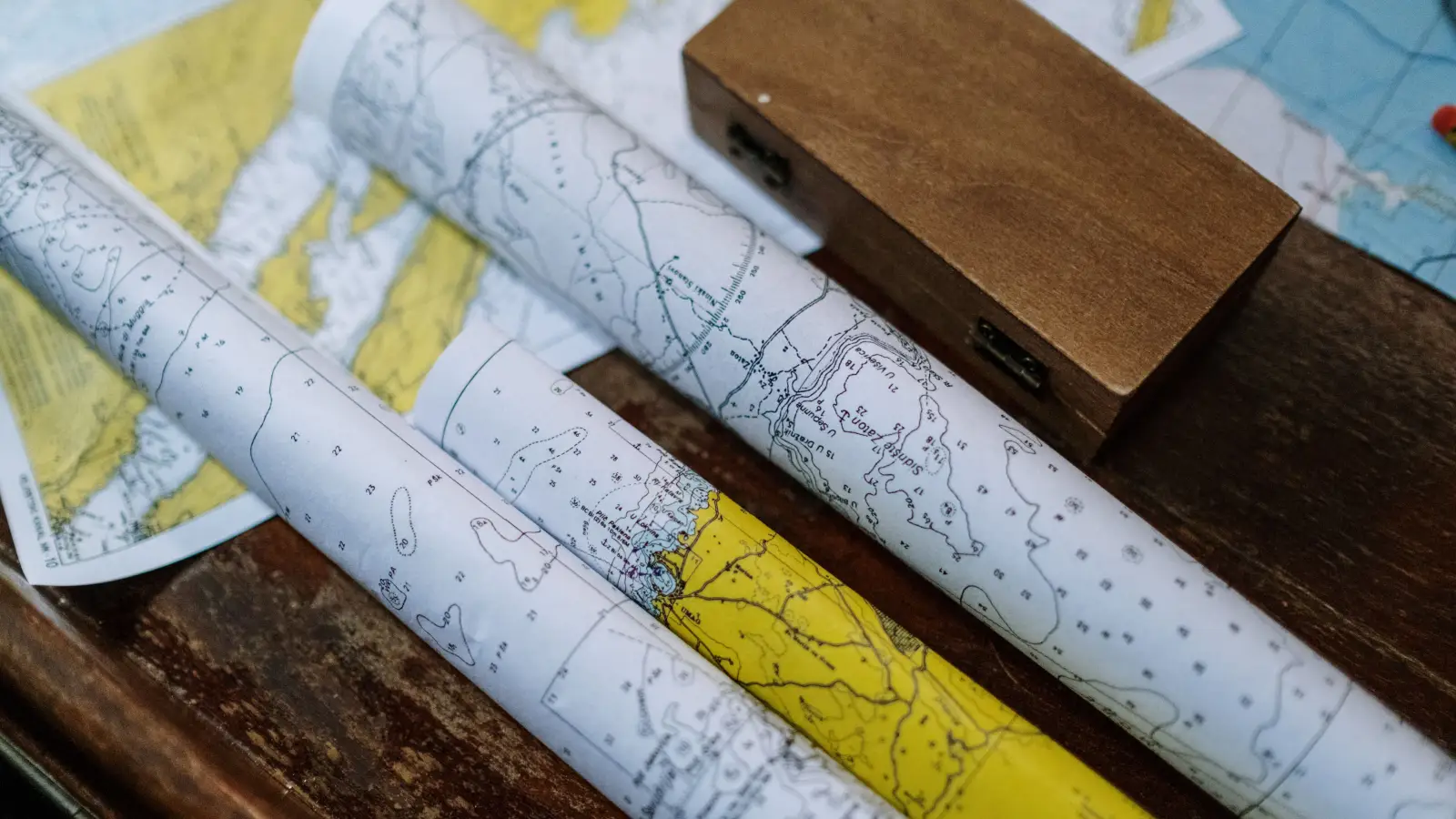
A point on a contour map screams fish, but a point alone doesn't catch them. Time of day, water temperature, and season decide whether that point is a hotspot or a waste of time. This article builds a decision tree from one map feature—a point or saddle—so you can predict exactly when it holds fish, and when you should motor right past.
The Decision Tree in One Quick Checklist
- Confirm the feature: a point (shoreline jutting outward) or a saddle (deep narrows between two high spots).
- Note the time of day and how cloud cover modifies it.
- Measure the surface water temperature.
- Place the date in the local fish calendar—pre-spawn, spawn, post-spawn, summer, fall.
- Cross-reference temperature with time of day to predict the depth zone fish are most likely using.
- Scan that zone for bait, current, or fine structure (stumps, rock piles) with sonar before wetting a line.
Is It Really a Point or a Saddle?
A true point has contour lines bending outward into the lake, creating a slope that drops on at least two sides. A saddle shows two high spots with a deeper channel running between them, typically pinching a passage. If the map feature doesn't match one of these shapes tightly, it's probably a shallow flat or a featureless bank—set it aside unless something else draws fish there. If you see a sharp point with quick access to deep water, note it as a high-confidence spot. If it's a broad, gradually sloping point, it's a low-confidence spot except under perfect conditions. Saddles demand that fish use them as a highway: if shallow water connects two deeper basins, the saddle becomes a choke point.
How Time of Day Shifts the Hotspot
Fish position on a feature changes dramatically with light. In low light—dawn, dusk, or heavy cloud cover—bass move shallower and prowl the top of points or the edges of saddle openings. In bright midday sun, they slide deeper or tuck tight against a drop-off. Branch here: if you're fishing early morning or an overcast day, target the point's tip and the adjacent shallow flat inside the point. If it's sunny midday, reposition to the drop-off at the point's base or the deepest part of the saddle's channel. A saddle fished at noon under clear skies often requires a bottom-hugging presentation right on the contour line.
Water Temperature Triggers When Fish Arrive or Leave
Temperature dictates activity level. Below roughly 55°F, fish are sluggish and prefer deep, stable water near the feature—think the deep end of a point or the center of a saddle. Between 55°F and 65°F, metabolism kicks in and fish stage on points and saddles that offer quick access to shallower feeding areas. When the water climbs above 70°F, the same fish often pull back to cooler, deeper zones, suspending off the feature or sliding into the main lake basin. Decision: if your reading is under 55°F, fish the deepest adjacent contour—not the point tip. If it's 55–65°F, the point tip or saddle opening becomes prime, especially if bait is present. Above 70°F, search for the thermocline near the feature and expect fish to be at or just below it.
Season Overrides Almost Everything
Season sets the biological imperative. Pre-spawn fish stage on points and use saddles to move toward shallow bays—time of day and temperature fine-tune this, but the movement toward the shallows is baked in. During the spawn, fish abandon the structure rules: they're on beds in protected flats, so a point nearby becomes a staging area before they lock on. Post-spawn, they transition back through the same features in reverse, feeding heavily. In summer, the saddle becomes a deep travel lane, and points only fire early and late. Fall brings a feeding migration along points and saddles as fish follow bait schools. If it's pre-spawn, prioritize shallow flats adjacent to points regardless of time of day. If it's summer, ignore the point tip after 9 a.m. and look for deep saddle structure instead.
Putting It All Together: A Real-World Decision
Picture a point on the north side of the lake. It's late spring, 8 a.m., partly cloudy, water temperature 62°F. The tree says: pre-spawn season, comfortable temp, low light—fish should be staging on the point tip or the shallow flat just inside. Check 8–12 feet of water near the tip with side-imaging sonar. If you mark bait and arcs, cast a squarebill across the flat. If the screen is blank, drop a dropshot along the point's drop-off at 15–20 feet. No fish? Slide to the nearest saddle and repeat the temperature and time-of-day check; the fish may be using the highway instead.
What You Should See If You've Read the Feature Correctly
- After identifying the feature: your map's depth shading confirms a rapid depth change on at least one side of the point or within the saddle channel.
- After assessing time of day: surface activity or bird presence matches your depth prediction (e.g., bait skipping on the flat at dawn, nothing at noon).
- After checking temperature: your thermometer reads within the range that supports your predicted behavior.
- After combining all inputs: your sonar shows fish or bait at the exact depth zone you expected. If it doesn't, move one depth zone deeper or shallower before concluding the feature is empty.
If Something Went Wrong
You misread the water temperature. Temperature can vary widely across a lake. A point that should be holding fish at 62°F may read 58°F after a cold rain. Re-measure at the depth you're fishing, not just the surface. If the temp is below expectations, fish deeper.
The structure doesn't connect to adjacent cover. A point without stumps, rock, or grass is just a slope. Sonar reveals whether fish are there; if they're not, the feature lacks the micro-structure that holds bait. Don't spend more than 15 minutes proving a negative—move to a point with known cover.
Fish are on the screen but won't bite. Your depth prediction was probably correct, but the presentation speed or size is off. Change retrieve cadence before moving. If a crankbait gets no reaction, switch to a slower jig. If that fails, the fish could be neutral due to a pressure change—downsize and dead-stick it.
Frequently Asked Questions
What's the best time of day to fish a point?
It depends on water temperature and season. Generally, low-light periods—dawn and dusk—bring fish shallower onto points. But in mid-summer, even dawn can be slow if the water is exceptionally warm; fish may hold deep until the sun drops.
How does water temperature affect fish location on a saddle?
Cold water keeps fish deep in the saddle's channel; warm water in the right range (55–65°F) pushes them to the edges or through the saddle as they travel. If water exceeds 75°F, they may abandon the saddle entirely for deeper, cooler basins unless there's current.
Can I use this decision tree for different fish species?
The logic applies broadly, but temperature thresholds and seasonal cues differ. A largemouth bass acts differently than a smallmouth or walleye. Adjust the temperature ranges and spawning seasons to match your target species.
What if the map feature has no nearby deep water?
A point or saddle without quick depth change is low-percentage real estate. It will only produce during low-light periods in comfortable water temperatures, and even then, it's often a temporary stop rather than a holding area. Prioritize features with at least a 10-foot depth change within 50 yards.
How do I measure water temperature accurately?
Use a probe thermometer dropped to the depth you intend to fish. Surface readings can be misleading, especially in summer when the top foot of water is sun-warmed. Take a reading at your casting depth.
With this decision tree, you stop guessing and start knowing when a point or saddle is worth a cast. The natural next move is to take this mental checklist onto the water and refine your seasonal thresholds for your home lake.