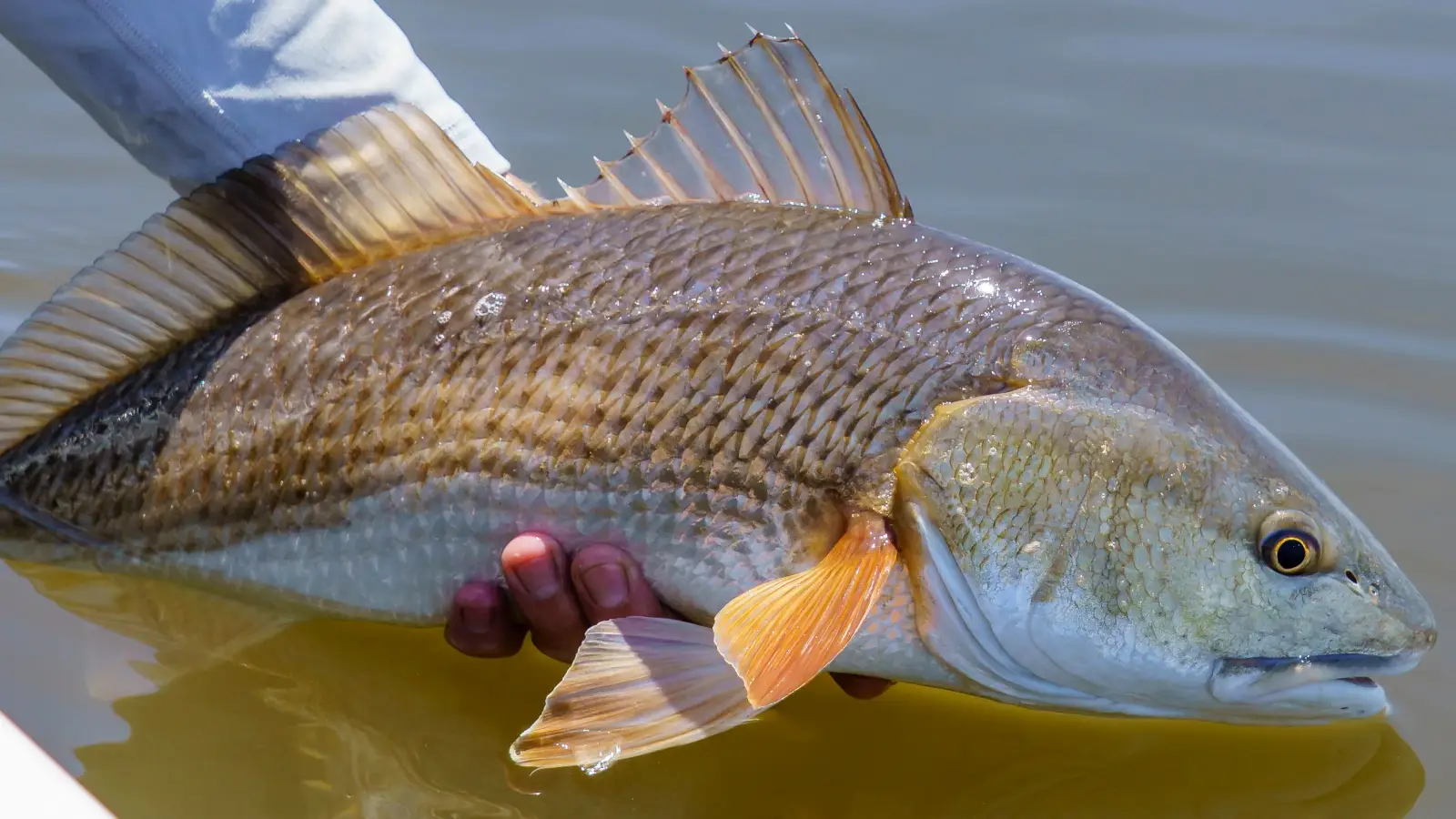
Guides find redfish by looking at the surface, not a sonar screen. Wind slicks, bait flickers, and color breaks are the map. Here’s how to read them.
The Five Surface Signals That Reveal Redfish Habitat
- Scan for color changes that break the flat’s uniformity.
- Trace wind slicks to locate current seams and structure edges.
- Watch for nervous bait—dimpling, fleeing mullet, or showers.
- Match those surface clues to likely bottom composition (grass, oyster, drop-off).
- Approach quietly and confirm with a test cast.
How to Read Each Surface Signal
Water Color as a Depth and Bottom Chart
Uniform color means uniform depth and bottom. A sudden shift—dark to light, green to brown—marks a change. Dark patches are deeper water or grass; pale water means a sandbar or hard bottom. The edge is everything. A crisp line between colors is a contour, the kind redfish cruise. A gradual fade is usually just soft silt, not worth your time. A dark, narrow ribbon winding through light bottom is a channel or grass line. That’s the target.
Wind Slicks: Signposts of Current and Structure
A slick is a surface tension break where water moves differently. It forms over current seams: a creek channel cutting a flat, tide running over a shell bar. When wind chop covers the flat, a persistent glassy streak marks structure. A long, narrow slick usually sits over a steep edge. A broad calm patch indicates a shallow bar deflecting flow. Glare isn’t a slick—slicks don’t shift when you move. A slick that floats with the wind is an eddy behind grass; the one that holds its line across the tide is the one with bottom under it.
Bait Activity: The Telltale Dance of Prey
Nervous bait means a predator is close. Mullet that shower in tight clusters are fleeing redfish. Scattered jumps are just mullet being mullet. Look for bait pinned against a grass line or point—that’s the ambush. A slow cruise is travel; a sudden eruption with fish clearing water is a strike happening now. Small flickers of glass minnows or anchovies tell the same story. Combine it: a slick, a color edge, and bait bunched on one side almost always means redfish below.
Matching Surface Signs to Underwater Lies
Connect the clues. A straight color shift with a parallel slick and bait on the shallow lip is a grass bank or ledge. A dark circle with a slick tail on one side is a pothole. Build the mental map: slick runs northeast‑southwest, deeper water on the north side, bait stacked on the shallow lip. Redfish hold deep and move up to feed. Get up‑current, drift into range, cast ahead of the slick edge.
Quiet Entry and the Verification Cast
Don’t throw right into the middle. Pick the edge: the color break, the head of the slick, or just past the bait. Cast soft. Shallow redfish spook on the first bad presentation. The first cast tests your read—a follow or take often comes in a few strips. If the water stays dead after a few drifts, the fish are deeper or the feature is empty. Leave it. Don’t flog empty water.
Verifying Your Read: Checkpoints for Each Signal
- When you get close to a color change, the bottom should shift (grass, mud, sand). If it looks the same, the surface light tricked you.
- Drift a piece of grass next to a slick. It moves along the edge? Current is real. If it crosses without deflection, there’s no seam.
- Bait staying in one spot, erupting every minute or so? That’s predators. If it’s just scattered and drifting, something else moved it.
- Combined signals with a quiet approach should produce a look. No look after several passes? Move up‑current or try the edge.
When the Water Lies: Misleading Signals and Fixes
Sun Glare Disguised as a Slick
Glare looks glassy but shifts when you move your head. Slicks stay put relative to the bottom. If the patch changes or disappears, it’s not current—drift past it.
Bait Activity from Non‑Redfish Predators
Jacks crash bait fast and loud, moving quick. Redfish push bait, tighter and more sustained. Look for bronze flashes, not a big dark blob.
Still Water That Doesn’t Reveal Anything
No wind, no slicks. Color changes flatten out. In dead calm, watch for subtle ripples or texture breaks; if the water’s clear, pole slow and look directly at the bottom. Grass edges and shell bars are visible then.
From Surface Clues to Hookup: Next Step
You now translate surface signs into a bottom map. The next piece is presenting a lure or fly without sound—quiet poling and soft casts keep the fish you just found.