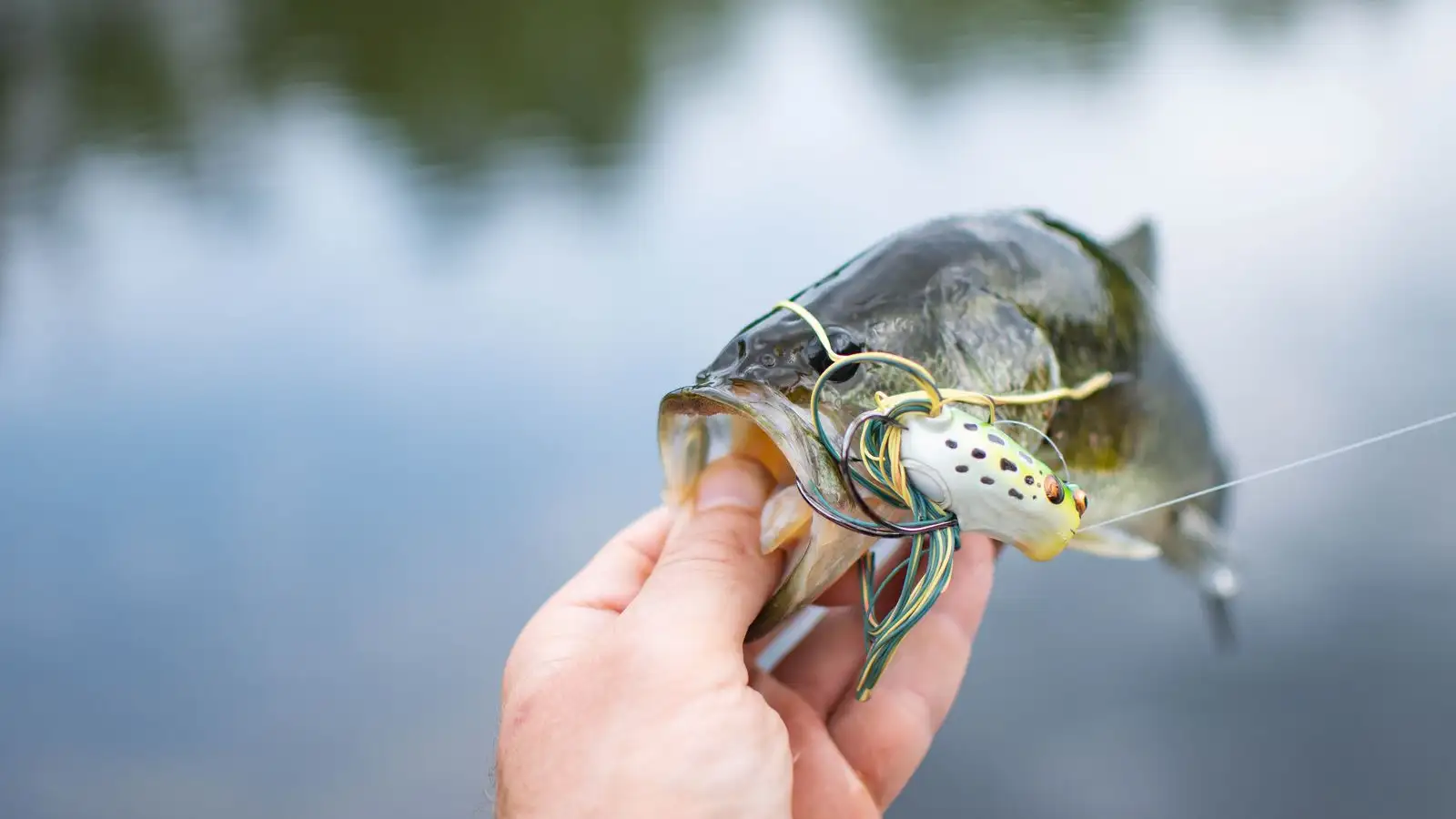
A bass bed identifies its builder before the fish ever shows itself, and the read comes in a fixed order: where the bed sits in the water body, what the bottom is made of, and how deep it is. Largemouth nest shallowest and softest, in the warmest, most protected corners — stumps, weed edges, backwater muck. Smallmouth nest on the hardest bottom available, gravel and rubble, usually where current moves across it, often in loose colonies rather than single nests. Spotted bass split the difference, on gravel and clay points and banks, frequently a little deeper than largemouth and often in the same reservoirs where the other two both live. The fish confirms the habitat. It doesn't come first.
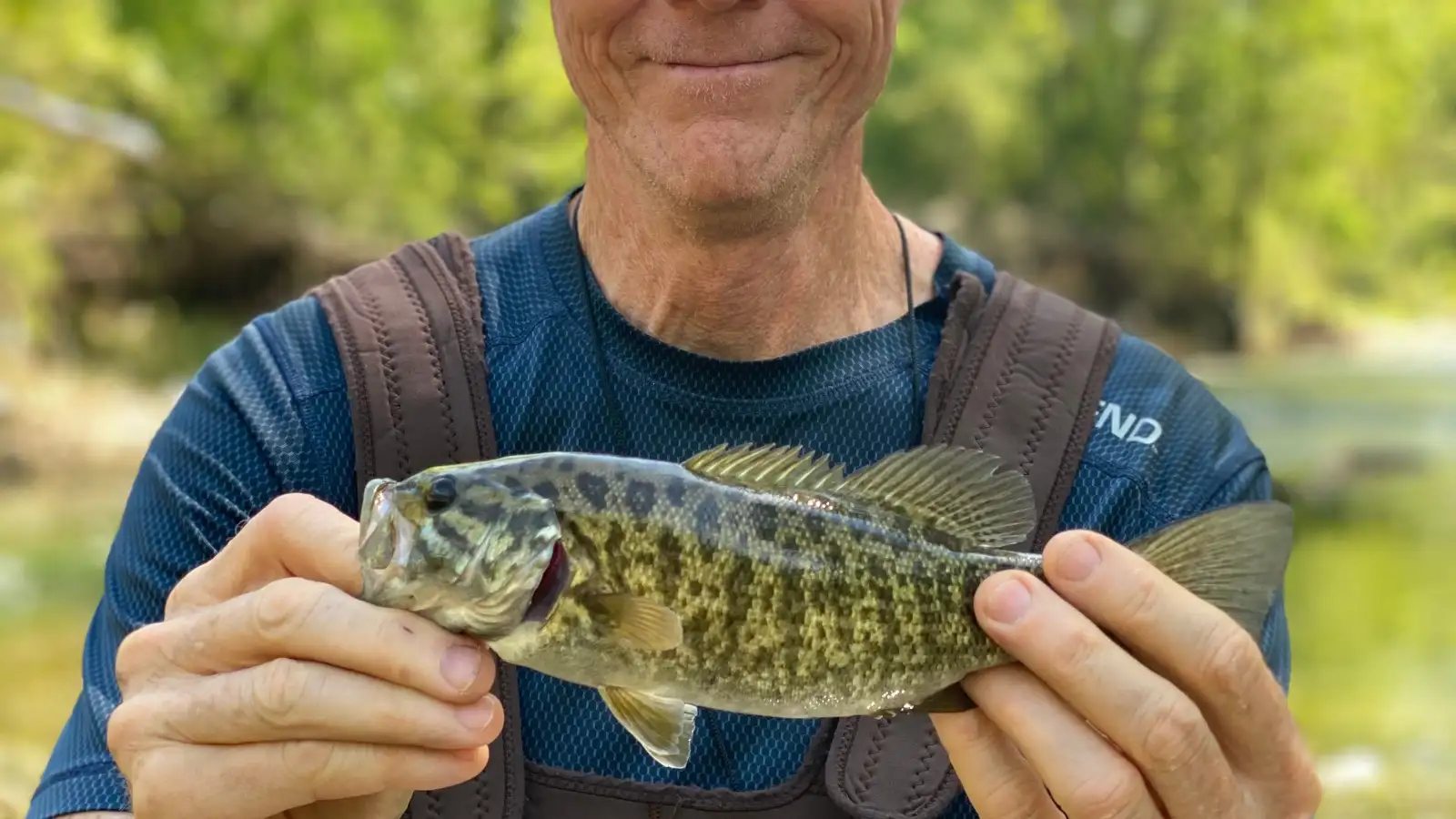
I was thigh-deep in a river running clear, and the bed was a pale circle about the size of a trash can lid, laid on gravel in moving water. Cold through the neoprene. Wind pushing upstream, killing the surface glare, bottom readable at six feet. That's the first thing you learn when you start hunting nests seriously — you see the clean spot before you see the fish. The gravel around it was dark and algae-slicked; the nest itself was scoured pale, a fan of swept stones with the tail end pointed downstream. The male was holding two feet off the upstream lip, dark as a tire, and he never left. Nothing about his size told me anything. The gravel under my boots told me everything.
Now walk that same picture a few hundred yards into the back of a creek arm. Two feet of water instead of six, warm on the top of your hand instead of cold, no current to speak of, and a bottom of soft dark muck with a stump and the edge of a weedline inside a cast. If there's a nest there, it's a lighter patch dished into the soft bottom with silt swept to one side, and the fish sitting on it is broad and green and unbothered by you. That's a largemouth bed. Not because largemouth can't use gravel — they will, in shallow protected water — but because what they're shopping for is warmth, quiet, and cover, and they take whatever bottom comes attached to that.
What each species is actually shopping for
That reframe is the whole trick. You aren't really asking "which species built this bed." You're asking what the fish that built it was optimizing for, and then matching that answer to the species you know are in your water.
Largemouth optimize for protection and heat. Shallow, out of the wind, near something — a stump, a log, a dock, a weed edge, a laydown. Soft bottom is common but not mandatory. Depth is usually measured in inches to a couple of feet, though in very clear water they'll push deeper to get away from light, and that's where people get fooled.
Smallmouth optimize for hard bottom and moving water. Gravel, rubble, fist-size rock, shell beds. In rivers they'll sit right in the current and the nest tail points downstream. In lakes they want wind-driven or current-swept rock, and they'll cluster — half a dozen beds within a short cast of each other, males facing out from the colony. That clustering is one of the most useful tells there is. Largemouth nests are usually scattered and singular; smallmouth nests often look like a neighborhood.
Spotted bass optimize for the in-between, which is exactly why they're hard. Gravel and clay points and banks, main-lake structure, often a few feet deeper than the largemouth in the same reservoir. They'll nest in loose groups too, and they'll use a point that looks for all the world like smallmouth water if the lake doesn't hold smallmouth. If it does hold both, that same point becomes the single hardest call on the lake, and you shouldn't pretend otherwise.
The order matters more than the ranges
People want a depth chart. Depth is the least reliable of the three signals and the one everybody reaches for first.
The same species nests deeper in clear water than in stained water. Deeper farther south than north. Shallower early in the spawn when the first wave of males moves up, deeper when a cold front shoves everybody back down. Any number I give you is a number for one lake on one week.
Position in the water body is far stickier. A largemouth bed in the back of a protected pocket is a largemouth bed almost anywhere you go. A nest in hard current on clean gravel is a smallmouth nest, full stop. So lead with position, let substrate narrow it, and use depth only as the tiebreaker — and expect depth to lie to you at least once a spring.
Timing helps too, because at the same latitude on the same water, smallmouth generally commit first. They'll start in the mid-fifties, spotted bass thread through that same window and just past it, and largemouth usually don't really settle in until the water is well into the sixties. Practically, that means you can find smallmouth beds already swept clean and empty while largemouth are still fanning in the backs of pockets a quarter mile away. Same lake, same weekend, three different stages — and in a mixed population, three different parts of the water body at once.
Confirming it on the fish
When the habitat read puts you on a fish you can actually see, three things settle it faster than anything else: the jaw, the tongue, and the pattern.
Largemouth — the upper jaw extends back behind the eye. The mouth is big and the hinge line is obvious.
Smallmouth — the upper jaw stops at or before the eye, and the mouth is noticeably smaller relative to the head.
Spotted bass — the jaw ends roughly under the eye, in between the other two, and there is usually a rough patch of teeth on the tongue. Neither largemouth nor smallmouth has that patch. It's the check people forget, and it's the closest thing to a clean answer you'll get on a fish holding still in good light.
Pattern helps as backup. Spotted bass carry distinct dark spots in rows on the lower half of the body, with a clearly marked lateral line. Smallmouth run bronze with vertical bars that often fade out. Largemouth show a broad dark band and a jaw hinge that reads like a hinge. The dorsal fin gives you one more clue — largemouth's is deeply notched, almost two separate fins, while smallmouth and spotted bass have a shallower connection, spotted slightly deeper than smallmouth.
What does not help is size. A big male of any of the three can be the same length as a modest fish of another, and bed fish are notoriously hard to judge without a reference. Stop trying to identify bass on a bed by how big they look.
When the habitat read lies
It lies more often than the internet admits, and knowing the failure modes is most of the skill.
Stained water and wind chop kill the read before it starts. If you can't see bottom, you're guessing on position alone and you should say so out loud instead of committing.
Deep beds vanish from view. Past eight or ten feet of clarity, you'll see the pale fan and nothing else, and a fan on a main-lake clay point is a coin flip between spotted bass and smallmouth in a lake that holds both.
Bluegill and other sunfish beds get mistaken for bass beds constantly. The difference: sunfish beds are saucer-shaped, shallow — often a foot or two — and packed into tight colonies where they overlap and merge into one big light patch. Bass nests are bigger, more separated, and dished with a lip.
Hybrids are real. Smallmouth and spotted bass cross in some waters, and those fish will show you a jaw that reads spotted and a mouth that reads smallmouth and no tongue patch at all. If a fish refuses to fit, it may genuinely not fit.
And finally: an empty nest is still a nest. Males get pulled off, females leave after the drop, and you'll find a perfectly good fan with nobody home. That's not a failed identification — it's just a bed you were an hour late for.
The habit worth building
Stand still. Find the clean spot. Read the position first, the bottom second, the depth last, and put a species on it before you ever see a fish. Then find the fish and either confirm it or throw your read out. Do that in order every time for a couple of springs and you'll stop guessing on the water you actually fish.
On your home lake, write yourself a local rule. In this reservoir, largemouth are in the backs of coves on muck at one to three feet, spotted bass are on clay and gravel points deeper than that, and smallmouth are on main-lake rock if they're here at all. Then next spring, go prove it.
One last thing, and it's the part that matters more than the identification. A bed you can see clearly is a bed the fish can't hide from either. Once you know what's on it, the practical move is to make it quick or leave it alone — a spawned-out male doesn't need to be caught twice in the same week.