The small, brightly colored sunfish you just slipped back into the water likely wasn’t a bluegill. Longear sunfish, pumpkinseed, and redear get lumped under that name so consistently that anglers lose the ability to recognize the differences. The fix is systematic: five physical checkpoints that cleanly separate the four species, and a logical order to apply them. Once you know the pattern, you stop guessing.
The Opercular Flap Gives You the Fastest Yes or No
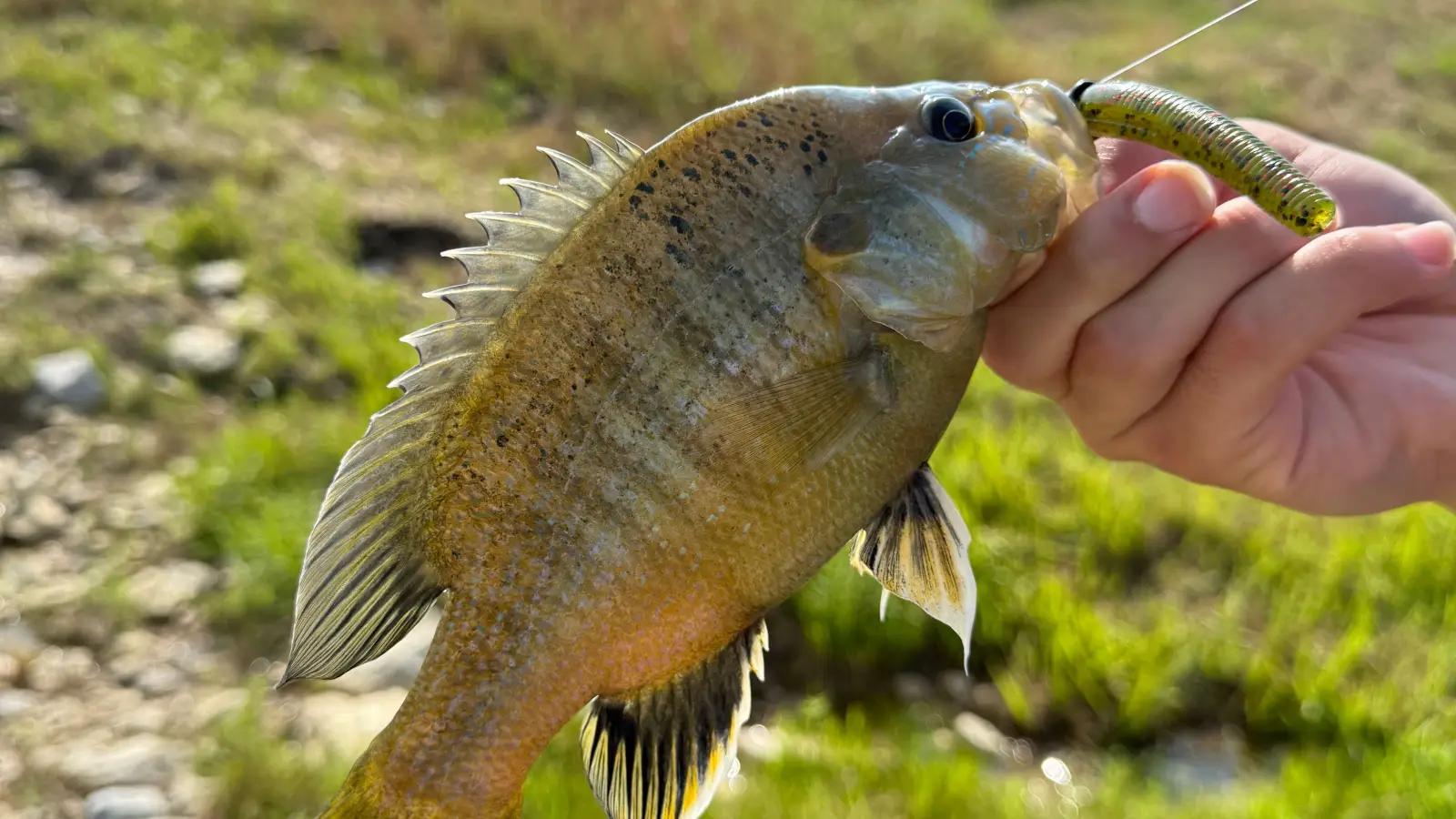
Skip body color as a first filter—it varies with water clarity, mood, and season. The opercular flap (the ear-like tab on the gill cover) shows far less individual variation within a species. If the flap is long, flexible, and bordered in white or pale blue, it’s a longear sunfish. A short, rigid flap that stays plain black points to a bluegill. Pumpkinseed and redear fall between these poles, each with a signature modification to the same structure. Sorting on the flap alone resolves the majority of mistaken-identity catches.
Quick Comparison: Bluegill, Pumpkinseed, Longear, Redear
| Feature | Bluegill | Pumpkinseed | Longear Sunfish | Redear Sunfish |
|---|---|---|---|---|
| Opercular Flap | Short, rigid, solid black with no pale margin | Short, stiff, black with a bright orange or red dot at the tip | Long, flexible, black with a distinct white or pale blue margin | Short, rigid, black with a red or orange crescent on the rear edge |
| Body Barring | 6–8 dark vertical bars on a bluish or olive back | Wavy blue and orange lines; often mottled, no clean bars | Faint bars or blotches; turquoise blue vermiculations on cheek | No bars; adults often plain olive sides or faint dark blotches |
| Primary Color | Blue-purple on lower cheek and gill cover; dark spot at rear of dorsal fin | Bright orange belly, blue-and-orange marbled flanks | Brilliant turquoise and orange; breeding male has bright orange belly | Olive to golden green; light yellow or orange belly in breeding males |
| Typical Size | 6–10 inches, deep-bodied, small mouth | 5–8 inches, very deep laterally compressed body | 5–7 inches, slightly more elongated than bluegill | 8–12 inches, bulkier body, larger mouth with molar-like throat teeth |
| Best Habitat | Ponds, lakes, slow rivers; near cover | Clear, vegetated shallows of lakes and ponds | Small, clear streams and rivers with gravel or rock | Lakes, reservoirs, ponds with snails and mussels |
Bluegill (Lepomis macrochirus)
The bluegill is the standard reference point, and that’s exactly why the confusion exists—other species get compared against it and mislabeled. The opercular flap is short, barely extending beyond the gill cover margin, and completely black with no pale border or colored spot. The body runs six to eight distinct, dark vertical bars. The lower cheek and gill cover show a blue-purple wash, and there’s a characteristic dark smudge at the rear base of the dorsal fin.
The limitation of these markers shows up in turbid water or when the fish is dark from stress: the bars wash out and the ear flap merges into the background. Then it’s best to check the small mouth (the jaw stops well short of the front of the eye) and the deep, almost circular body profile. Bluegill have noticeably rounded, saucer-like shapes that pumpkinseed exaggerate even further.
Pumpkinseed (Lepomis gibbosus)
Pumpkinseed share the short, stiff opercular flap with bluegill, but there’s a critical difference: the flap ends in a bright orange or red dot. The body lacks clean vertical bars entirely; instead, wavy blue, green, and orange lines run in a net-like pattern across the flanks, and the belly is a warm golden-orange. These fish are among the most colorful sunfish, but their identification can trip up anglers when the orange dot is faint in juveniles or when washed-out individuals lose contrast.
The backup is the combination of a highly compressed, almost disk-like body and stiff, short pectoral fins that don’t reach the vent. The dark opercular margin often forms more of a crescent than a dot in smaller fish, so check the mouth, too—pumpkinseed mouths are small, with the jaw ending under the front of the eye, similar to bluegill.
Longear Sunfish (Lepomis megalotis)
Longear sunfish are the species most constantly misread as bluegill. The opercular flap is the diagnostic feature that the entire set of checkpoints hinges on: it is long—often more than twice the eye diameter—and pliable, almost fin-like. Its black background is trimmed with a stark white or pale blue border. Breeding males take this to an extreme, and their cheeks light up with turquoise vermiculations that no other Lepomis in this set reproduces.
Beyond the ear, longear never display the crisp bluegill barring. Their sides show faint, irregular blotches or an even orange wash. The body is slightly less deep and more elongated than a bluegill’s, and the mouth reaches a bit farther back—roughly under the middle of the eye. In clear streams, the identification is obvious; in murky water, the flexible ear flap and cheek pattern hold up better than body color.
Redear Sunfish (Lepomis microlophus)
Redear are the heavyweights of the group, often called shellcrackers because they crush snails with molariform throat teeth. The opercular flap is short and rigid, like a bluegill’s, but carries a red or orange crescent on the rear edge rather than being plain black. The body is usually plain olive to golden-green, without vertical bars, though older fish can develop faint dark blotches. The mouth is noticeably larger—the jaw reaches near the front of the eye—and the pectoral fins are longer and more pointed than a bluegill’s.
In low light, the red crescent can look dark, so the best fallback is the absence of bars paired with that larger mouth and the elongated body. The crescent is present even on young fish, though it may be pale, so don’t rely on it being vibrantly red in every specimen. When all else fails, the body depth-to-length ratio alone points toward redear rather than the deeper bluegill or pumpkinseed.
Five Checkpoints That End the Guesswork
These five physical features, checked in order, turn a quick glance into a firm ID. Keep the fish in a wet hand or net and work through them systematically.
Checkpoint 1: Opercular Flap Length and Border Color
Hold the fish so the gill cover is fully visible. Compare the flap to the eye: if it’s at least twice the eye length and flexible, it’s a longear. A short flap with an orange or red dot belongs to a pumpkinseed. A short flap with a red crescent indicates redear. A short, solid black flap without any colored spot or margin is a bluegill.
Checkpoint 2: Vertical Barring and Body Markings
Look at the flanks. Bluegill reliably show six to eight dark vertical bars. Pumpkinseed have wavy, netted orange and blue lines—no straight bars. Longear carry weak bars or blotches over a bright orange underlay. Redear show no bars, only plain sides with possible diffuse dark mottling.
Checkpoint 3: Cheek and Opercle Color
Below the eye, patterns diverge sharply. Bluegill have a blue-to-purple wash on the lower cheek. Pumpkinseed display intense blue and orange vermiculations across the entire cheek. Longear shine with turquoise or emerald lines radiating like a fingerprint. Redear are the most subdued, with little cheek color beyond an olive tint and the unambiguous red ear crescent.
Checkpoint 4: Pectoral Fin Length and Shape
The pectoral fin position and length help when other features are ambiguous. Bluegill and pumpkinseed both have relatively short, rounded pectorals that end well ahead of the vent. Redear and longear have longer, more pointed pectoral fins that reach the vent or beyond, giving a more streamlined appearance when viewed from the side.
Checkpoint 5: Breeding Colors and Belly Hue
During the spawn, each species hits extremes that are hard to misinterpret. Bluegill males darken to a deep blue-black with an orange throat. Pumpkinseed males flare with orange bellies and electric blue cheek lines. Longear males develop a burning orange belly and a turquoise face pattern unmatched by the others. Redear males show a lemon-yellow or orange wash on the breast, but the red ear crescent remains the primary marker. Outside the spawn, rely on the ear flap, barring, and pectoral fin length in that order.
Match Your Catch to the Right Species
Use the water you’re fishing and the fish’s physical profile to make the call.
- You’re wading a clear, rocky stream and pull up a small sunfish with an ear flap that’s long, flexible, and trimmed in white. That’s a longear sunfish. The stream habitat alone narrows the field, and the flap locks it.
- You’re at a farm pond and the fish has dark vertical bars, a deep body, and a short, all-black ear flap. Classic bluegill. Even when the bars are faint, the combination of pond habitat, body depth, and flap shape confirms it.
- A weedy lake flat produces a fish with wavy blue-orange lines, a short black ear flap tipped in orange. Pumpkinseed. The dot on the flap is definitive; the wavy body markings are secondary confirmation.
- You’re fishing a reservoir and catch a larger sunfish with plain olive sides, a red crescent on the ear, and no bars. Redear. The red crescent is present even on small specimens, so check that edge first.
Common Questions About Sunfish Identification
What is the fastest way to tell a longear from a bluegill?
Look at the opercular flap length and flexibility. A bluegill’s flap is short, stiff, and solid black. A longear’s flap is visibly longer—often more than twice the eye diameter—and has a clean white or pale blue margin.
Can pumpkinseed and longear produce hybrids?
Hybrids occur occasionally. When the parentage is uncertain, rely on the opercular flap length: longear-influenced fish typically retain an elongated flap relative to pumpkinseed. Pumpkinseed hybrids rarely show the intense turquoise cheek lines of a pure longear.
Do these species taste different?
Differences are minimal. All produce good white, flaky fillets. Redear sometimes yield a slightly firmer texture due to a snail-based diet, but cooking method overshadows any species-based variation.
Are there other sunfish that look like these four?
Green sunfish and warmouth both have larger mouths and different ear flaps. Green sunfish have a short flap with a white margin, but the mouth extends well past the middle of the eye, which immediately separates them from the four species covered here.
A practical sequence cuts through every ambiguous catch: check the opercular flap first, then the body bars, then the cheek pattern. Three checkpoints in ten seconds will handle nearly every panfish you encounter.