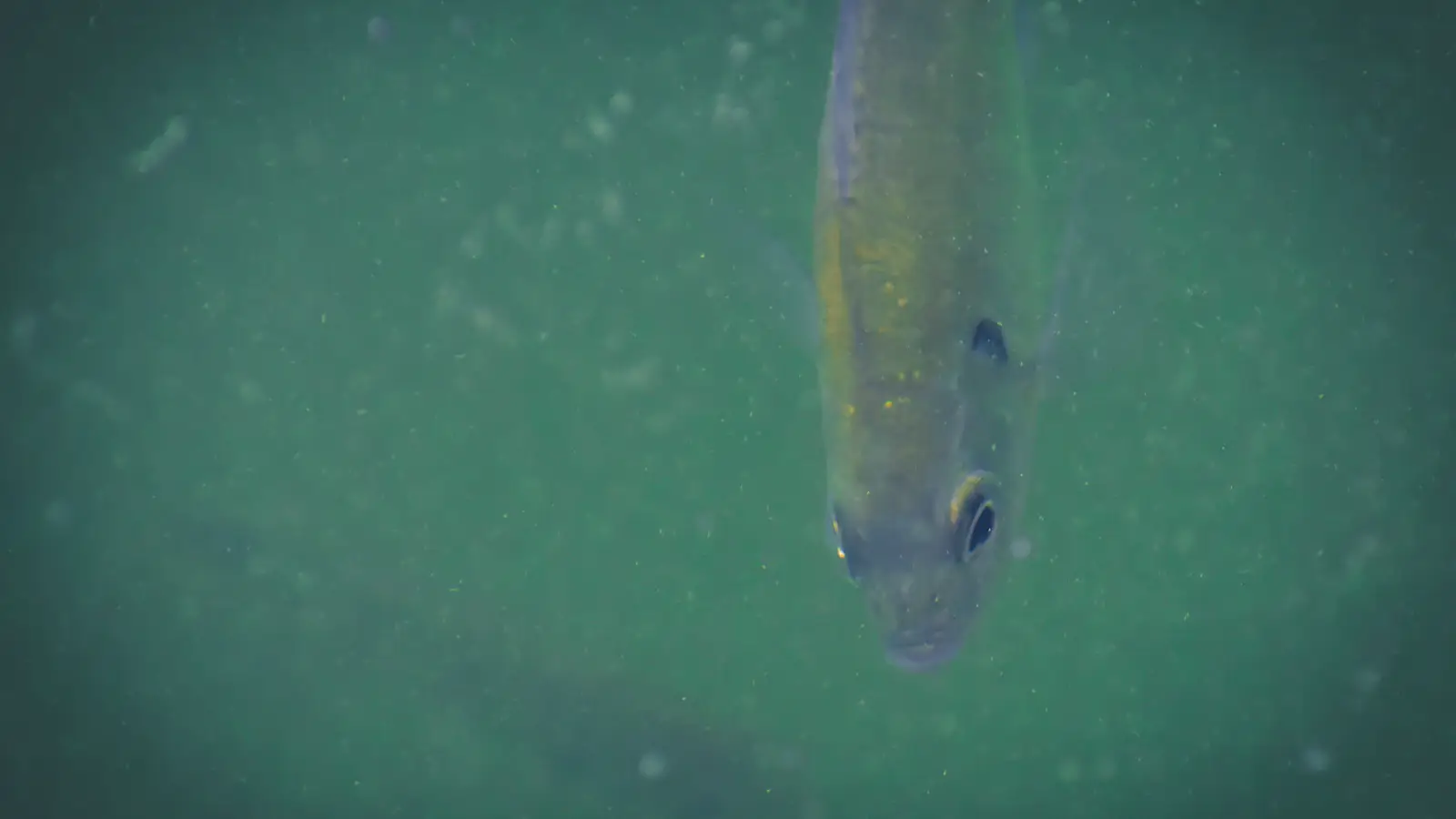
Stained water doesn’t carry a simple label. It can concentrate fish close to cover or empty an entire flat, and the dividing line isn’t how muddy the water looks—it’s how much light still reaches the zone where fish feel safe and can feed. The framework that follows replaces guesswork with three measurable thresholds: light penetration, comfort, and feeding visibility. Once you learn to read those signs, you’ll be able to walk up to any stained-water scenario and know where to cast, regardless of the species you’re after.
Light Penetration: The First Lever in Stained Water
Water clarity works as a dimmer switch, not a simple on/off filter. Every foot of depth steals a percentage of the surface light, and in stained water that theft happens fast. A lake where you can see bottom at 12 feet holds fish at depths that would be pitch black in water with 18-inch visibility. That compression is the first piece of the puzzle: the fish aren’t just picky about clarity—they’re confined to the thin slice of the water column where there’s still enough light to hunt.
Understanding this light layer is step one in the framework. Rather than judging the entire body of water as good or bad, ask: how deep is the light, and where does that intersect with cover, bait, and bottom structure?
A Quick Reference: Visibility and Light Depth
| Water Clarity (Visibility) | Approximate Feeding Light Depth | Typical Fish Position |
|---|---|---|
| Clear (>4 ft) | 8–15 ft | Suspended or on deep structure |
| Moderately Stained (2–4 ft) | 4–8 ft | Top 10 ft, often near cover |
| Stained (1–2 ft) | 2–5 ft | Extremely shallow, behind objects |
| Muddy (<1 ft) | Less than 2 ft | Bank-hugging or absent |
These ranges are rough estimates—tannin-stained water might allow a bit deeper light than suspended clay—but the pattern holds: as visibility drops, fish move into the remaining bright layer or abandon the area if that layer disappears entirely.
The Comfort Zone: Why Fish Move Shallower in Stained Water
Reduced visibility changes a fish’s internal math. In clear water, a bass might feel naked and hold tight to deep brush. When visibility drops to a couple of feet, that same bass gains confidence to slide into the shallows, cruise the edge of a weed bed, or hang behind a single stump in open water. It’s less about bravado and more about the fish’s biological need for cover—dim light provides that cover.
But comfort has its ceiling. Muddy runoff that coats gills or drops oxygen can drive fish out even faster than clear water would. The framework doesn’t rely on memorizing each species’ tolerance; instead, check whether the stained condition is widespread and uniform or a localized plume, and whether baitfish are present. If bait is absent, the comfort threshold has likely been breached.
Feeding Visibility: The Strike-Zone Threshold
Even if a fish is comfortable, it still needs to see its prey to commit. Stained water shrinks the effective strike zone around a lure. A bass that would charge a crankbait from 3 feet away in clear water might not react unless the bait passes within 6 inches in murky conditions.
That doesn’t mean fishing stained water requires pure luck. Fish use their lateral line to detect vibration, so a noisy, thumping bait can draw attention from a distance. But the final strike almost always hinges on visual confirmation. The rule of thumb: assume a fish’s reaction distance is roughly half the current water clarity. In 18-inch visibility, expect a fish to strike only when your lure is within about 9–12 inches of its face. That means you need to put the bait right on top of cover, slow down, and make repeated casts to the same target so the fish has multiple chances to see it.
This threshold also guides lure size and color. Large-profile baits with a dark silhouette stand out against the lack of light, while bright colors can become a glowing beacon in shallow stained water. But the real key is delivering the lure into that tiny visual bubble.
The Tipping Point: When Stained Water Becomes a Dead Zone
Stained water shifts from magnet to dead zone when one of three systems breaks: the light layer vanishes entirely, turbidity causes physiological stress, or dissolved oxygen crashes.
A classic dead zone forms after heavy rain that washes thick silt into a creek arm. The water turns chocolate-milk brown with visibility under 6 inches. Even the hardiest bass move away from that area, often suspending in the clearer main lake nearby or pressing into pockets of clean water. Similarly, decaying vegetation in a stained swamp can pull oxygen down to levels fish cannot tolerate.
The practical test: if you see baitfish skipping at the surface or fleeing, the area might still hold predators at the edge. But if the surface is flat, no bait moves, and you haven’t had a tap after 15 minutes of covering likely cover, the water has likely crossed into dead-zone territory. Pack up and find a transition line where cleaner water meets the stain—that’s often the magnet.
Putting It Together: A Rapid Assessment Framework
Here’s a field system to decide whether to fish stained water—and how.
- Measure clarity. Tie a white jig or a Secchi disk to a line, lower it until it disappears, note the depth.
- Estimate the feeding light layer. Multiply visibility by 2–4 (depending on water color) to get the rough depth where fish can feed visually.
- Check comfort elements. Look for baitfish, nearby cover, and signs of life. If bait is absent, the water may be too stressed.
- Map the strike zone. Use half the visibility as your effective lure detection distance. Plan your casts to pass within that distance of the target.
- Match the presentation. Choose lures with strong vibration and silhouette, and slow your retrieve to give fish time to react.
- Recognize the dead zone. No bait, no bites after thorough coverage, and visibility under 6 inches—move to clearer water.
This sequence turns a vague “stained water might be good” into a clear yes-or-no decision based on measurable thresholds.
Lures That Match the Framework, Not the Color Chart
Instead of falling back on a generic “chartreuse for muddy water” rule, select lures by how they work within the light and strike-zone thresholds.
- When light penetration is decent (2–4 ft visibility): Dark-colored lures (black, blue, junebug) create a strong silhouette against the surface light. Spinnerbaits with a single Colorado blade thump enough to call fish from a few feet.
- When visibility drops below 2 feet: Switch to baits that push water and send loud vibrations—wide-wobble crankbaits, heavy bladed jigs, or soft plastics with a rattle inserted. Here, vibration is more important than exact color, though a solid black or white bait still helps.
- In extreme mud (<1 ft): Scent becomes critical. A Texas-rigged worm with garlic or crawfish scent, fished painfully slow, gives a fish the time to home in by feel and smell. Surface lures with a loud plop might still draw a reaction if bass are looking up for silhouettes.
The goal isn’t a color chart—it’s matching the lure’s “detectability range” to the water’s visibility threshold.
Framework Recap: Your Stained Water Checklist
- Light penetration compresses fish into the remaining bright layer; find that layer first.
- Stained water gives fish comfort to move shallow, but only within their tolerance for turbidity and oxygen.
- The strike zone shrinks to about half the visibility distance; deliver lures inside that bubble.
- Extreme murk, lack of bait, and zero action signal a dead zone—look for the clean-water edge.
- Choose lures based on visibility thresholds: silhouette, vibration, and scent in that order.
Your Next Step on the Water
The real test happens when you stand at the shoreline and the water is the color of weak tea. Instead of wondering if it’s a magnet or dead zone, you’ll measure visibility, estimate the feeding light layer, scan for bait, and pick a spot where light, comfort, and strike zone align. Work that spot deliberately, and the fish will give you a clear answer long before any color chart could.