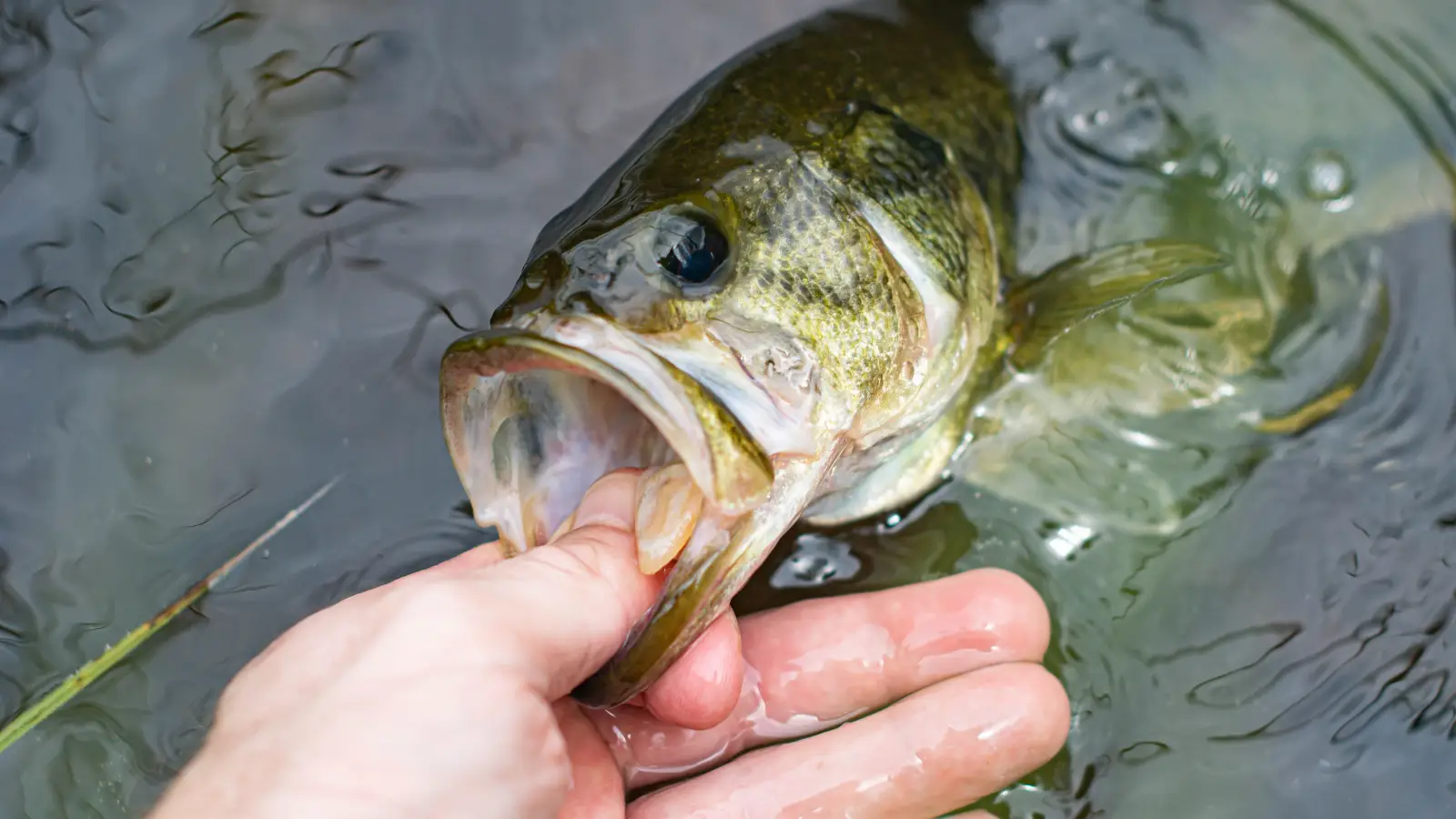
Suspended bass are finicky. They’ll shadow a bait all day and never open their mouths unless the presentation sells the right story. The wacky rig already gets a lot of bites, but the one adjustment that turns followers into eaters escapes a lot of anglers: O-ring placement. Center that ring and the worm dives nose-first, half the wobble gone. Slide it forward to the one-third mark and pair it with a thin-wire weedless hook—now the bait drifts sideways on a slow, dying shimmy. The plastic stays intact, the hook stays hidden, and bass that have ignored a dozen same old wacky rigs suddenly commit.
The Suspended Bass Problem
Bass holding off a ledge, under a dock float, or next to a bridge piling in 15 to 25 feet of water aren’t actively feeding. They’re suspended, neutral, watching. A regular wacky rig sinks too vertically, the worm tears after a catch, and the action dies by the second drop. The trick isn’t a new knot; it’s getting the worm to fall horizontally with a side-to-side quiver that stays that way through multiple fish.
The 5-Step Trick in a Nutshell
- Push an O-ring onto a 5-inch stick worm and slide it to one-third of the worm’s length from the head.
- Hook a #1 or #2 thin-wire weedless wacky hook through the ring—never pierce the worm.
- Cast beyond the target and let the bait free-fall on a completely slack line.
- Scan the line at the surface: any sideways jump, sudden stop, or line floating the wrong way signals a bite.
- If nothing happens on the initial drop, twitch the rod tip 6 inches and let the worm drop again.
- Repeat that twitch-and-fall sequence once or twice, then recast.
How to Rig It for the Horizontal Shimmy
Pick a Stick Worm That Doesn’t Just Dive
Go with a 5-inch stick worm that’s uniformly dense and buoyant—too much salt and it sinks like a rock, killing the flutter. Stained water calls for dark, solid colors (black/blue, junebug); clear water favors translucent greens like green pumpkin or watermelon seed. The plastic itself needs enough body to wobble without folding over.
The O-Ring: Why 1/3 Matters
Placement at one-third from the head shifts the worm’s center of mass forward. It falls belly-down with a side-to-side rock, just like a crippled shad struggling in place. Center the ring and the worm drops head-down, losing that horizontal presentation. If the ring slips during a cast, a tiny dot of superglue locks it. Too tight? Move to a slightly thinner worm or a larger O-ring so the plastic can still flex.
The Hook That Won’t Kill the Action
Thin wire is everything. A #1 or #2 weedless wacky hook with a slight offset bend adds barely any weight, preserving the slow fall. Thicker hooks, even in the same size, pull the bait into a straight drop. In heavy cover—brushpiles, timber—bump to a 1/0 but keep the wire gauge light. The offset point increases hookups without snagging on the way down.
The Cast and the Dead-Drop Fall
Deliver the bait past the target with a low splash. Open the bail or disengage the spool immediately; any tension from the line pulls the worm forward and ruins the horizontal wobble. With a light wire hook and a buoyant worm, expect a fall of roughly one foot per second. Count it down to the zone and stay alert.
Reading the Slack Line Strike
Forget feeling the tap—suspended bass eat on slack line, and the bite shows up as a visual cue. The line twitches sideways, jerks, or just stops sinking before you count it out. Reel down fast and sweep sideways. Hesitate, and the fish spits the bait.
The Second-Chance Twitch and Re-Fall
A bass that follows but won’t commit on the first drop often crushes the bait on the second. A short rod-tip twitch makes the worm dart, then die again. Let it fall slack and repeat. If three twitch-and-fall cycles don’t produce, change your angle—the fish saw it and said no.
Signs You’ve Nailed It
On the Drop: The Wobble You’re Looking For
Drop the rig next to the boat in clear water. You want a steady, side-to-side rocking motion, not a corkscrew spin. If it’s twirling, push the O-ring slightly closer to center.
After a Catch: No Torn Plastic
Check the worm after landing a bass. The O-ring slot should be clean, no rips. Tearing means the ring is too tight or the worm too soft; switch one variable.
On the Retrieve: The Line Tells All
Once the bait hits bottom or you finish the drop, the line should lie slack on the surface. If it’s still tight, you pulled the worm off its horizontal path.
When the Wacky Rig Misbehaves: Spin, Slip, and Tear
The Worm Spins Instead of Shimmies
Spinning usually means the O-ring is too far forward or the hook’s weight is off-center. Nudge the ring back toward the middle in small increments until the wobble returns. Also check that the hook sits balanced in the ring.
The O-Ring Slips Off
A loose ring slides off on the cast or after a fish. Match ring diameter to worm thickness—3/8 inch for average 5-inch worms, 7/16 inch for thicker profiles. A dab of superglue cures a repeat offender.
You Miss Strikes After the Twitch
Short strikes point to too small a hook or too much weedguard. Go up one size from #2 to #1 with the same wire gauge, and try a sideways hookset that clears the guard faster.
The Plastic Still Tears
If even an O-ring doesn’t prevent tearing after a couple of aggressive fish, double up the rings or use a thicker, reinforced O-ring. A more robust stick worm formula also helps, as long as it stays buoyant.
Questions That Come Up Every Trip
What Size O-Ring for a 5-Inch Stick Worm?
Use a 3/8-inch O-ring for standard-profile worms and a 7/16-inch ring for fatter sticks. It should grip without pinching the plastic shut.
Can You Wacky Rig Without an O-Ring?
Yes, but the hook gouges the worm immediately, and the plastic often spins. The O-ring is what extends worm life and keeps the fall horizontal.
What’s the Best Hook for a Slow-Falling Wacky Rig?
A thin-wire #1 or #2 weedless wacky hook with a slight offset. Gamakatsu Finesse Wide Gap and Owner Wacky Hook are both proven choices that stay light.
How Slow Should the Fall Actually Be?
About a foot per second. If suspended bass are deeper than 25 feet, adding a tiny nail weight to the tail gets the bait down without killing the horizontal shimmy—start unweighted, then adjust.
Fine-Tuning for Depth
Once the offset O-ring and light-wire hook are second nature, the next variable worth playing with is a nail weight inserted in the head or tail to alter the fall angle and speed, letting you match the exact depth where suspended bass are holding.