Identifying a freshwater fish starts with the mouth, then moves to the dorsal fin, then the tail, then the lateral line. That order is the method, and the order does more work than any single check inside it, because each step is chosen to eliminate the largest possible group first. Mouth position tells me where a fish feeds and divides a mixed net into surface, mid-column, and bottom feeders before I have looked at a single fin. Dorsal fin structure narrows that group down to a family. Tail shape and the lateral line carry the family down to a species. Color is a last check, not a first one — it shifts with water clarity, light angle, stress, spawning condition, and the age of the fish. Starting with color is why most identifications stall.
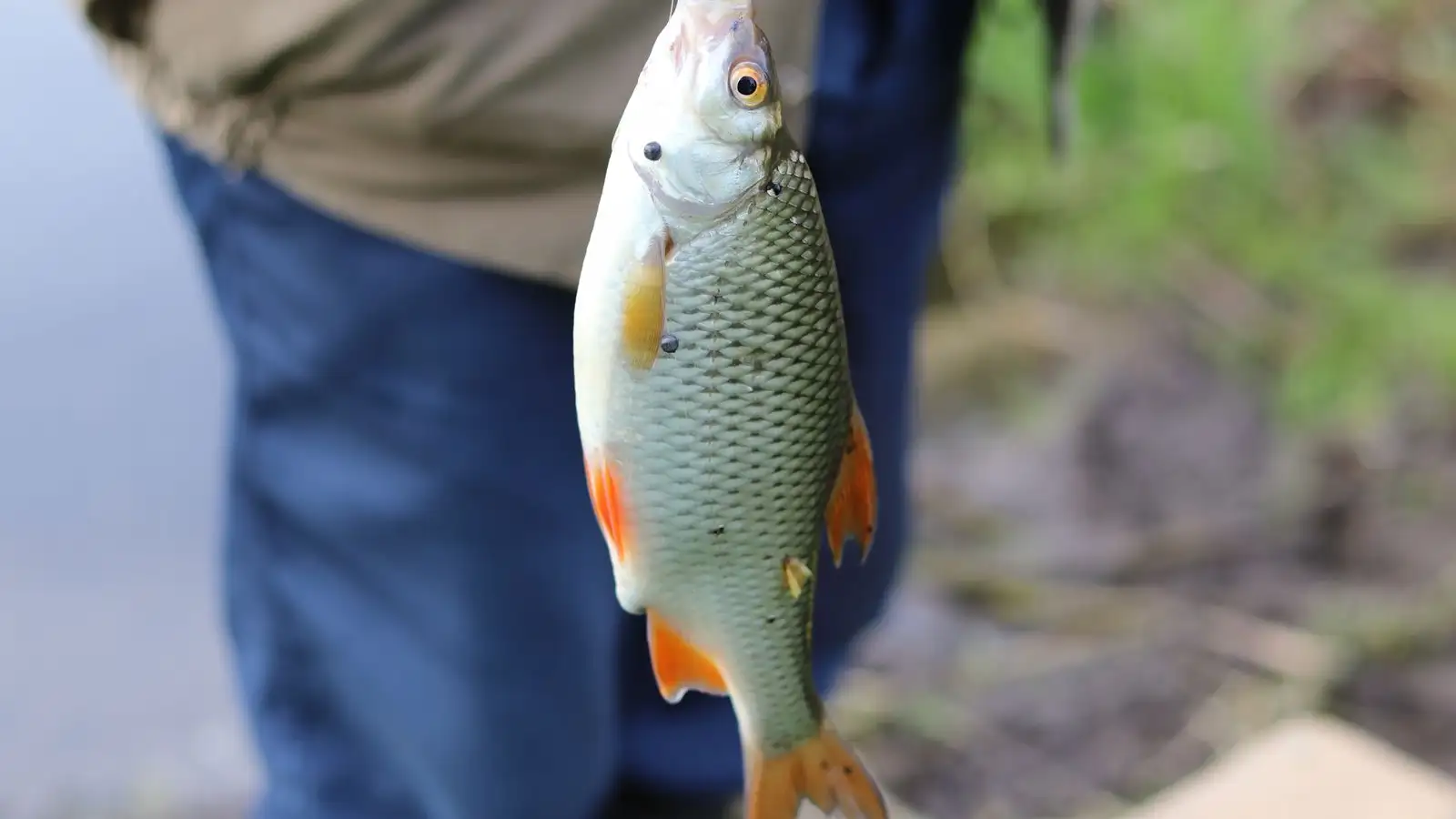
The fish is still in the net when I start, mesh under water, my hand in the water with it. Two fingers under the belly, thumb just behind the pectoral fin, and I turn the fish so it faces me. That position is the whole reason the sequence works: I can run the first check without lifting the fish into the air, and on a hot afternoon that matters more than anything else I do.
The mouth check does most of the work
Where the jaws close is the single most informative thing on a fish, and it takes about three seconds to read.
Four mouth positions, four feeding styles
A terminal mouth has the upper and lower jaw meeting right at the tip, and it belongs to a fish that takes food in front of it — mid-water, sometimes up. Bass, most sunfish, and trout all sit here. An upturned, or superior, mouth has the lower jaw jutting out past the upper so the mouth opens toward the surface; that's a topwater feeder, and it shows up on topminnows and killifish. A subterminal mouth is slightly underslung, with the upper jaw overhanging a little, and it points a fish at the bottom without committing it there. A ventral mouth sits entirely underneath the head — an underslung, fleshy, vacuum-cleaner arrangement with no barbels — and that is a bottom feeder that grubs in gravel and silt all day. Suckers and sturgeon are the ones I see most.
The mouth also carries a finer check, because jaw extension is where the mouth stops being a family clue and starts being a species clue. On a bass, the hinge of the upper jaw reaching back behind the eye is one fish, and that same hinge stopping at or before the eye is a different one. On trout, the upper jaw bone running past the rear of the eye is one species and stopping short of it is another. Same jaw, same head, two different answers, and I get both without ever looking at a fin.
The caveat is juveniles. Young fish have short jaws relative to their heads, so a mouth check on a three-inch fish is a rough guess. Suckers stay underslung from the day they hatch, though, so that one holds up at any size.
Dorsal fin: count the sections
Once the mouth has told me roughly where the fish lives in the water column, the dorsal fin tells me what family it belongs to. I run a wet fingertip along the fin from front to back, because fingertips read structure better than eyes do.
There are three arrangements, and they split cleanly.
A single dorsal fin made entirely of soft rays — the whole thing gives when I push it, bending under my finger with no sharp points — points me at trout, salmon, minnows, suckers, pike, and catfish. A single dorsal fin with a spiny front section built into it, stiff and unbending, plus a softer rear section either joined to it or separated by a shallow notch, is a bass or a sunfish. And two separate dorsal fins, a spiny one forward and a soft one behind, puts me with the perch family: yellow perch, walleye, sauger, darters.
Do not grab the front of a dorsal fin to test it. I run the fingertip forward, not backward, and I keep my other hand on the fish. The spines and gill covers on a walleye will open a finger faster than you can pull back.
The adipose fin splits the warmwater fish off in one look
Behind the dorsal fin, on top of the caudal peduncle, there may be a small fleshy flap with no rays and no spines in it at all. That's an adipose fin, and feeling for it takes a second: just run the finger back along the top of the tail base.
Here's the thing about the adipose fin that generic guides get lazy about. It doesn't identify anything on its own, because trout, salmon, and char have one, and so do catfish and bullheads — two completely different kinds of fish. What it does is combine with the dorsal check. If I have a single soft-rayed dorsal and an adipose fin, I know I'm holding either a salmonid or a catfish. Then I look at the head. Barbels around the mouth and skin with no scales means catfish. A scaled body and no barbels means trout or salmon. Two checks, one answer, no color involved.
Tail shape is a tiebreaker, not an answer
Tail shape gets overused. Forked, square, or rounded tells me something about how a fish makes a living — a deeply forked tail belongs to a fish that swims in open water and needs to accelerate, a rounded or fan-shaped tail belongs to a fish that turns and hovers over structure — but it overlaps across families, and I've never identified a fish on tail shape alone.
What it's good for is breaking a tie. When the mouth and the fins leave me with two candidates in the same family, the tail often settles it. I look at the outer edges, whether the fork is shallow or deep, and whether the lobes come to a point or round off.
The lateral line has two things worth looking at
The lateral line is the row of pored scales running down the flank, and there are two separate questions inside it: is it complete, and how does it curve?
Complete means the line runs unbroken from the shoulder to the base of the tail. In several sunfish, the line stops well short of the tail, and in that family a broken or incomplete lateral line can separate species that otherwise look nearly identical. Curvature is the second question. Some fish carry the line high on the shoulder, arcing down through the middle of the flank, and the position of that arch relative to the dorsal fin is a usable clue.
Counting pored scales is the part most people skip
If I've already narrowed a fish to a genus and still need an answer, I count the pored scales along the lateral line. Wet fingertip, count from the shoulder to the tail base, saying the numbers out loud so I don't lose my place. It's tedious, and it isn't worth doing until the shape checks have already done most of the work. It's also the check that embarrasses me most often when I try to shortcut it.
Barbels and gill rakers, but only after the shape says so
Both of these get reached for too early.
Barbels are the whisker-like feelers around the mouth, and if a fish has them, it's almost certainly a catfish or a bullhead — or a sturgeon, which carries four in a row ahead of a ventral mouth. There's also a single barbel under the chin on a burbot, which is worth knowing because a burbot reads as some strange cross between an eel and a cod at first glance. But you use barbels to confirm a family the shape checks have already suggested, not to open the identification.
Gill rakers are the comb-like structures on the gill arch, and they tell you what the fish eats. Lift the gill cover gently and look at the first arch. Long, fine, and numerous means the fish strains small food out of the water; short and stubby means it grabs things. On a shad or a paddlefish the rakers are dramatic. On a bass they're practically nubs. This is a family-confirming check and, occasionally, a genus-confirming one.
Photograph side, top, and belly before it goes back
If any doubt is left, the answer is not to keep holding the fish while I think about it. It's to photograph it properly and put it back.
Three angles: straight side view, top-down view, and belly-up view. The belly shot is the one people skip, and it's the one I want most, because it shows mouth position, the pelvic and anal fins, and the fin ray counts all in one frame. Lay the fish on a wet measuring board or a wet boat deck, never dry grass or hot aluminum, put something of known length beside it, and take two frames per angle. Then it goes back in the water.
One note on light: a fish photographed under direct sun loses most of its pattern. If I'm shooting for identification, I move the board into shade or shoot it in the net in the water. Color still comes last, but if I'm going to record it, I want it recorded honestly.
When the sequence doesn't finish the job
It doesn't always finish. Hybrid sunfish are common and routinely fall between two species on every check. I've held fish where the mouth said one thing and the fin count said another, and the honest answer was "sunfish, probably a hybrid." Trout hybridize too. Hatchery fish wear their fins down, which wrecks the dorsal check, and a fish with a healed injury can lose a lobe of its tail.
When that happens, I lean on the checks that survive damage: mouth position, lateral line, and the presence or absence of an adipose fin. Those three rarely lie.
And when a regulation hinges on the exact species, I don't guess. I photograph the fish, note the length, and check the rule before I decide anything. Running the sequence in the right order gets me to a family in a hurry. Getting the species right is what keeps me honest, and sometimes that means checking a photo at the dock instead of guessing on the water.