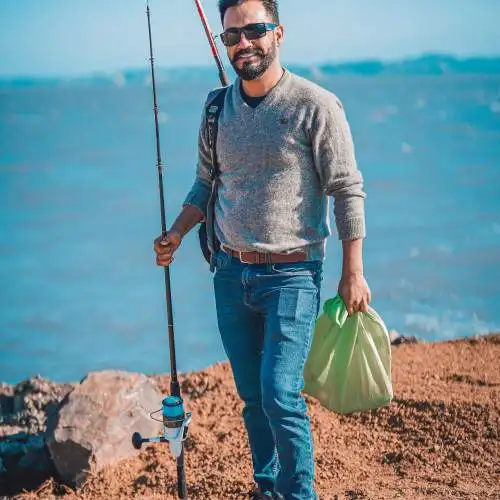
Fishing line ages in four ways, and all four are checkable before you tie on: ultraviolet light, heat, chemical contact, and physical abrasion. The date on the filler spool, the season you bought it, the shelf it sat on — none of that tells you anything the line can't tell you faster. Learn what each of the four does and how to feel for the result, and the calendar stops being your replacement schedule.
Now I want you in my driveway at seven in the morning, coffee going cold on the tailgate, rod leaning against the truck, first cast still twenty minutes out. Wet a yard of line off the tip in the creek or the livewell, pinch it between your thumb and forefinger, and pull it through under tension. That's the whole ritual. Forty seconds, and it has saved me more fish than any knot I've ever tied.
Everything below is what you're feeling for.
Ultraviolet Light: The Slow Bleach
Sunlight doesn't need to be direct to do damage. A spool in the bed of a truck under a tonneau cover, or sitting on a garage shelf in front of a window, gets enough UV over a season to matter.
What it does to nylon monofilament is break down the polymer chains, slowly and invisibly. You won't watch it happen. What you'll notice months later is line that has gone pale and chalky, lost its gloss, and feels dry between your fingers instead of slick. Fluorocarbon holds up to UV noticeably better, which is part of why it survives on a rod left rigged in the boat all summer, but better isn't immune — I've had fluoro come back stiff and glassy after a season in the sun. Braid barely cares about UV at all. The color fades and that's mostly cosmetic. If your braid is failing, sunlight is almost never the reason.
One practical note: UV damage is a surface effect at first. The outside of the line goes before the core. That's why you can pull a length off a sun-baked spool and have it feel fine for the first six inches and then rough in your fingers a few feet in.
Heat: The One That Kills Fast
If I could only worry about one of the four, it would be heat.
A closed truck cab in summer, a dash, a boat locker with no ventilation, an unconditioned garage in a hot climate — these are ovens. Heat accelerates oxidation in nylon and fluorocarbon, and it does it on a scale of weeks, not years. That's the whole answer to why a spool in a hot vehicle ages faster than one in a cool, dark drawer. It isn't a subtle difference. It's the difference between a line that lasts a season and a line that's finished before the season starts.
The honest complication is that heat damage is invisible until it isn't. A baked spool looks completely normal. Spool it on and it casts fine for the first twenty minutes. The only way I've found to catch it is to test it.
I've pulled spools out of center consoles in August that snapped like dry spaghetti between my hands, with almost no stretch at all. Same line, same brand, off a shelf in the basement, still perfectly serviceable. Nothing about the spool told me which was which. The snap did.
Chemical Contact: What's Already on Your Hands
Sunscreen. Insect repellent. Gasoline from a sloppy fill at the dock. Solvent on the rag in the bottom of the boat. Plasticizer leaching out of a soft plastic bait that sat on the hook for a week in a closed box.
The rule I use is simple: if it's on my hands and it isn't water, it's on my line.
Repellent is the one that catches people, because you reapply it all day and then handle your leader like nothing happened. Some of those chemicals will soften nylon and fluorocarbon, and a softened line is a line that fails at the knot instead of the hookset, which is the worst possible place for it to fail. I keep repellent in a different pocket than my leader spool now. That's not paranoia, that's just having lost fish to it.
Treat anything you put on your line — including conditioners and lubricants — as a variable you're adding. Some help with memory and cast feel. Some are neutral. You won't know which until it matters, so keep the list short.
Abrasion: The Damage You Can Actually Feel
This is the one that shows up first, because it's mechanical. Rocks, shell beds, dock pilings, bridge pilings, the teeth of a fish that took the lure deep, and most often of all, your own rod.
Run the last few feet of line through pinched fingers and you can feel it: flat spots, roughness, thin sections, a kink that never came out. Fluorocarbon resists this better than nylon, which is why it makes a good leader around structure. Braid is the toughest of the three against a rock but the most vulnerable to a rough guide, because braid will cut a groove into a guide insert and then ride in that groove and fray.
Before you blame the line, check the rod
Run a fingertip or a cotton swab around the inside of every guide, tip-top first, then the running guides. If it snags, you have a crack or a groove, and no fresh spool will survive it. Do the same with the line roller on a spinning reel and the levelwind on a baitcaster. I've chased a mystery break-off three trips in a row and found a hairline crack in a tip-top that I couldn't see in any light, only feel.
The line is often a symptom. Read it that way.
The Tug Test, and What It Tells You
Two parts, and neither one takes long.
The first part is feel. Pull four or five feet of line through pinched fingers under tension, at the working end first and then a few feet back from it. You're looking for anything that isn't uniform: flat spots, roughness, a thin stretch, a spot that kinks and stays kinked.
The second part is the snap. Back off four or five feet, wrap each end a couple of turns around your hands or around two screwdriver handles, and jerk it hard. Good nylon stretches visibly before it lets go and leaves a long, stringy, curled break. Dead line gives you almost nothing — it pops flat, sometimes with a glazed or powdery look at the break, and your hands barely move.
Do this on the water, not at the bench. The line doesn't care where you test it, but you'll actually do it if it's part of the routine, and the fish is going to take it out there anyway.
A note on fluorocarbon: it's stiffer and gives less warning. There's no long stretchy break. What you're listening for is a crackle in the fingers, or a sudden snap with a foot of give instead of three.
A note on braid: the tug test won't tell you much about strength, because braid is enormously strong for its diameter even when it's tired. What it will tell you is fraying. Pull a few feet through dry fingers and any abrasion shows up as roughness and fuzz. That's your signal, not the snap.
How Much to Cut Back
People want a number. The honest answer is that you cut back until the test passes, which means the amount depends entirely on what the line went through.
After a hard snag, cut back well past the point where the line was stretched and bruised. If it was buried in rock and you had to break it off, that could be three feet or it could be twenty. Test, cut, test again. If it still pops early, keep going.
After a season of use, the answer is more about maintenance than surgery. Lop off the last few feet at every retie — it costs you nothing and it means the end of your line is never the oldest part. Then, when the last fifteen or twenty feet feels or sounds different from the middle of the spool, cut back to the good line and re-tie. That gritty vibration you feel through the guides on a cast is a real signal.
After a visible nick near the lure, cut back past the nick plus a couple of feet. A nick is a stress riser: a break starts there and travels, so the line will let go on the next hookset rather than the one that caused the nick. And retie after any fish with teeth, after any fish you had to pull out of cover, and every few hours of hard casting regardless of what happened.
Backing, Reversing, and the Gradient on a Spool
Here's the idea that changed how I think about all of this: a spool isn't one age. It's a gradient.
The line down at the arbor has been under compression, out of the light, and away from the guides for its entire life. The line at the lure end has taken every cast, every guide, every fish, every rock. They are the same purchase date and completely different lines.
That's the argument for backing. Fill the bottom of the spool with backing line and let the working line occupy only the top stretch. Now when the working line gets tired, you're not throwing away a whole spool. You're stripping a hundred yards and replacing a hundred yards. It also means you can spool up tighter and cast better, because you're not paying to fill the arbor with premium line that will never see daylight.
Reversing is the other half of it. On a double-filled spool, you can pull the line off, flip it end for end, and put the never-fished inner line on the outside. It works, and it buys you real time.
The tradeoff is honest and worth saying out loud: line that's been compressed on a spool for a season carries coil memory. Flipped nylon on a spinning reel will want to jump off the spool for the first hour or so, and if you're fishing in cold water it'll do it longer. Some days that's a fair trade, some days I'd rather just respool. It isn't free.
Judging Replacement by Use, Not by Date
Count casts and exposure, not months.
A line that's made two hundred casts into open water from a boat is a completely different line from one that's made two hundred casts along a rock jetty with a crosswind pushing you into it. Same number, wildly different wear. That's why "replace it every year" is such a lousy rule: it's right by accident for some people and badly wrong in both directions for everyone else.
What I actually go by:
- Heavy abrasion water — rock, shell, wood, pilings, or anywhere you're dragging fish out of cover. Inspect every trip. Cut back often. Replace the working section once the cutbacks start reaching into the middle of the spool.
- Light abrasion — open water, sand bottom, casting from a boat. The line will usually tell you it's done by how it feels and how it sounds through the guides long before it actually breaks.
- Salt or brackish water. Rinse the reel and strip the working line more often. Salt works on the reel as much as the line, and the line sits against metal that's corroding.
- Any line that has spent the summer in an open boat in the sun. You're not really fishing that line anymore, you're fighting a calendar.
If there's one habit I'd want you to take off this, it's the forty seconds in the driveway. Wet a yard, pull it through your fingers, snap a length, look at the break. That tells you more about whether your line is good than every rule of thumb anyone has ever handed you — including mine.